The dashboard from hell
These may only be numbers and they don’t tell the full story, but they are simply staggering. And on Yom HaShoah, I think we owe it to those murdered to look at them clearly.
I reject utterly the claim that the Holocaust should be blended in with other genocides. It stands on its own and must stand on its own.
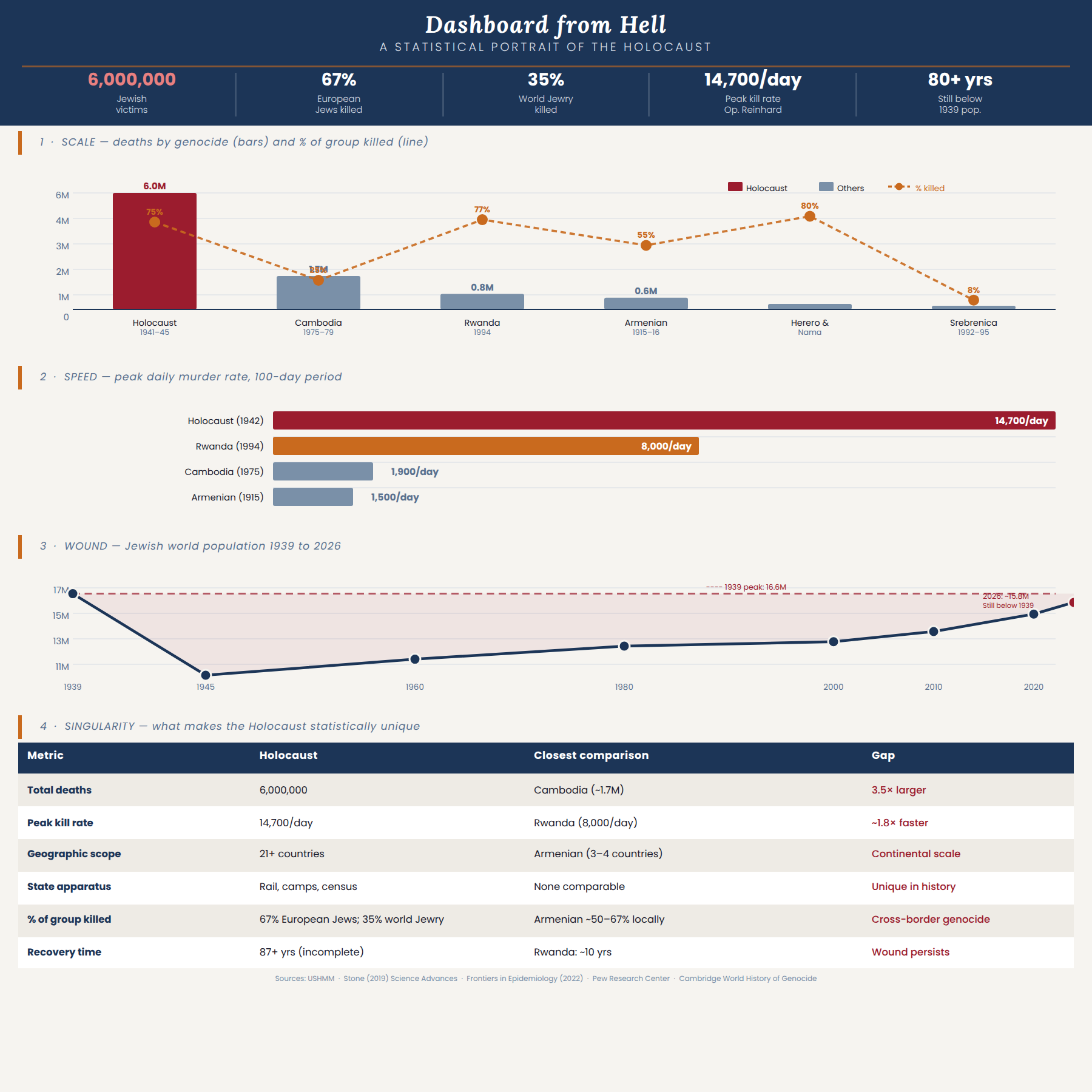
I put together what I have come to call the “Dashboard from Hell.” It is a statistical portrait of the Holocaust, four dimensions of data that, taken together, try to convey something that words alone cannot.
I am sharing it here not to reduce six million human beings to a spreadsheet, but because I believe that for some people, the magnitude of what happened only truly lands when you see the numbers laid bare, one against another. Many of us grew up with these numbers etched on our brains, but that is sadly no longer the case.
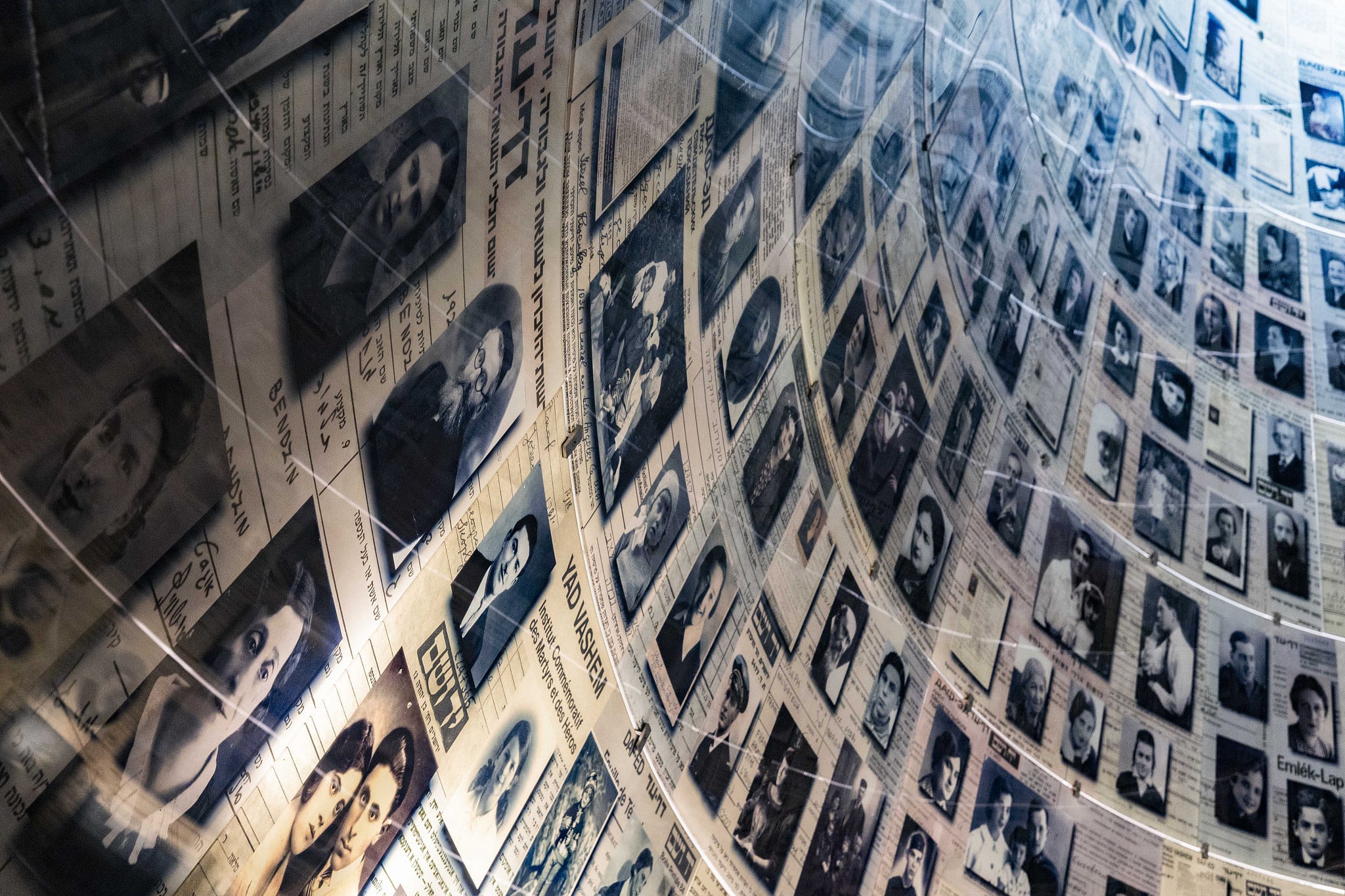
 Let me say something plainly. I am not, for one second, suggesting that numbers are what matter most. My own broader family lost people in the Holocaust, names I know, faces I have seen in photographs, branches of a family tree that simply end. Every one of the approximately six million was somebody’s grandfather, somebody’s child, somebody’s reason to get up in the morning.
The work of remembering individuals, the Yad Vashem pages of testimony, the family stories passed across Seder tables, the yahrzeits observed in living rooms around the world, that work is sacred and irreplaceable, and nothing I write here diminishes it. What I am arguing is that the magnitude also matters. That the scale is itself a fact that demands to be felt, not merely noted.
And that scale must not be forgotten, because it stands out of all proportion to any other crime and is irrefutably in a category of its own. That we have reached a point where anyone feels the need to justify the existence of Holocaust museums around the world tells you everything you need to know about how short memory has become.
The scale
About six million Jews were murdered. That is the number we all know, or think we know. But knowing it and feeling it are different things. The dashboard puts that figure alongside other major mass atrocities of the modern era, Cambodia, Rwanda, the Armenian genocide, Srebrenica, the Herero and Nama massacres, and the bar representing the Holocaust dwarfs all of them. Not by a little. By a factor of more than three compared to the next largest single-group atrocity in the list.
Two out of every three Jews in Europe did not survive. One in every three Jews on earth, roughly a third of world Jewry at the time, was murdered. These are not statistics about distant communities.
They are statistics about people who kept Shabbat, who made cholent, who argued about Torah, but equally about those who had long since walked away from all of it, who had married out, changed their names, built lives as Germans or Poles or Hungarians first and Jews a distant second, and who discovered in the cruellest possible way that the murderers did not share their definition of themselves. Behind every data point is a family like mine, a photograph, a name, a silence where a voice should be.
The speed
During Operation Reinhard in 1942, a hundred-day surge in which more than 1.47 million Jews were murdered, the Nazis killed at a rate of 14,700 people per day. The closest comparison on the dashboard is Rwanda in 1994, with an estimated 800,000 murdered over approximately 100 days, roughly 8,000 per day at its peak.
The Holocaust’s rate was nearly double that. And Rwanda lasted one hundred days. The Holocaust lasted more than four years, across twenty-one countries, powered by railways, camps, census data, and bureaucratic precision that the world had never seen before and, mercifully, has never seen since.
Nothing in this article is intended to diminish the horror of what happened in Rwanda, Cambodia, or anywhere else. Those were crimes against humanity too, and they deserve their own reckoning. The comparison here serves only one purpose: to show how far beyond any modern reference point the Holocaust stands.
The wound that has not healed
Here is the number that stays with me most. More than 85 years after 1939, the global Jewish population has still not recovered to its pre-war level. In 1939, it stood at approximately 16.6 million. Today, in 2026, it stands at around 15.8 million, still below the line, still filling in the hole. Most peoples targeted in genocide have seen their populations recover within a generation or two. The Jewish people are still climbing back. And we are facing the same struggles again!
Rwanda’s population recovered within a decade. The Jewish demographic wound from the Holocaust persists into the 21st century. Each of those missing millions is not an abstraction. They are the descendants who were never born, the communities that were never rebuilt, the family branches that ended in a transport list.
Why I look at this on Yom HaShoah
As the number of survivors dwindles rapidly (the Claims Conference estimates more than 200,000 Jewish Holocaust survivors still alive worldwide, most now in their late 80s and 90s, with the majority expected to be gone within a decade), the temptation grows to let it recede into history. Another atrocity. Another chapter. Another memorial service.
I refuse that. Some argue there are too many Holocaust museums, that the attention has become disproportionate, that the world must move on. I find that logic not just wrong but dangerous. The Holocaust happened within living memory. That it is already becoming just another chapter in public discourse is itself a warning, one we should hear clearly.
It is sadly exactly the same type of voices (often European) who denied it was happening then who preach that it couldn’t happen now, yet allow the seeds to be sown.
For me, Yom HaShoah is about memory and about the demands that memory places on us. There has never been a crime on this scale against a single people. Nothing in Jewish history comes close; arguably nothing in human history comes close. And it happened in a generation that considered itself the most culturally and scientifically advanced the world had ever produced. The people who built Beethoven concert halls also built Auschwitz. That is the fact we have to sit with.
Out of the ashes, the State of Israel was born. That is not a coincidence. It is not merely a political event. It is the response of a people who decided that the lesson of the Holocaust was that we must build a home where we can defend ourselves, because the alternative, reliance on the goodwill of others, had been tested to destruction.
And here is my honest answer to the question I know some readers will want to ask: Is the Jewish people facing a comparable threat today? Not in the same industrial form, no. But is there a desire, in certain quarters of the world, to see the same result? Yes. I believe that, and the events of October 7th and everything that followed have not softened that belief. See how quickly the world changes, and perhaps we begin to understand the chill those in the 1930s felt, watching a world that preferred to look away.
That is why we stand when the siren sounds. That is why we look at dashboards like this one, not once, but twice, three times, until the numbers stop being numbers and start being people. Until the percentage becomes a grandfather. Until the kill rate becomes a name on a wall.
Look at it. Let it land. Then let it drive you to act, to remember, to speak, to defend, to build.
Yizkor. May the memory of all those who perished in the Holocaust be a blessing. May their individual stories never be forgotten. And may the world never see such evil again.