Working to protect people and our shared planet.
Dayenu Vs Zeldin – A Battle to Save the People and Places We Love
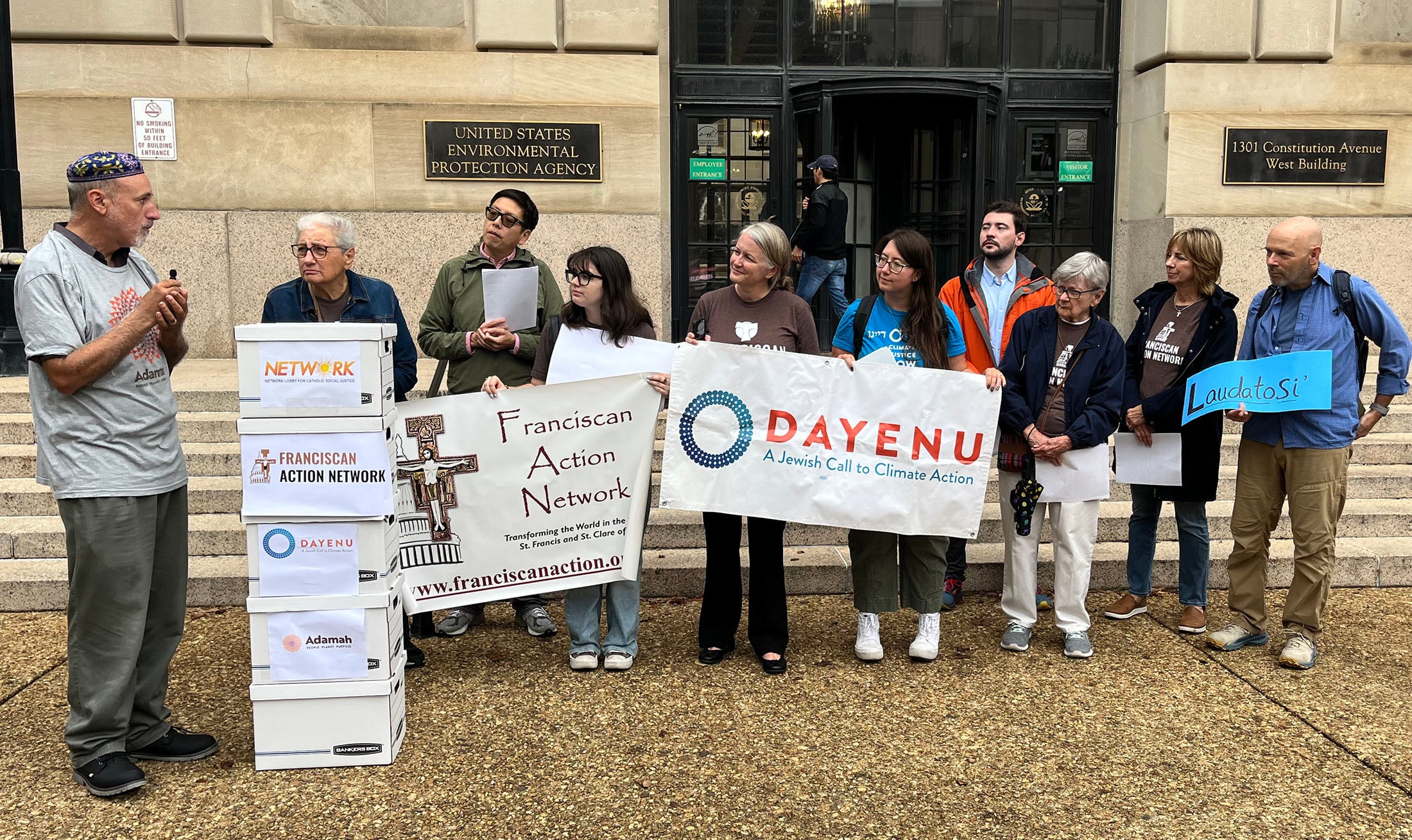
Dayenu joining an interfaith coalition delivering nearly 10,000 public comments to the EPA in protest of rescinding the Endangerment Finding. Photo courtesy of Dayenu.
At the start of Lee Zeldin’s appointment as the first Jewish Administrator of the Environmental Protection Agency (EPA), there was a spark of hope. After all, while he had been a partisan Republican in Congress, his record on environmental issues was relatively moderate compared to some of his peers. Many of us wondered whether his Jewish values, especially those rooted in pikuach nefesh—the obligation to save lives—might guide him to safeguard the health of our families, communities, and planet.
Unfortunately, that hope has turned into heartbreak. Rather than protecting life, Zeldin is undermining it. His push to repeal the EPA’s Endangerment Finding—the foundation that requires the agency to regulate climate pollution—is perhaps the most dangerous rollback of environmental protections in American history. By gutting it, he would strip away the very tools the EPA needs to reduce the pollution that drives extreme heat, dangerous storms, flooding, fires, and deadly air quality. In Jewish tradition, we are commanded to “choose life so that you and your children may live” (Deuteronomy 30:19). Zeldin’s actions do the opposite.
That’s why Rabbi Jennie Rosenn and the grassroots Jewish climate organization Dayenu are standing up and speaking out. Dayenu has organized Jewish communities nationwide to submit comments, testify at hearings, and demand that the EPA uphold its mandate to protect health and life. In testimony submitted to the EPA, Rabbi Rosenn put it plainly: “Our Torah is clear: we are obligated to protect life. Repealing the Endangerment Finding would endanger lives, including those of our children and grandchildren.”
The contrast between the symbolism of Zeldin’s Jewish identity and the substance of his policies could not be starker. Yes, Zeldin placed a mezuzah at the door of his EPA office—a small parchment scroll reminding us to love God and uphold God’s commandments. But inside that office, he is tearing down the most critical commandment of all: to preserve life. A mezuzah without action is an empty symbol.
Jewish values have always called us to be guardians of creation. The Midrash teaches that when God led Adam around the Garden of Eden, God warned: “See My works, how fine and excellent they are! Now all that I created, I created for your benefit. Think upon this and do not corrupt and destroy My world; for if you corrupt it, there is no one to repair it after you.” Zeldin’s actions fly in the face of this sacred responsibility.
Dayenu, by contrast, is embodying the Jewish principle of l’dor v’dor—from generation to generation. By organizing synagogues, rabbis, and Jewish institutions to speak out, they are ensuring that Jewish moral clarity is brought to the public square. Their work reminds us that Judaism is not only about ritual, but also about justice, compassion, and action.
Repealing the Endangerment Finding would not only hurt the environment—it would disproportionately harm vulnerable communities, including low-income families, communities of color, and people with disabilities, who already bear the brunt of pollution and climate disasters. Jewish tradition demands that we pay particular attention to the most vulnerable among us. The Prophet Isaiah reminds us to “defend the oppressed, take up the cause of the orphan, plead the case of the widow” (Isaiah 1:17). Jewish history, with its painful legacy of persecution, should make us even more attuned to the moral stakes of Zeldin’s decisions.
Rabbi Rosenn and Dayenu are not alone. They are part of a growing interfaith and intergenerational movement demanding that the EPA fulfill its mission to protect human health and the environment. But the Jewish voice in this struggle is unique and powerful. It says: we cannot claim Jewish identity with mezuzot and menorahs while dismantling the very protections that safeguard life. Our children, our elders, and our neighbors deserve better.
As Jews, we are taught to live in covenant—not just with God, but with each other and with the generations that will follow us. To repeal the Endangerment Finding is to break that covenant. It would lock us into more fossil fuel pollution, more asthma in our children, more deadly heat waves for our elders, more devastation for communities across the country and around the world. It would be a betrayal not just of American responsibility, but of Jewish values.
The question before us is simple: will we, as a Jewish people, stand on the side of life, justice, and responsibility—or will we remain silent as one of our own undermines the very foundations of life itself? Rabbi Rosenn and Dayenu are showing us the path forward. They are calling on us to bring our voices, our prayers, and our power to bear. They are reminding us that hope is not naïve—it is an act of courage.
Lee Zeldin may be the first Jew to lead the EPA. But if his legacy is the destruction of life-saving climate protections, his tenure will be remembered not as a breakthrough, but as a tragedy. Jewish leadership means more than heritage. It means living our values in the public square.
Now is the time for all of us to join Rabbi Rosenn and Dayenu in standing up for life. To organize, to testify, to push back against policies that endanger our future. To remind Zeldin—and ourselves—that Judaism commands us to choose life. Because in the end, what matters is not the mezuzah on the door, but the actions we take inside.
Related Topics
Related Posts