Consultant and writer exploring policy, society, and identity
From ‘Never Again’ to Tikkun Olam

The Road Ahead...
Who Gets to Define What Being Jewish Means? · Part 3 of 3
To me, Tikkun Olam is the most important concept in Judaism. It gives meaning to being the “Chosen People”: a responsibility to help repair a world in which human beings, animals and all forms of life can be harmed by our actions or our indifference. This is a personal conviction. I do not claim that every Jew must interpret chosen-ness in this way, or that Jewish tradition has always used Tikkun Olam as I use it today. But it is the conviction through which I understand my Jewish identity. It also shapes my response to the debate that opened this 3-part series. Jewish survival has value in itself. Our right to exist is not a reward for good behavior or public service. Yet survival does not answer every question about what we are here to do.
Memory can guide us without governing every decision
“Never Again” expresses a necessary refusal of Jewish helplessness. After the Holocaust, the capacity to defend Jewish life could not reasonably be treated as an abstract preference. Jewish security remains a real obligation. But political leaders also choose how to interpret memory. At the May 2024 Holocaust remembrance ceremony, Benjamin Netanyahu tied the readiness to stand alone and continue fighting to the phrase “Never again is now.” That is a political use of Holocaust memory. My concern is that when leaders repeat this message, they encourage Jews to define themselves as a people always under threat, always needing to prove they cannot be defeated.
One speech does not mean all Israelis share this view. Israelis disagree, and their fears can be real even when politicians use them. But does this message help people judge government decisions, or make them see compromise and criticism as threats to their safety? The memory of catastrophe should help us judge government decisions more carefully. It should never put a government beyond criticism.
Our past contains more than one lesson about power
Jewish texts preserve more than stories of victory. In 2 Samuel 12, Nathan confronts King David over wrongdoing. The king’s status does not remove his accountability. The rabbinic story in Gittin 56b remembers Rabban Yohanan ben Zakkai asking for Yavneh and its sages during the Roman siege. Whether or not the story records exactly what happened, it teaches the importance of preserving Jewish learning even in the face of military defeat. These stories challenge the assumption that Jewish continuity can be measured only by the ability to defeat an enemy. Power matters but so do limits on power and the institutions that transmit a way of life. An identity confident enough to defend itself should also be confident enough to examine itself.
Protection, accountability and purpose
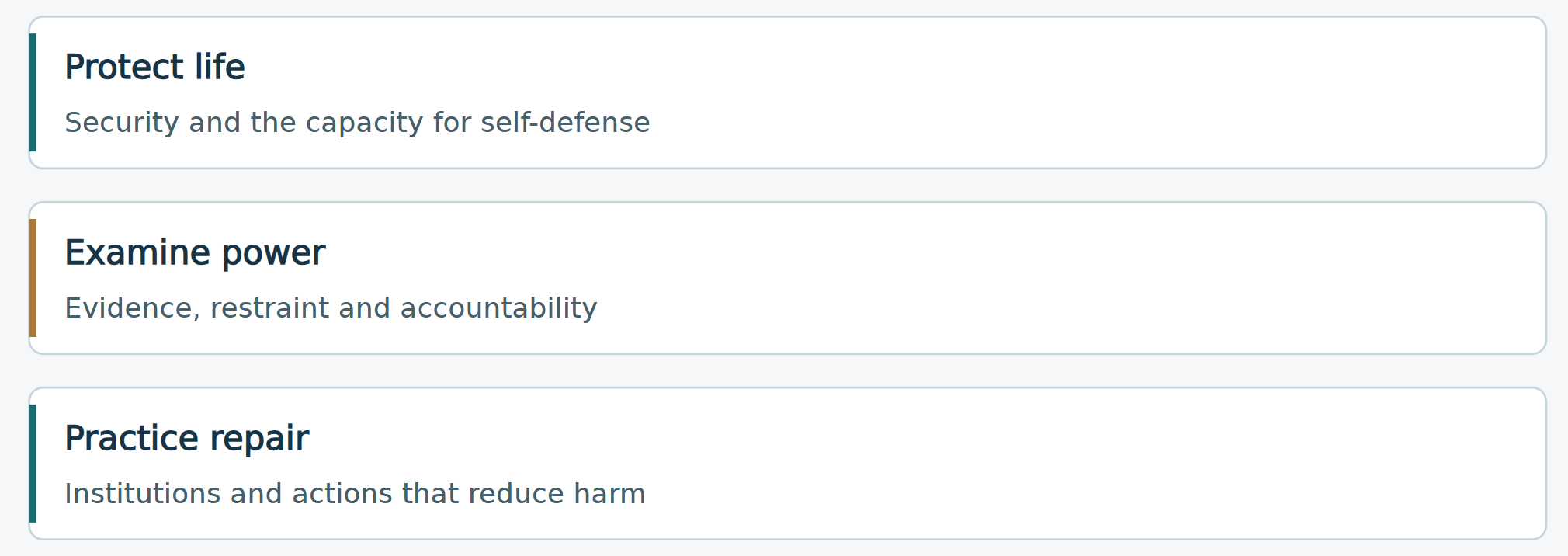
The author’s framework: these obligations coexist. Repair does not replace security.
Tikkun Olam asks what power is for
The phrase has a history. Levi Cooper’s study traces its different uses rather than treating today’s social-action meaning as timeless.
-
- In rabbinic law, repair could concern practical arrangements that made communal life work.
- In prayer, it could express hope for a world ordered under divine sovereignty.
- In Jewish mysticism, it acquired a cosmic meaning.
Modern social-justice usage draws on this inheritance while changing its emphasis. I see that development as an invitation to take responsibility, not permission to attach a Hebrew phrase to whichever political program I may prefer. Repair must be judged by what it does for those who are vulnerable, and by whether it creates new harm. It can involve a law, an institution, a habit or a refusal. It requires attention to consequences as well as intentions.
The living world belongs inside the obligation
My understanding extends beyond humanity. Animals experience suffering. Habitats sustain forms of life that cannot petition a government or write a newspaper column. Human power brings responsibility toward them. Jewish texts are not modern environmental policies, but they challenge the idea that humans can use the world without limits.
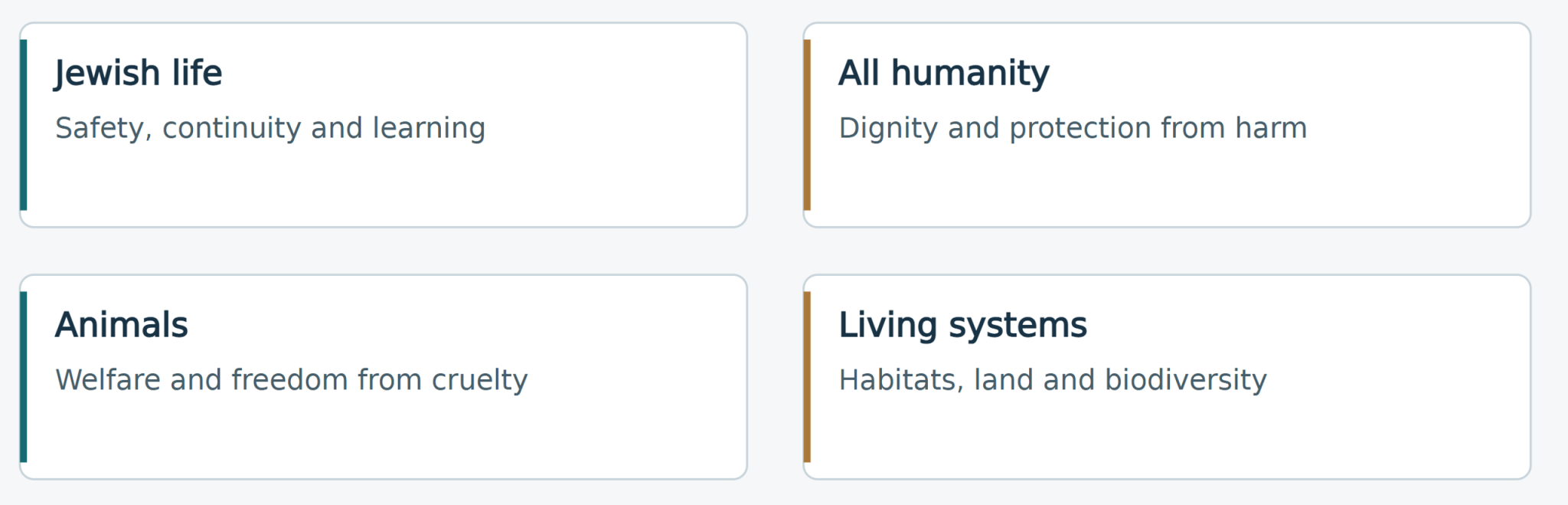
For me, chosenness means accepting an obligation rather than claiming a higher rank. It is a Jewish way of committing myself to responsibilities that other people may understand through their own traditions. It gives us no monopoly on goodness. Care for animals, protection of habitats and restraint in consumption belong beside human dignity. A commitment to all life becomes meaningful through choices about whose suffering we notice and what we are willing to change.
The scope of responsibility
We cannot remove either half of the obligation
Hillel’s Pirkei Avot 1:14 teaching holds responsibility for oneself alongside the inadequacy of living only for oneself. Neither obligation can simply cancel the other. That is why I resist the suggestion that Jews should surrender their safety for humanity and the suggestion that Jewish danger makes other lives secondary by default.
This applies to Israel and the diaspora, to Israeli and Palestinian civilians, and to the wider living world. “Never Again” tells us that Jewish life must be protected. Tikkun Olam asks what kind of life we will build, and what we will protect beyond ourselves. To me, Jewish identity holds both questions open—and to make our answers visible in what we do.
–
Related Topics
Related Posts