Journalist
Featured Post
Defending Jewish life in Germany made Hudhaifa Al-Mashhadani a target
He heads a secular Arab school, teaches about the Holocaust, and has publicly condemned antisemitism and Islamist violence. On a Berlin subway platform, the threats became physical

Pexels
On a Friday morning, nothing about the subway platform suggested danger. People were late. A train was approaching. The familiar choreography of a European city moved forward without pause, footsteps, screens, the quiet impatience of commuters waiting for metal doors to open.
Hudhaifa Al-Mashhadani was standing on the platform at the Rathaus Neukölln subway station in Berlin, waiting for the train. According to his account, the attack came without warning. He never saw the man.
The shove came from behind, sudden and violent, timed, he says, to the moment the train entered the station. It was not chaotic. It was directed. As the train arrived, the air shifted. The edge of the platform was suddenly too close.
Al-Mashhadani reacted instinctively. He did not fall onto the tracks. He twisted forward, stumbled, and managed to keep his balance. As the doors opened, he rushed into a carriage. The attacker followed him inside.
Al-Mashhadani says the man struck him on the head and shoulder and grabbed at his jacket. He says the train doors closed quickly. Al-Mashhadani believes that the decision likely saved his life.
As the train began to move, he looked through the window. The man left behind on the platform made two gestures: first, drawing two fingers across his throat; then pointing to his eyes and back at Al-Mashhadani. Al-Mashhadani says the attacker did not speak.
In his assessment, that silence was deliberate. In his experience, he says, those who intend serious harm often avoid speech. Words create identification. Silence leaves only fear.
Why Hudhaifa Al-Mashhadani
Hudhaifa Al-Mashhadani is an Iraqi-born Arab educator living in Germany. That description should not be remarkable. It should not carry risk. But context matters.
According to his account, he was born in Baghdad and later studied medicine and political science, focusing on extremism, radicalization, and how violent ideologies take root, and how societies dismantle them. His academic work and public positions brought him into conflict with militant actors long before he arrived in Europe.
In Iraq, he says, the conflict cost him his freedom. He was imprisoned for two years and tortured. He was accused of being aligned with Israel and Jews, an allegation that, in that environment, functioned as a death sentence. After his release, he says he was warned to leave the country. He later sought political asylum in Germany.
He believed Europe would be different. That disagreement would be argued, not punished. For a time, it was.
The School That Became a Target
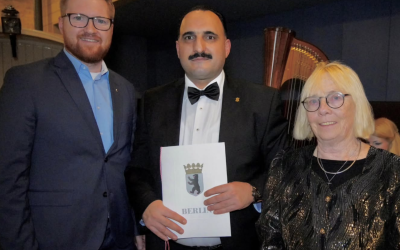
In Berlin, Al-Mashhadani became the head of the Ibn Khaldun German-Arabic School, a secular language school serving hundreds of children from immigrant families. The school was not designed to provoke. It was designed to be normal.
Arabic language instruction. Reading. Writing. Critical thinking. What made it unusual was what it refused to become. It was explicitly secular. Boys and girls sat together. No religious authority shaped the curriculum. The school rejected ideological instruction.
Students learned about antisemitism and the Holocaust, not as a ritual of guilt, but as part of understanding the society they lived in. Hebrew was taught. Jewish educators and community representatives were invited. Encounters between Arab and Jewish students took place quietly, without slogans or press conferences.
After October 7, 2023, when Hamas massacred Israeli civilians, Al-Mashhadani spoke publicly. He called the attack terrorism and condemned it without euphemism. He also spoke in favor of coexistence and Israel’s right to live in security. From that moment on, the atmosphere changed.
From Words to Symbols to Violence
The threats began verbally. Then in writing. Then symbolically. Flyers appeared in the neighborhood calling him a traitor, a collaborator, a spy. His name was crossed out in red.
Red triangles, symbols widely associated with Hamas propaganda, were sprayed on the school’s walls. A stone was thrown through a classroom window, sending glass flying inside. Police guarded the school building during class hours.
Al-Mashhadani says he was not provided with permanent personal protection. In the months that followed, he says, additional pamphlets and messages appeared in the neighborhood suggesting that violence against him had merely been delayed.
Much of this, he says, was reported to authorities. Nothing stopped the morning on the platform.
After the Attack
The following day, Saturday, November 15, Al-Mashhadani went to Police Precinct 54 in Berlin to give a statement. It was early afternoon. He was still in shock. He expected urgency. Instead, he describes confusion.
He says basic facts had to be clarified repeatedly. Officers questioned whether the subway station he named existed. There was confusion about surveillance footage. At one point, he says, officers asked why he lived in that neighborhood, and why Jewish organizations appeared on his social media. He began to understand something that frightened him more than the attack itself. Not hostility. Fatigue.
A system stretched thin, where the line between victim and inconvenience begins to blur. At one point, he says, he spoke a sentence aloud that surprised him: “Now I understand why Jews in Berlin do not feel safe.” No one contradicted him.
Why Jewish Leaders Understood Immediately
Jewish leaders did not need extended explanations. They recognized the pattern immediately: escalating threats, symbolic markings, public incitement, and then a physical test of whether anyone would intervene.
A rabbi who himself survived a terrorist attack stood beside Al-Mashhadani publicly. There was no calculation in that gesture. Only recognition. An Arab educator had defended Jewish life. Jewish leaders understood what that cost.
The Question Europe Cannot Avoid
In a public place, in a European capital, a man was almost killed for refusing to accept that Jews must live in fear, and that Arabs must remain silent. He survived because someone acted quickly.
As of this writing, the attacker has not been publicly identified. The investigation continues, and authorities have said a possible political motive is being examined. History rarely announces itself loudly. More often, it quietly tests societies in ordinary places to see what they will tolerate.
The question is not whether Europe condemns hatred. The question is whether it protects those who stand against it, before silence finishes what violence begins.
Related Topics
Related Posts