The views expressed herein are solely mine.
Dermer’s Exit and Israel’s Strategic Vacuum
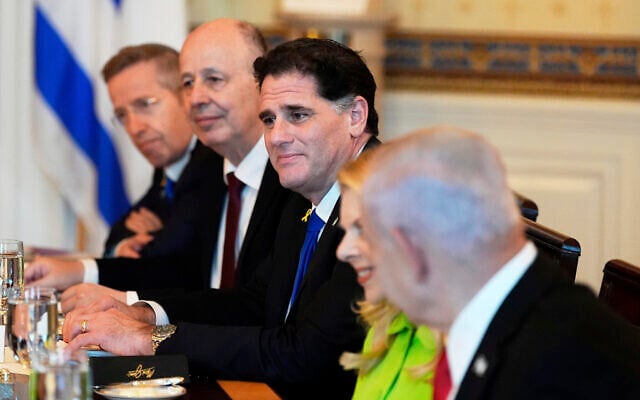
Prime Minister Benjamin Netanyahu, from right, attends a meeting with President Donald Trump, not pictured, as Netanyahu's wife Sara Netanyahu, Israel's Strategic Affairs Minister Ron Dermer, Israel's National Security Adviser Tzachi Hanegbi and Israel's Cabinet Secretary Yossi Fuchs listen, in the Blue Room of the White House, Monday, July 7, 2025, in Washington. (AP Photo/Alex Brandon)
Ron Dermer was never a conventional diplomat; he was a force multiplier. American-born, Ivy-trained, and ideologically fluent in Washington’s grammar of power, Ron Dermer fused personal trust with state authority and converted access into leverage. He understood something most envoys never do: in Washington, proximity precedes policy, and persuasion is often personal before it is institutional.
Certainly, his ascent—from behind-the-scenes adviser to ambassador and later strategic affairs minister—reflected a hard belief that individuals, correctly positioned, can bend the arc of geopolitics.
Dermer’s bond with Benjamin Netanyahu was not chemistry; it was doctrine. Together they wagered that Israel’s survival required locking in American power while reordering the Arab world around a single organizing threat—Iran. It was a wager grounded in realism and executed with precision. Dermer was the translator, the calibrator, the man who could read a room, count votes before they were cast, and anticipate where U.S. bureaucratic gravity would land months in advance.
From Washington, he turned worldview into outcome. He helped engineer the U.S. exit from the Iran nuclear deal; he quietly stitched together the scaffolding that became the Abraham Accords; and—less visibly—he normalized an unprecedented level of intelligence, defense, and energy coordination between Israel and key Gulf actors long before it was fashionable to admit it.
Under his watch, Israel ceased behaving like a junior ally pleading for attention and began operating as a regional node in American security management—sometimes even a veto point.
What few appreciate is how granular his influence was.
Dermer cultivated second- and third-tier U.S. officials who actually draft memos and shape options. He memorized committee calendars, mastered appropriations politics, and knew which deputy assistant secretaries mattered more than cabinet secretaries on any given file.
Simultaneously, he was also comfortable arguing theology with evangelical leaders as he was briefing generals on missile ranges.
Hence, this was not charm; it was operational literacy.
That era is now ending.
As reported by TOI last week, Dermer’s departure has created an operational, not symbolic, vacuum. American officials reportedly bypass Israeli intermediaries because no one else carries his authority, institutional memory, or earned trust. Strategic dialogues slow. Sensitive regional files drift. This is the cost of personalized diplomacy when the person disappears.
The timing could not be worse.
As Israel loses a central channel to Washington, Qatar has surged as a dominant interlocutor inside the White House.
Through energy leverage, mediation roles, and a financial footprint that touches think tanks, universities, and crisis negotiations, Doha has positioned itself as indispensable—even when its interests collide with Israel’s. Influence that once flowed naturally through Jerusalem is now conditional, fragmented, and negotiable.
The long-term implication is stark. Dermer’s career proved how far personal diplomacy could carry Israel. His absence exposes its limits. U.S.–Israel relations are becoming less exclusive, less insulated, and more transactional precisely as the region fractures into a multipolar contest where access is currency.
The State of Israel now faces a choice: rebuild institutional depth in Washington or watch others—Qatar foremost among them—shape the rules of entry and influence.
Dermer compressed decades of statecraft into a single career. He navigated administrations, neutralized bureaucratic ambushes, and delivered outcomes that reshaped the Middle East’s diplomatic map. The vacuum he leaves behind reveals a hard truth: alliances built on individuals can win battles; only institutions survive realignment.
What makes his exit more unsettling is how strangely it unfolded. It did not follow a political rebellion, a leadership challenge, or an ambition clash. One can only hope it was not the residue of the “Doha fiasco” involving Hamas, nor a rupture with Netanyahu over disagreements that never defined Dermer’s career.
That reading would be profoundly mistaken. Dermer never harbored high-level political ambitions. Unlike so many who circled Netanyahu, he did not seek to outgrow the mission or monetize proximity. His record shows something rarer in modern politics: sustained loyalty without personal advancement as its motive.
In an era of opportunists, that loyalty was not incidental—it was strategic. Losing it lightly would not just be inelegant. It would be a historic error.
The verdict is clear: his record reflects a form of public service grounded in discipline rather than display—defined by strategic precision, steadfast commitment, and a sober command of power, carried out with uncommon seriousness, intellectual depth, and restraint, and admired precisely because it sought outcomes over recognition in an age obsessed with self-promotion.
Related Topics
- Abraham Accords
- Benjamin Netanyahu
- Christian Zionism
- Donald Trump
- Iran Nuclear Deal
- Israel At War
- Israel-Iran Conflict
- Israel-US Relations
- Israeli Foreign Policy
- Jewish-Christian Relations
- Jewish-Muslim Relations
- Middle East
- Qatar
- Ron Dermer
- Syria
- Terrorism
- The Arab World
- Trump Peace Plan
- US Embassy
- US Politics
Related Posts