Working to protect people and our shared planet.
Despite Climate Setbacks at the Federal Level, Strong Progress Is Still Possible
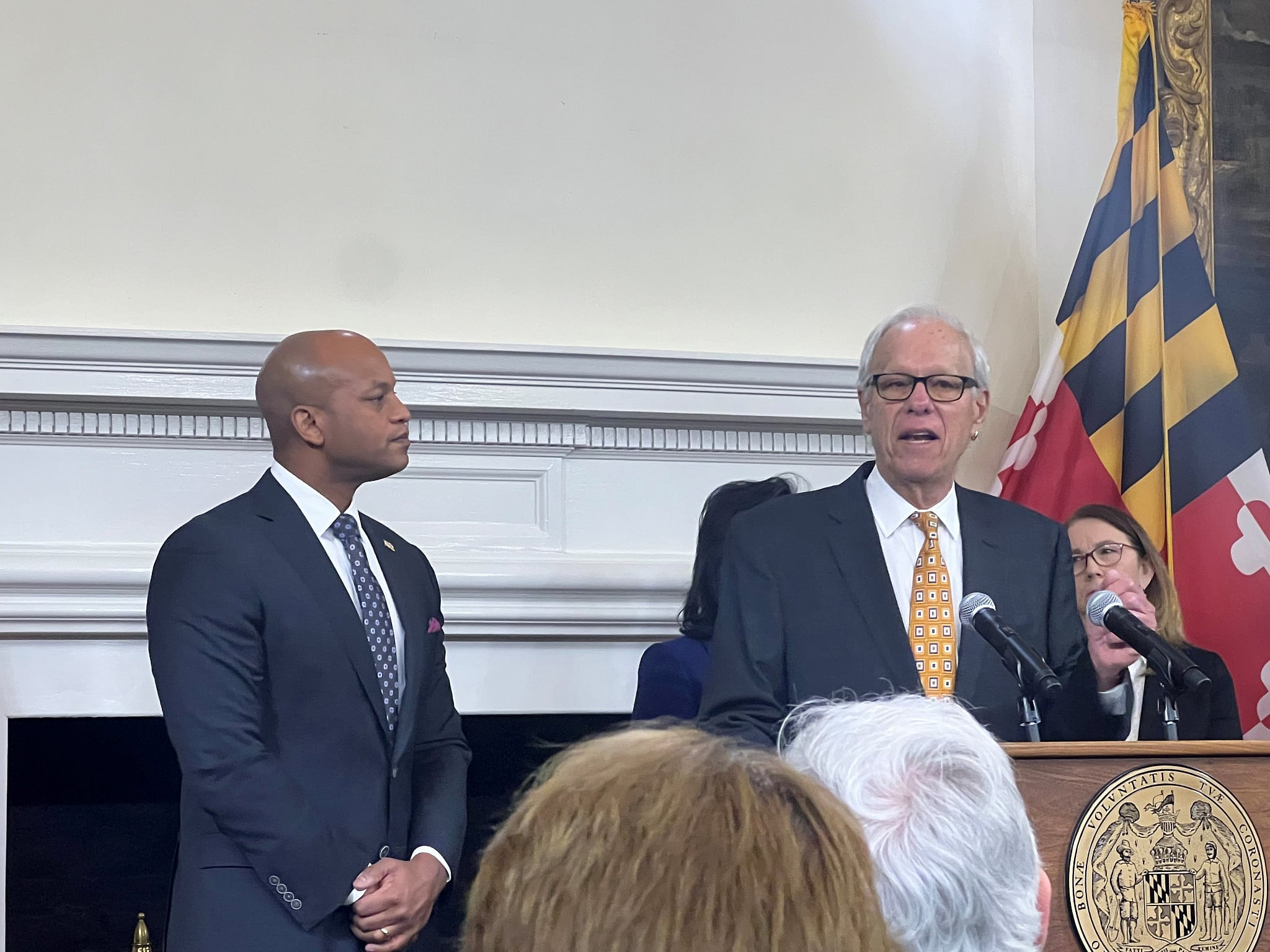
Governor Wes Moore looking to Paul Pinsky for solutions on affordable and reliable clean energy. Photo courtesy of Paul Pinsky.
At a time when federal climate policy is lurching backward, it would be easy to succumb to despair. President Donald Trump has rolled back tax credits for wind, solar, and electric vehicles. Federal momentum has slowed. Corporate lobbyists are circling with checkbooks in hand.
But despair is not a strategy. And as Paul Pinsky recently reminded a gathering of the Jewish Funders Network’s Green Funders Forum, progress is not only possible — it is already happening.
Pinsky, who is Jewish, is a former Maryland state senator who recently retired from serving as director of the Maryland Energy Administration under Governor Wes Moore. One of the most impactful leaders in America, he spoke to the philanthropy group with a mix of realism and resolve.
“We know 2025 was the third hottest year on record globally,” Pinsky said. “The number of fires, floods, tornadoes, hurricanes have increased. The melting ice caps — the estimates have gone up tremendously. We see these challenges virtually every night on the news.”
Yes, he acknowledged, federal tax credits have been cut. But, he emphasized, “It doesn’t mean that all U.S. efforts should be abandoned.”
States as Laboratories — and Launchpads
Pinsky’s career offers proof that states can lead when Washington falters. As the author of Maryland’s landmark Climate Solutions Now Act, he helped pass one of the most ambitious state climate laws in the country. The law requires Maryland to reduce greenhouse gas emissions 60% by 2031 and reach net-zero by 2045. It established building energy performance standards (BEPS), created a green bank, required electrification of the state vehicle fleet and school buses, and launched an urban climate corps focused on environmental justice.
Earlier, Pinsky helped pass the Healthy Air Act, restricting NOx, SOx, and mercury pollution, and bringing Maryland into the Regional Greenhouse Gas Initiative (REGGI).
None of this happened by accident — or by legislative eloquence alone.
“It wasn’t because of my arguments,” Pinsky said with characteristic humility. “It was because people flooded the halls.”
He spent 30–50% of his legislative time coordinating with grassroots groups like the Chesapeake Climate Action Network, Maryland League of Conservation Voters, and the Sierra Club. Coalitions broadened to include doctors, nurses, and public health leaders.
“If I have 200 or 2,000 people behind me who can hold my colleagues accountable, it puts pressure on them,” he explained. “A lot of legislators put their finger up to see which way the wind is blowing.”
The lesson for funders — including Jewish funders — is clear: grassroots organizing matters. Funding smart, accountable, mobilizing organizations is essential infrastructure for climate progress.
The Gaps — and the Opportunity
Pinsky is candid about the challenges. Even before federal setbacks, Maryland was unlikely to hit its 60% reduction target; new projections suggest closer to 42–45% from the 2006 baseline. EV sales have slowed. Transportation and buildings remain the two largest sources of emissions.
Allowing new gas plants, he warned, “would be a catastrophe.”
But alongside the headwinds are real openings.
“Geothermal remains a great opportunity,” he noted. “Heat pumps are a great avenue for potential growth.” Some large-scale solar developers believe they can still make projects work even without federal tax credits. Four previously blocked offshore wind projects have been revived.
He pointed to a fully electric development in Las Cruces, New Mexico — no gas hookups at all — where residents’ energy bills run $50–$60 a month, and could drop to $7 with rooftop solar. In Maryland, the state was prepared to cover the marginal cost between traditional gas hookup and all-electric construction. The New Mexico project found there was no marginal cost.
“We need more models,” Pinsky emphasized. Even if new buildings represent just 1–2% of the building stock, they prove feasibility and normalize the transition.
Funders can help accelerate these models by:
1. Providing incentives to builders to go all-electric in new developments
2. Supporting low-interest green bank financing for large buildings to meet BEPS requirements
3. Funding public-facing EV chargers, especially for apartment dwellers
4. Creating low-interest loan programs for EV purchases, targeted by income
Range anxiety, Pinsky observed, is real — and solvable. When he shifted Maryland incentives from private garage chargers to public chargers near workplaces and apartments, it expanded access for working- and middle-income families.
Community solar is another bright spot. Through the Maryland Energy Administration, funds were directed to rooftop and community solar — especially benefiting low-income subscribers who can lower their bills 10–20% without owning a roof. Partnerships with nonprofits like Civic Works in Baltimore helped aggregate participation and deliver projects.
Data Centers, Nuclear — and Hard Conversations
As energy demand grows — especially from data centers — Pinsky sees another policy frontier: requiring data centers to bring new clean energy online rather than drawing from an already stressed grid.
States, he said, should pass laws requiring new energy procurement, ideally clean energy, as a condition of operation. Grassroots and philanthropic support can help drive those efforts.
On nuclear power, Pinsky offered a personal evolution. “Fifty years ago, I was protesting nuclear in the streets,” he said. Today, he believes small modular reactors (SMRs), with proper safeguards, may be necessary to reach 100% clean energy. A Maryland study suggested the state would need to double its nuclear generation — currently 40% of its electricity — to reach full decarbonization.
Not every environmentalist agrees. But Pinsky’s point was pragmatic: we must use every responsible tool available.
The Jewish Community’s Role
Faith-based organizations, including Jewish groups, are engaged — but not yet at full strength.
“They’re not at the forefront the way the large grassroots environmental groups are,” Pinsky acknowledged. “Good philosophy and good sermons are great. But having 10, 100, 1,000 people do something — letters, protests, coming to the state capitol — that’s power.”
Jewish groups can amplify their impact by mobilizing congregants at scale and aligning with broader coalitions. Our tradition teaches lo alecha hamlacha ligmor — we are not required to complete the work, but neither are we free to desist from it.
In a time of federal retrenchment, Jewish funders and activists have a unique opportunity to:
1. Invest in state-level innovation
2. Fund grassroots organizing and accountability
3. Support litigation by state attorneys general and class actions
4. Expand green banks and community solar
5. Accelerate electrification of buildings and transportation
6. Develop replicable models ready for national scaling
“Trump will be gone in three years,” Pinsky said. “But the heating of our planet will not.”
We must maintain — and strengthen — the infrastructure of progress so that when political winds shift, we are ready to press the electric accelerator.
Backing off now would breed fatalism. Moving forward builds resilience, models, and momentum.
Despite federal setbacks, strong progress is not only possible — it is imperative.
Related Topics
Related Posts