Hadassah Evolve Leadership Fellow, Hadassah Writers' Circle
Diagnosed With Breast Cancer at 45: Facing the Hard Choices and Their Aftermath
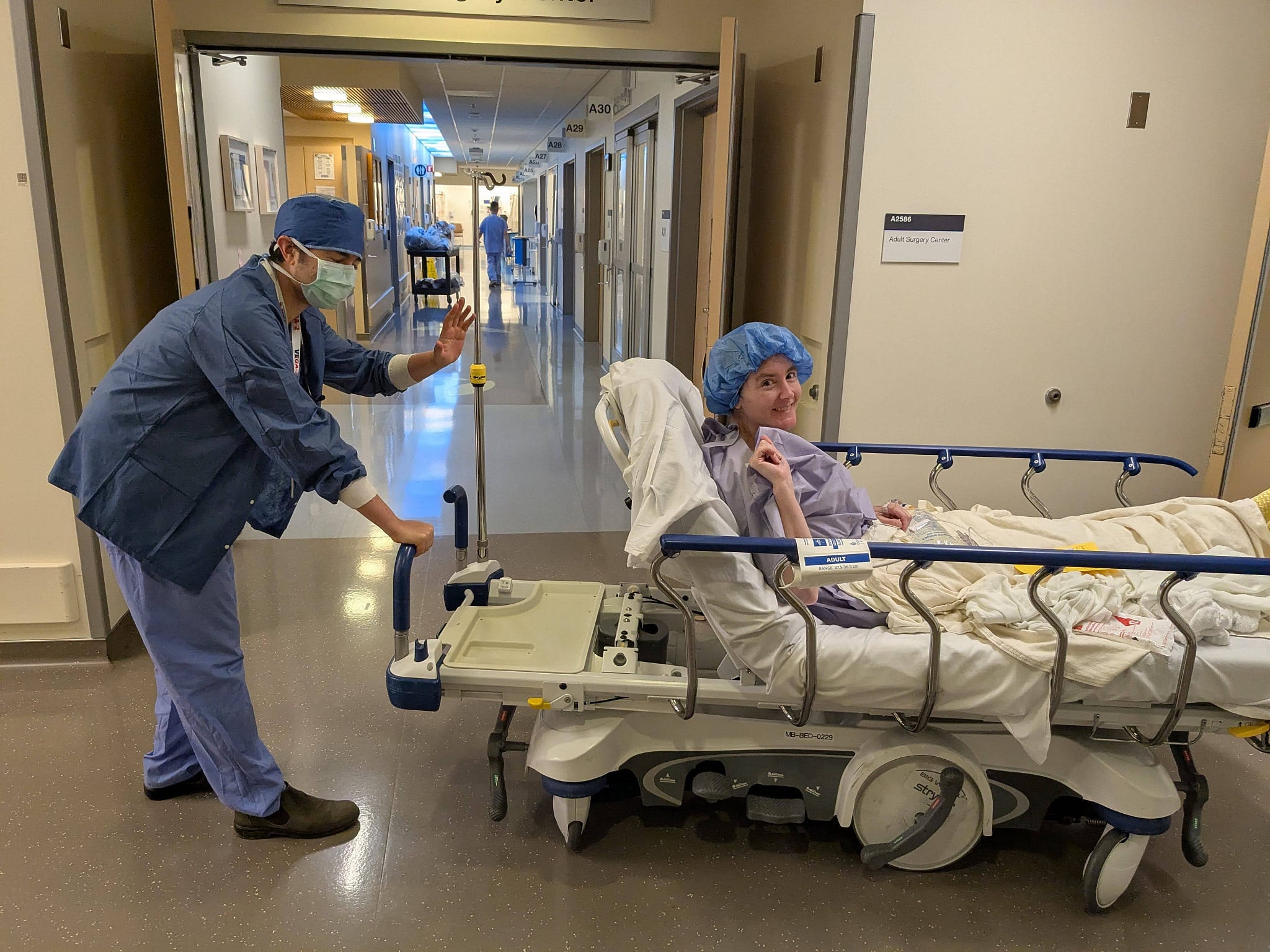
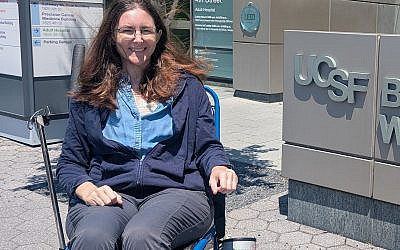
The author headed into morning surgery. Pphoto courtesy of the author.
This is part two of a three-part series by the author for October Breast Cancer Awareness Month
Being diagnosed with breast cancer was the easy part. Receiving the diagnosis was shocking but, in that moment, I assumed that my path would follow that of my mother’s before me. I had no idea that, unlike for my mother whose breast cancer was more advanced when discovered, my early-stage diagnosis would require me to take control over the next steps. And I didn’t realize how traumatic it would be to have to make choices and then face the outcomes of those choices.
The only certainty in the days and weeks following my diagnosis was that the first step in my treatment, based on the relatively small size of the tumor, had to be surgery. I didn’t know yet if the cancerous cells had spread outside my breast or what other treatments I would need. Radiation, chemotherapy, medication — it was all unknown.
A week earlier, I had been preparing to check my mammogram off my year’s “To Do” list with the casual confidence of a veteran patient. Now I felt myself drowning in uncertainty. Fear and doubt crept into my every waking moment and haunted my restless nights. My subconscious spun vivid nightmares: I was driving cars that could only turn left, rushing to flights for which I had no ticket and sleeping in hotel rooms with no walls.
There was some comfort in returning to the same oncology surgeon who had operated on my other breast four years earlier, when I had a non-cancerous lesion. He explained that the standard of care for my current case was a lumpectomy, followed by radiation. This would remove the cancerous tumor and leave most of my breast intact. But, if I preferred, I could choose a single mastectomy and probably avoid radiation. Or, given my personal and family histories, I could choose to undergo a double mastectomy. Each choice carried its own risks, benefits and long-term consequences, but survival rates for early-stage breast cancer are the same with each route.
In addition to choosing which surgery I wanted to have to remove the cancer itself, I also had the option of breast reconstruction by a plastic surgeon. Four days out from diagnosis, my body coursing with adrenaline, I told my surgeon with confidence that I wanted a double mastectomy and breast reconstruction – as if I was following a mental “Emergency Action Plan.”
In the days and weeks that followed, doubt clouded my confidence. Though eager to have the tumor removed, I was paralyzed by the enormity of these decisions. My mind spun with questions that begat more questions. Was I blowing this whole situation out of proportion? Did I really want to amputate parts of my body that didn’t show any signs of cancer? Was reconstruction necessary if it served no obvious biological purpose? What is the main purpose of breasts if not for breastfeeding – and that wasn’t on my horizon!
My oncology surgeon has always had an uncanny ability to avoid pushing me in any one direction regarding my surgical choices. I am grateful for that, though it can also be frustrating. These irreversible surgical decisions leave physical and mental scars and challenge the very way I view myself as a woman. I wanted direction from him, yet I knew that direction had to come from within me.
Working with my long-time therapist, I began to understand that there were no right or wrong decisions – just potentials to consider. Together, we created lists of potential challenges and benefits of lumpectomy and mastectomy and their overlaps. Then I reviewed the lists and considered how each challenge or benefit made me feel.
At the bottom of the list of “potential challenges following lumpectomy,” I wrote: “not doing everything I could,” while at the bottom of the corresponding list for mastectomy, I wrote: “am I overreacting?” I realized both involved imagining scenarios as to what each choice could mean.
Ultimately, I realized that all I had were possibilities – not certainties. I had to make a choice and have faith that I could handle whatever came next. I stuck with my initial decision to have the double mastectomy with reconstruction.
Surgery Day
My surgery was scheduled for early July, just four days before my 46th birthday. Due to my physical build and my personal preference to use my own tissue, I required a staged surgical approach.
The first step would be a lumpectomy and reduction of both breasts. This would remove the tumor and prepare my breasts for nipple and skin-sparing mastectomies – options that didn’t even exist when my mom had breast cancer.
On the morning of my surgery, I listened to a “Tits Up” playlist compiled by friends. I read from a Jewish Prayers & Reflections on Healing pamphlet I found through the JCFS Chicago. And I laughed with my mom about all the “sewing pattern” lines my plastic surgeon had drawn on my skin.
By 8:45 am, I was rolling into the operating room and, by early afternoon, I was settling into my patient room. Despite significant pain, I was relieved and in a relatively good mood. By early evening, I had sent my parents off to have their dinner and go to sleep. Sometime after 7 pm, though, things started to change for the worse. Almost exactly 12 hours after I had been taken into surgery, I was back in the operating room.
The experience leading up to my emergency surgery was surreal – as if I was suddenly a character in a TV medical drama. While at 7 pm it had been just me mentioning to my nurse that my pain was increasing, an hour later my room was filled with too many doctors, nurses and assistants. The plastic surgery fellow quickly confirmed that I needed to call my exhausted parents back to the hospital.
After that, everything unfolded in a rapid blur: blood drawn, photos taken and my chest wrapped tightly to minimize the bleeding that was causing my right breast to swell to an alarming size. I was overwhelmed and sobbing from pain. I wished I had called for my parents earlier.
Thankfully, my nurse had refused to leave my room from the moment the swelling and pain had started. She stayed after her shift ended and wisely ignored my tearful attempts to assure her that I would be ok alone. When I picture her now, standing near the foot of my bed, I always imagine her with angel wings.
I remember my bed moving down the hallways, into the elevator and back to the surgical floor. An entire operating room team surrounded my bed, introducing themselves and asking questions as we all waited for my plastic surgeon to arrive. I kept apologizing to the anesthesiologist for having eaten pizza before surgery, as if I could have known.
Looking at the faces around me, I noticed that the tall nurse at the foot of my bed was wearing something gold around his neck. To my fuzzy eyes, blurred with the ketamine anesthetic and without my eyeglasses, the gold looked like it was forming the words to the Shema prayer, a Jew’s daily declaration of faith in God (“Hear, O Israel: Adonai is our God, Adonai is One.”)
I was not that far off – the necklace was a Star of David that had belonged to his grandfather.
While I had not faced direct antisemitism at this medical center, I knew it was happening to others there. Seeing this simple necklace on someone responsible for my care brought a sense of safety and solidarity to a frightening situation.
To my great relief, my parents arrived moments before the surgeon. As someone began moving my bed toward the operating room I turned back and called out: “Mom, wait! He’s wearing a Star of David – it’s going to be all right.”
Danielle is a member of the Hadassah Writers’ Circle, a dynamic and diverse writing group for leaders and members to express their thoughts and feelings about all the things Hadassah does to make the world a better place. It’s where they celebrate their personal Hadassah journeys and share their Jewish values, family traditions and interpretations of Jewish texts. Hadassah members are proud of their Zionist mission and their role as keepers of the flame of Jewish values, traditions and beliefs as well as advocating for women’s empowerment and health equity for all. Since 2019, the Hadassah Writers’ Circle has published nearly 650 columns in The Times of Israel Blogs and other Jewish media outlets. Interested? Please contact hwc@hadassah.org.
Related Topics
Related Posts