NYC Attorney, Activist, and Graphic Designer
Diaspora Jews: Be strong and of good courage

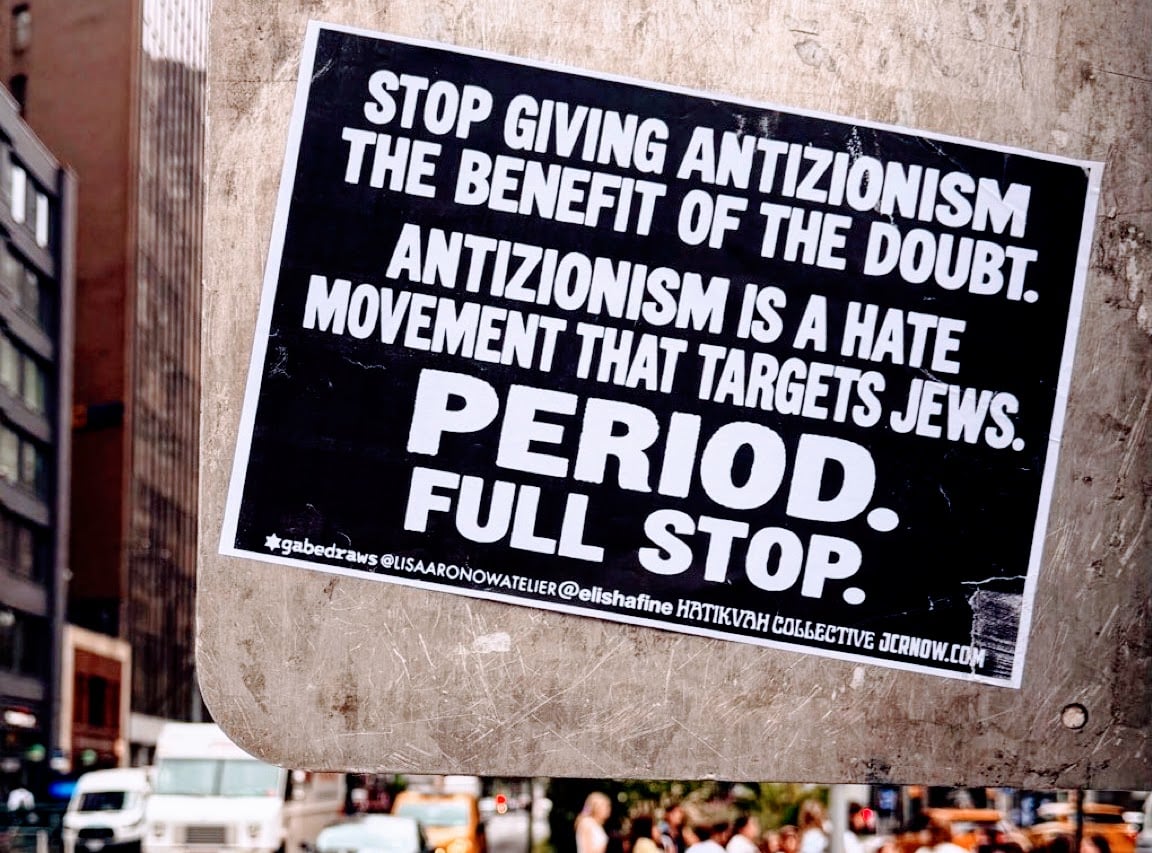
Sticker by @gabedraws and the Hatikvah Collective.
Somewhere in the Diaspora, there’s a Jew who has decided, without ever saying it out loud, that the fight against antizionism belongs to somebody else.
We soothe ourselves with these stories. That antizionism is “just about Israel,” and after all, I don’t live in Israel. That, if this hate movement ever comes for me, I’ll explain that I’m a different kind of Jew. That the smart move is to stay quiet and let it burn itself out.
No. Every Diaspora Jew is already smack in the middle of this fight. And these stories we tell ourselves are locked doors, fake exits. You’re not going to be able to just sit this one out.
But be not afraid. Al tirah. Remember Roza Robota, integral to the October 7, 1944 Sonderkommando revolt at Auschwitz-Birkenau. Shortly before her execution in January of 1945, she signed her final message to her comrades: Hazak ve’ematz. “Be strong and of good courage.”
This is OUR fight, and we have three thousand years of courage at our disposal.
 I. This was never about Israel
Let’s look at the stories we tell ourselves. The first story: this is “just about Israel.”
Antizionism never needed, nor did it even wait for, an Israeli government to supply a grievance. Jerusalem in 1920, Jaffa in 1921, Hebron in 1929, the Farhud in Baghdad in 1941: all of them occurred before there was a State of Israel to object to. As Naya Lekht puts it: “Israel does not need to exist for the anti-Zionist to exist.”
What’s more, Pew found that 82 percent of American Jews consider caring about Israel essential or important to their Jewish identity. Once the Diasporic connection with Israel becomes grounds for indictment, most of us in the Diaspora are already in the moral interrogation room.
The charges boil down to what Adam Louis-Klein calls the “triad”: colonizer, apartheid, genocide. In “The Nakba as Libel,” Lekht explains that an antizionist libel “does not merely assert something false.” It assigns “fixed moral roles, villain, victim, savior,” and moves “from the particular to the universal in order to render a whole group morally indictable.” It is the logic of the ancient charge of deicide, and the Nakba narrative makes precisely the same move, just shifted in time: “from the particular suffering of 1948 to the universal guilt of every Zionist, everywhere, forever.”
In The Anti-Zionist Complex, Jacques Givet showed what the accusation becomes once it fastens onto a country:
We thus arrive at a rule to which, for the militant anti-Zionists, there can be no exception, namely: Israel can and must be attacked on every possible occasion, for it deserves attack. Self-defence is not permitted; indeed, it is impossible, for Israel does not exist. The country is therefore at one and the same time a universal scapegoat, Satan, and a void.
Ask what any Israeli government, of any party, could possibly do to satisfy or dispel this accusation. The answer is a null set, because the demand is for the Jewish People to unravel itself and cease to exist. Which, naturally, we refuse to do.
This vocabulary didn’t appear out of nowhere, of course. Fayez Sayegh’s Zionist Colonialism in Palestine, published by the PLO Research Center in Beirut in 1965, recast Jewish national return as a colonial enterprise, and Soviet antizionism gave such accusations the reach of a state. In 1975 the United Nations declared Zionism a form of racism via Resolution 3379, whose principal architect was Sayegh himself. Daniel Patrick Moynihan, who wrote the introduction to Givet’s book, immediately called out what was happening: “What we have here is a lie.”
Resolution 3379 was revoked in 1991—sixteen years too late. Still, it proves that what humans built, humans can dismantle.
II. The bargain that didn’t protect Max Naumann
The second story: distance yourself, renounce or downplay Zionism, and hope the distinction counts for something when it matters.
Dr. Max Naumann thought so, too. A Berlin lawyer and First World War veteran, he argued in his 1920 pamphlet, Vom nationaldeutschen Juden, that Jews in Germany were Germans of Jewish descent whose national loyalty belonged to Germany alone: “For politicians who are in Germany only with mouth and pen, but with their soul in Palestine, there is no room in our German Fatherland.” He was no naif; he knew the völkisch antisemites were dangerous. Yet he still sorted Jews by their degree of Germanness and told the waverers: “An honest stranger is dearer to us than a repugnant cousin.”
The category was always and only JEW. His careful distinctions bought him no exemption. His League of National-German Jews was banned in 1935, and he was arrested by the Gestapo. He died in 1939.
THERE IS NO BARGAIN TO BE MADE. The hate movement offering you acceptance decides whether your renunciation is sufficient, and it will change its mind whenever it wishes.
 III. Your silence is already priced in
The third self-soothing story is the one educated folks prefer: silence deprives hatred of oxygen.
True, the risk of amplifying a libel by answering it is real, and speaking up carries a cost of its own. Moynihan described what awaits anyone who objects to these libels: countries combine “for the purpose of doing something outrageous, and thereafter, the outrageous thing having been done, to profess themselves outraged by those who have the temerity to point it out.”
That move is run on us every single day. Object, and the objection becomes evidence of Jewish power, Jewish censorship, Jews “weaponizing antisemitism.” The outrage was always priced in. But so was your silence. Failing to speak up concedes the argument without your ever having made one. As Andrew Pessin and Doron Ben-Atar put it: “Words, Jewish history teaches us, have consequences. As does silence.”
In StandWithUs v. MIT, the First Circuit affirmed dismissal in October 2025 and wrote: “This absence of consensus reflects ongoing debate as to the relationship between anti-Zionism and antisemitism – debate that our constitutional scheme resolves through discourse, not judicial fiat.”
Where did that “absence of consensus” come from? From our own silence. For years the institutions charged with our protection have struggled to name antizionism, or to explain how it works, so we forfeited the definitional field to the people accusing us. We sat down in the middle of the fight, hoping it would sort itself out. It didn’t.
Speak up and, sure, you might still lose, but you’ll be back in the fight; stay silent and you’ve already lost.
 IV. What standing up looks like
The stories we tell ourselves may fall apart, but no one can take away our millennia of courage. Lekht’s “The A-Word” explains why our existing defenses don’t help: we spent decades teaching people to recognize one vocabulary of Jew-hatred while another passed straight through. Antizionism has its own origin story, its own lexicon and delivery mechanisms. It is a mutated virus, the same genetic core in a new coat, and the old vaccines don’t recognize it.
We need the courage to see it, name it, and expose it. In real life, not just online. Five things you can do:
- See it and name it. Say ANTIZIONISM (one word, no hyphen), and say what you mean by it: the hate movement that generates and wields libels to cast Jews as villains and Israel as born in sin. Genocide, apartheid, colonizer, ethnostate, a Möbius strip of libels. Name them all. Out loud. (Don’t bother trying to disprove them; you can’t debate hate.)
- Expose the machine. When you’re handed a libel, look at who’s used that charge before, and when, and why: Sayegh’s pamphlet, the Soviet workshop, Durban in 2001. Learn the history and etymology of each libel. Teach others.
- Refuse the frame. Every antizionist libel offers you two chairs: villain, or “good Jew,” and the accuser decides where you sit. Sartre saw the same danger in the well-meaning “democrat” who offers the Jew acceptance through the dissolution of Jewish identity. Don’t sit. Stand and shout, “ENOUGH!”
- Flip the antizionist gaze. They demand that Jews and Israelis justify our existence and answer for our “crimes.” No. Je refuse. Turn the mirror around. Demand that its adherents, many entirely ignorant of antizionism’s roots, account for their own eliminationist Jew-hatred. They have something to explain. You do not.
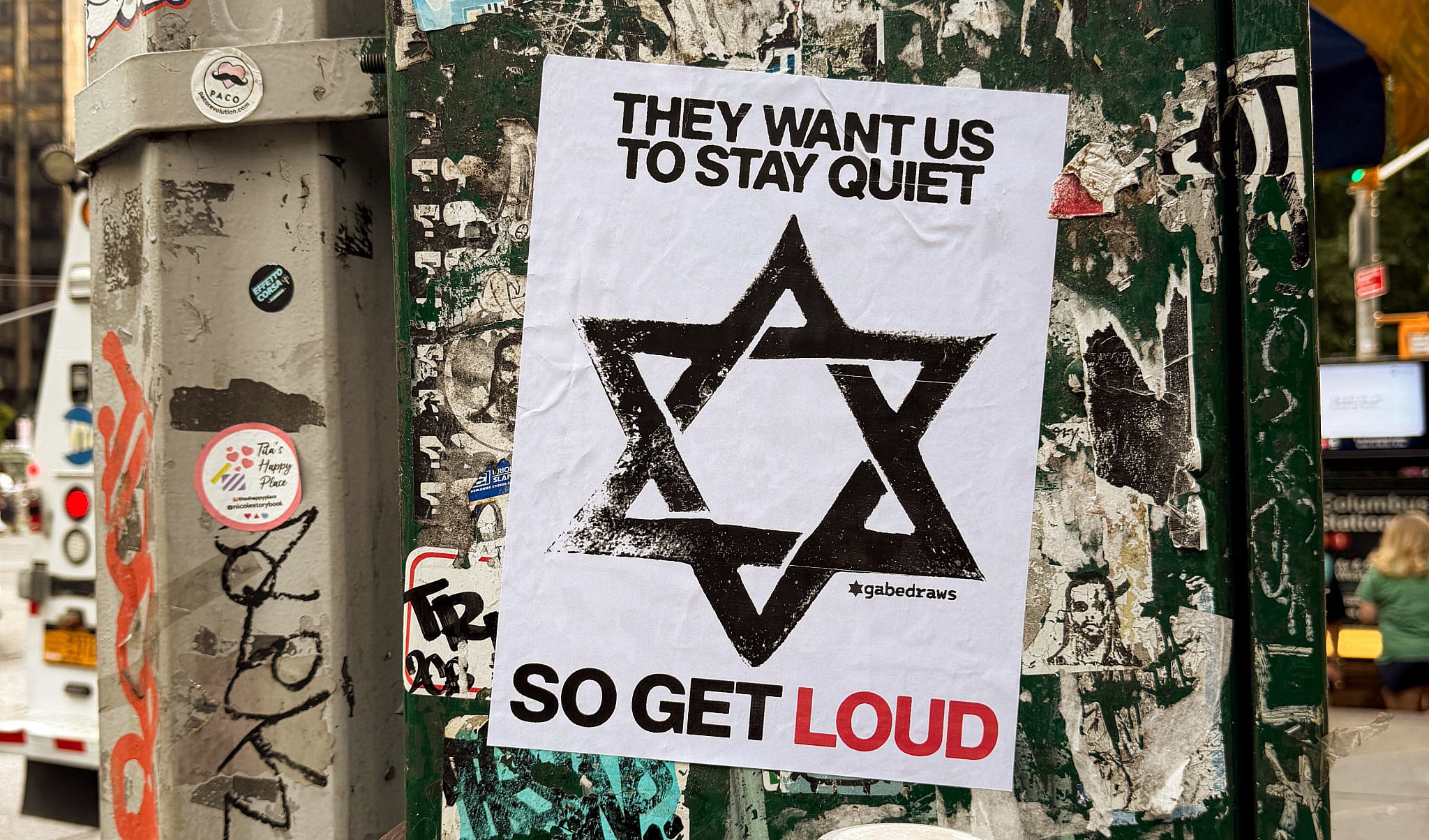
- Show up. The scholarship, the litigation, the symposiums, the rallies, the street advocacy already exist. The only thing missing is … you, in your own city, at your kid’s school board, on the street slapping up stickers. The one thing you can’t do is sit there and hope it works out.
The Diaspora Jews who fight back are the ones who understand that the fight has already come to them. Act on even one of these, and when you look back in a month or a year or a decade, you’ll know you wrote a letter in the scroll of Jewish Peoplehood.
Time is not on our side. It’s up to you to act. Just keep Roza’s words in your heart: Hazak ve’ematz.
Be strong and of good courage.
Related Topics
Related Posts