Public Speaker & Content Creator
The Loudest Anti-Israel Voices Don’t Speak for America
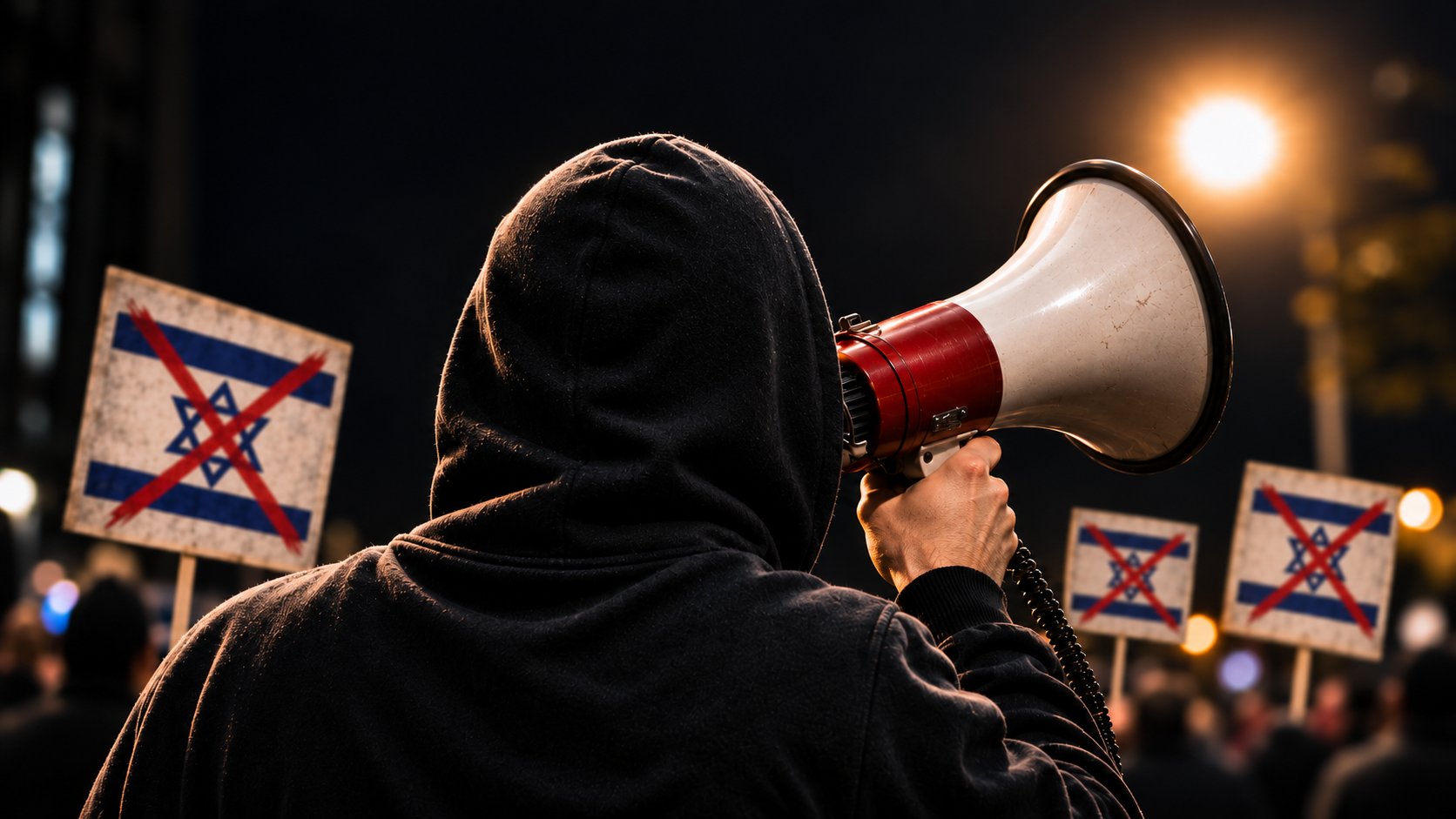
Illustrative image
A small, virulent anti-Israel minority has acquired a vastly disproportionate voice in America’s political debate, spanning from right to left. Tucker Carlson says America put Israel’s interests “before ours” and that Benjamin Netanyahu “pushed” President Trump into war with Iran. Hasan Piker says Israel “does not have a right to exist” in its current form, calling it a “settler-colonial operation” and comparing the question to whether Nazi Germany, apartheid South Africa or Rhodesia had a right to exist. Whatever else separates their politics, both push claims that go well beyond criticism of a particular Israeli government or policy.
A new national survey by Schoen Cooperman Research for the Israel on Campus Coalition (ICC) shows the gap. In a three-way question designed to distinguish opposition to the current Israeli government from opposition to Israel’s existence, 73% of Americans supported Israel’s right to exist while just 8% fully opposed it, and 69% supported Israel’s right to defend itself.
For supporters of the Jewish state, we know that supporting Israel does not require indifference to Palestinian civilians. Caring about Palestinian civilians does not require opposing Israel’s existence or severing America’s alliance with it.
The arguments taking place online are much more radical than public opinion held by the majority of the country. The problem is where that argument travels. The generational gap is stark: among Americans under 30 who followed the war, 77% named social media as a main source of news, compared with 52% of adults overall. Among under-30s, 16% named influencers and 13% named blogs from Gaza, and just 8% named local newspapers. A fringe position does not need majority support to become ubiquitous on a phone screen.
Our enemies, namely Iran, exploit that information environment.
In 2024, Director of National Intelligence Avril Haines warned that actors tied to Iran’s government were posing as activists online in order to encourage Gaza-war protests, even going so far as to provide financial support to protesters. Americans taking part in protests are expressing genuine views, but might not know they’re interacting with a foreign government. Microsoft Threat Intelligence separately documented Iranian influence operations aimed at undermining international support for Israel, including personas masquerading as pro-Palestinian groups, some of whom described Israel’s actions in Gaza as “genocide.”
Microsoft found that Iranian operations expanded beyond Israel to countries that support Israel, with the intention to weaken political, military, or economic support for Israel. Undermining international support for Israel was a key objective of Iran’s influence operations during the war.
That objective fits a wider strategy. The Congressional Research Service says Iran has long backed armed groups across the Middle East to advance its regional interests, providing help for Hamas for decades and extensive support to Hezbollah. Both groups have attacked U.S. and Israeli targets for years, earning them Iran’s continued loyalty.
Another key feature in the new polling: Americans distinguish between Israelis and American Jews. When asked if American Jews are unfairly blamed for actions of the Israeli government, 69% of respondents agreed. Among adults under 30, 67% agree, up from 49% in July. Americans believe that Jews should not collectively be held responsible for decisions made by a foreign government.
The U.S.-Israel relationship is a two-way economic and defense partnership. In 2025, bilateral goods and services trade totaled $54.2 billion. U.S. exports to Israel included $13.7 billion in goods and $9.7 billion in services. That economic relationship is not new: the U.S.-Israel Free Trade Agreement, in force since 1985, was the first free trade agreement entered into by the United States.
Missile defense is similarly collaborative. Congress provides $500 million annually for joint U.S.-Israeli missile-defense programs. U.S. contributions for research, development, testing and evaluation are matched by Israel, while at least 50% of annual procurement and co-production funding must be spent in the United States. Those programs support missile-defense systems including Iron Dome, David’s Sling and Arrow. The Congressional Research Service says at least $100 million a year in missile-defense funding is spent inside the United States by U.S. firms or American-based subsidiaries of Israeli defense contractors.
Americans also see what is happening on campus. A clear majority, 59%, call campus antisemitism a serious problem, and 61% are concerned about anti-Israel protests and Boycott, Divestment and Sanctions (BDS) petitions on college campuses. As a recent college graduate, I know how dangerous campus has become for Jewish students, and of those surveyed, 38% agree that campuses have become less safe for Jewish students over the last few years. Colleges are responsible for protecting their Jewish students, polling concludes, with 75% agreeing that colleges should protect Jewish students as they would any other group.
ICC’s polling shows that the anti-Israel rhetoric amplified by some of the country’s loudest political voices does not represent America as a whole. The vast majority of Americans support Israel’s existence. They also support its right to defend itself, reject collective blame of American Jews, and expect Jewish students to receive equal protection.
Related Topics
Related Posts