
Divorce is traumatic but can be made child-healthy: Erica Komisar’s must-read book

 “Divorce is a traumatic experience but there are ways to mitigate it, to help all involved handle it better” says Erica Komisar. “Parents and courts should take the child’s developmental stage into account, and stop thinking of children as a possession that can be evenly split, it is not about 50/50 or 70/30 but what is best for the child.”
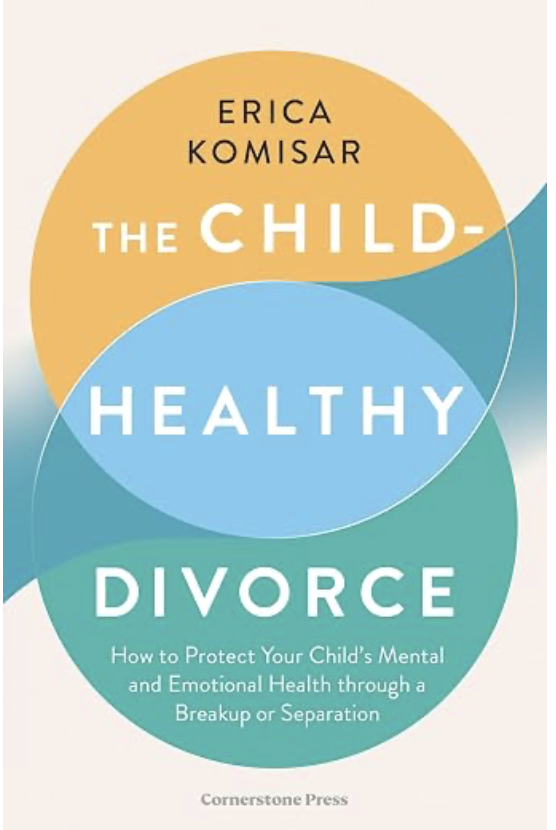
On ARC’s podium and as a guest on The Kardashians, psychoanalyst Erica Komisar rests on real life experience and solid research to bring the child into focus. From her ground breaking bestseller Being There explaining why prioritising motherhood in the first three years matters, to her latest advice to separating parents. Here Komisar speaks of her latest title The Child-Healthy Divorce – How to Protect Your Child’s Mental and Emotional Health through a Breakup. I begin by asking why after decades of stigma-free divorce, society, and so many parents are getting separation so very wrong.
EK That’s an interesting question. I think the problem is that when it was stigmatised, people felt ashamed and as a result weren’t talking about it. They weren’t learning about it or trying to understand how to do it better because it was stigmatized. Now it’s not stigmatized but treated as a very commonplace thing, it’s like the pendulum swinging in a way – because it’s so common place people don’t try to understand it and find ways to do it better. I still think that there’s a lot of shame around divorce. The fact that 50% of people divorce who marry and have children is a very big number and yet it’s not something we talk about when we talk about childhood trauma. It’s not something we talk about when we talk about children’s mental health, because there’s a massive feeling of guilt around it.
HG You speak of guilt an an opportunity for betterment
EK Guilt is helpful in that it signals to you that you should explore things more deeply and explore your conflicts, but it can’t be the thing that stops you from learning. If guilt helps foster repression and turning away from learning and improving, then guilt is excessive, so I would say that a little bit of guilt can make you turn towards understanding and doing things better. Hopefully this book will give people the tools and the resources to think about it in a serious way.
HG Stigma or not, divorce is a very serious thing, it is noted by many as the most devastating experience, after death of a loved one
EK Although people who are going through it take it with great seriousness, I’m not sure that they understand just how important it is to do it right with their children. I think people are so consumed with their own pain as adults that they don’t really focus on what’s important for children. So I think the pendulum has swung from a time when people didn’t talk about it because it was stigmatized and now people don’t talk about it because it’s so common place – the truth is that we have to talk about it and how it affects children.
HG This book is preventative in many ways. I love that you chose the King Solomon story to show us that children are not possessions that can be split

- “The King Solomon metaphor is interesting because it talks about the importance of both fathers and mothers” Judgement of Solomon image courtesy of The British Museum.
EK The King Solomon metaphor is interesting because it talks about the importance of both fathers and mothers. The truth of the matter is that people treat their children like possessions, like things to be split evenly.
I am saying that the baby is a person who has emotional and developmental needs that are different at different stages and ages. That is why the 50/50 concept is false.
HG You talk about the different stages in a child’s development in the book, this is so important, every parent should have this list
EK At different stages of development, mothers are more important than fathers and at other stages, fathers are more important than mothers, they’re both important, they’re just not equally important at the same time. And this idea of splitting the sandwich in half has to do with the gender wars and somehow telling fathers and mothers that they’re exactly the same when they’re not. Fathers are critical to children but they’re not necessarily critical to children at the same time that mothers are critical to children, and not in the same way.
I tell parents right out, that they shouldn’t separate and divorce before a child is three. Unless you’re being severely abused or sexually abused, it’s selfish to separate before the age of three. We’ve created a paradigm where people have too high an expectation of marriage and raising children together. There’s this fantasy that it’s all supposed to be perfect and the person you’re with has to be the perfect female ideal. There’s a lot of unrealistic expectations that young couples go into marriage with, that are causing them to split. Having children changes your relationship, hopefully for the better, and marriage is hard, and whoever told you that it wasn’t going to be challenging was wrong.
HG You also speak of the rise of narcissism in relation to parenting
EK Its a culture of idealism and there’s a sort of a narcissistic fantasy – the grass is always greener. There are abusive relationships with alcoholic, drug addicted or abusive partners of course, but there are many people divorcing and putting children through this trauma over just differences in love languages, in hobbies or opinions. 100 years ago they didn’t divorce over those differences or even 50 years ago.
Divorce is a trauma, you’re going to put your child through trauma, and there are ways to mitigate the trauma, consider the child’s level of development for a start, and delay separation if any serious events such as grandparent passing have just taken place.
This is why I wrote the book. What’s also happened is judges favoured mothers, particularly with very young children, so they would assign mothers generally as the primary custodians of children with fathers having visitation rights every weekend, three nights a week. It was the norm that fathers were considered important but not as important as mothers. Now, because of the gender neutrality, the courts have to recognise fathers as the same as mothers. I always say that mothers screwed themselves in terms of divorcing, by fighting for gender neutrality because what they did is they erased their importance to children. It has all become about fairness to the adults and gender neutrality. So if we say that men and women are exactly the same and their roles are exactly the same, which they aren’t, then we’re saying that fathers and mothers should pass the baby back and forth like a sack of potatoes, and that’s what’s happening.
And it’s very damaging to children because the importance of mothers and fathers is clear. But their importance is different to a child and so they need both, but they don’t need both at the same time and with the same intensity. So the idea of 50/50 is probably a ruse. when children are very little it’s probably more like 70/30 in truth leaning towards mothers, and then as children get older, there are moments in an adolescent boy’s life when his father is more important when he may choose to live with his father, and I say to the mothers, you have to let your son go and live with their father for a short period of time if that’s what they need, it should be about what’s healthy and fair to children, not what’s fair to adults.
There is not always a need for overnights stays and for passing the baby back and forth for example. With 50/50, its like the baby is cut in half, even if the father’s working full-time, so, the father can put the baby into daycare or hand the baby to his mother or an aunt rather than hand the baby to the mother of the baby. In other words, if the mother says, ‘I’m only working part-time, I can watch the baby when you’re working and you can come and see the baby right after you’re done with work’, the courts will say, no, and the father will say, “no, that baby’s mine, I want that baby on my premises, even though I’m not with that baby.” This isn’t an object, this isn’t a possession – so if a father is not going to be home with that child in the same way that a mother might be home with that child in terms of presence, that child would be better off during the day with that mother than in daycare or with another caregiver. Fathers will hire babysitters and say, ‘I have the right to have that child in my house with a babysitter rather than the child being with their mother.’ so it’s all about parents selfishness and self orientation and the courts have followed suit.
HG Many are fighting for 50/50 to be the starting point-separation point, rather than 0 /100 being the starting point.
EK The fact that we started referring to children in percentages is very disturbing. We are talking about what parents need, not what children need.
HG What would be your message to judges and family courts?
EK Stop treating children like possession, and stop considering the fairness to the adults in the room, instead, think about what a child needs at that moment. Who is that child’s secure attachment object? What does that child need in terms of overnights? Overnights generally are not recommended with the non attachment figure parent until a child is old enough to be able to internalise that sense of security so it may be later than three years old when a child can do overnights with the non-attachment oriented parent.
HG You refer to the vulnerability of teen boys, you say that they are still developing and asserting their manhood.
EK Teenagers are in the second critical period of brain development, the first being 0 to three, the second being 9 to 25. So those two critical periods of brain development are the hardest on kids when you have trauma or adversity. Early to mid adolescence is more traumatic than late adolescence, nine till about 15, that’s a very turbulent period with physical and emotional change, so that’s a very difficult period for adolescence to go through a divorce process. So again the sensitivity and care with which you handle it and always thinking about their needs before your own.
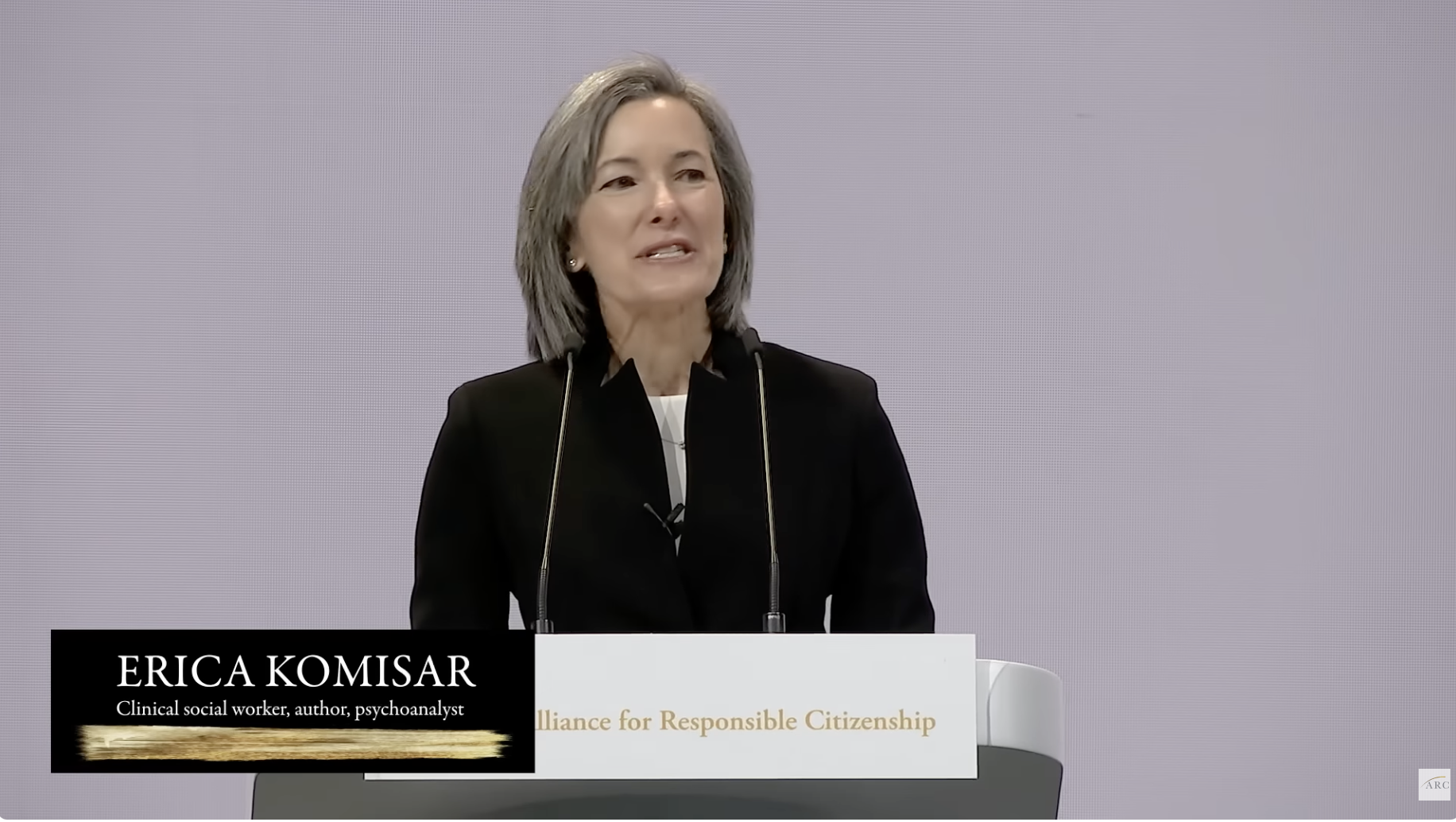
- Erica Komisar speaking at ARC (Alliance for Responsible Citizenship)
Parents get into very self-oriented modes when they are hurt, they would say ‘you went on vacation with your father and you didn’t go on vacation with me’, this concept of fairness makes kids crazy. The other thing is when parents use the children as weapons, criticise the other parent to the child, this is terrible for children because even though you’re divorcing your spouse, your children are stuck with both of you.
HG You also mention using the child to get information
EK They’re not your messenger – ‘what is your mother’s boyfriend like? What is she doing with her money?’ And so on – you’re taking their childhood away, infusing their life with hostility, envy and competitiveness. Parents really have to be on their best behaviour when they get divorced and mostly they’re not. If I get to parents early enough then sometimes I can help to save marriages or help them separate in an amicable, child centred way, but often they come to me when they’ve been battling for years and the children are developing symptoms.
HG What alerts parents about child’s behaviour so that they seek help – is it depression? Anxiety?
EK Children developing behavioural problems at school mostly, it could be depression, anxiety, attentional issues, suicidal ideation, also more serious personality disorder traits. There are some parents who come to me prophylactically, who say ‘we’re getting a divorce we want to know how to talk to our children, how to handle this well.’ What you need is two secure people coming to the table to do what’s best for their child, not what’s best for them, and sometimes what’s best for your child is not what’s best for you in the moment. In the long run, it’s best for you because you want a healthy child, but you may get less time or you may have a child who isn’t as connected to you in that moment, but in the long run, your generosity and your ability to see beyond your own needs means that the child will love, appreciate and respect you for being the adult in the room.
Being an adult means that you can sacrifice. Children should not have to sacrifice. That’s not their role, they shouldn’t be sacrificing for us, we are sacrificing for them.