
Distinguished Professor of Sociology Emeritus CUNY
Do You Feel Safer Today?
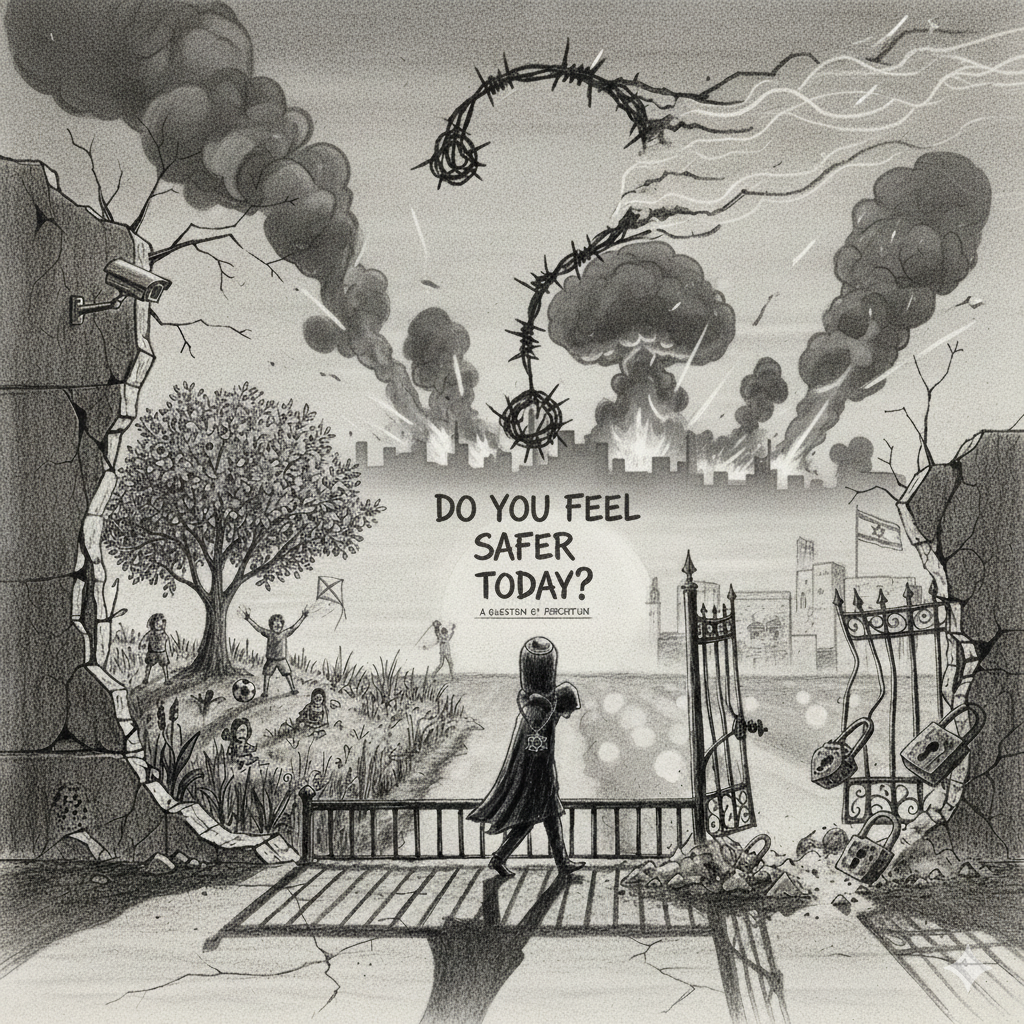
(Generated by AI)
As we close in on two years of the war that began on October 7, 2023 – forget all the jingoistic names this government gave it and its subsidiary battles in Lebanon, Iran, Yemen, the occupied territories, and of course in Gaza (from which Israel formally withdrew in 2005) – here’s my question. After expending so many lives and so much treasure during this war, do we feel safer today? The idea that Netanyahu – who has held power as prime minister longer than anyone else in Israeli history and is largely responsible for what Israel has become in this generation – has provided security is of course now seen as preposterous.
Even on October 6th and the days preceding the Hamas attack, many in Israel warned we were in a precarious situation, much as was the case in October of 1973. Beyond the fact that we were not prepared for the military attack that came, stand the obvious divisions and civil unrest that the ill-conceived ‘judicial reform’ initiated by our right-wing extremist government aroused. To many observers, as a result Israel appeared distracted and divided. That its attention was on internal and political battles more than its external security seemed easy for the world (and our enemies) to believe. The mass protests made world headlines.
While some within Israel claimed the unrest was an expression of the freedom of speech and democracy that had been essential to this state’s identity (a self-identity of course undermined by our treatment of the Arab minority, the occupation, and the failure of the Haredi sector to share an equal burden in the state’s defense – but that had gone on so long, many had become accustomed and therefore blind to it), it obviously showed we were distracted.
But what the brutal and traumatic events on the morning of Simchat Torah, normally a holiday of joy that ends the high-holy-days season, which in 2023 fell on October 7, showed perhaps most clearly was that Netanyahu and all his appointees and government were not only distracted too, but also that they were incapable of providing security and had made the nation less safe than perhaps any time in modern Israel’s short lifetime. If these people were running a corporation, the shareholders would have long ago fired them.
Instead, as a nation with a poorly organized political system and a prime minister for whom holding onto personal power is everything, the same gang that failed on October 7th continues to do so. Still doing almost everything to hold onto that power, they do not know (or maybe care) what to do to make people feel safe.
For starters, what is the goal of this war? Besides the repeated Bibi (and his acolytes’) bluster about wiping out Hamas (which so far we have not done), there is no vision of where we are being led and no explanation offered to describe clearly what happens when hostilities are over. These so-called leaders offer no solution that would bring peace or what it would look like. The evidence of history, which all of us know, is that peace and hence security comes only from honest negotiation and a genuine vision of what it means. That we have not received.
In the meantime, a sense of security still evades us. Surveys have been tracking how safe and secure Israelis feel. In March of this year the Institute for National Security Studies (INSS) reported in their survey that the percentage of Israelis who felt “very safe” was 25% while those who said their sense of safety was ”very low” stood at 33% (among Arab respondents the insecure feeling was at 54%). A Gallup poll found the negative emotions (stress, worry, sadness) among Israelis rose sharply after October 7th and in spite of battlefield successes, they remain elevated compared to pre-conflict levels. The overall picture from the data is that a minority of Israeli adults feel very safe – somewhere around a quarter to a third. All this is even lower among Arab Israelis. And if Israelis expect that they can count on our American allies to keep them safe, then Gallup has bad news for them. Only 32% in the U.S. back Israel’s military action in Gaza; a new low. As of July of this year, 60% of Americans disapprove of Israel’s military action – a number that surely will drop after the recent attack on Qatar, an American ally.
While on a day to day basis, I feel safe on Israel’s streets and places, as I reported elsewhere, my own perception as a Jew traveling abroad was to be far more wary about being identified as an Israeli. Both Israel’s political and military conflicts have taken a heavy toll on all sides. Even recent immigrants like me, who fulfilled their Zionist dream, have been beaten down by these wars.
No less troubling is the fact that whenever it seems we are about to come to a ceasefire that will bring home our hostages and end the shooting, our prime minister finds a way to undermine the deal. He and his government’s strongest success is in making Israel and its citizens near pariahs in the world, and unraveling the fragile relations with our neighbors. His latest decision to bomb the few remaining Hamas leaders who were supposedly meeting in Doha, Qatar to consider accepting the latest ceasefire proposal to which Israel had already agreed only adds to the insecurity. Its apparent failure to hit its targets does no less. How do we make peace when the people with whom we need to negotiate on the other side are the ones we tried to kill on their way to the table?
Did attacking the gulf nation improve our national and personal security? Did it alienate our most important ally, the U.S.? Did it strengthen the prospects for a comprehensive peace with our middle east neighbors, focused on the gulf nations? Do I feel safer today than I did before this latest Netanyahu-ordered military event? Do the people whose loved ones are hostages feel that those held by in Gaza are any safer? Do the people of Gaza have more hope now for peace or less? Do we? The answers to all these questions seem to be a resounding “no,” regardless of the claims of our failing Transport Minister Miri Regev.
How ironic and discouraging: the state that was supposed to make Jews safe after the Holocaust, the place where Jewish national sovereignty was heroically reclaimed after two millennia, the state for which Zionists like me dreamed, when we still lived in the diaspora, has now made many of us actually feel less safe and more precarious in the world, thanks to Netanyahu and his extremist government.
We all know what war looks like run by this gang that brought us October 7th. It’s endless, and every success begins to look like its opposite. We have lost the sympathy of much of the free world, ruined our reputation as a moral and democratic state, “a light among the nations” and divided our people as never before. This war and the Prime Minister who is keeping it going is sapping the spirit and hope from a people whose national anthem is “Hope.” Mr. Prime Minister show us what peace looks like. Show us how to find what we mean with the word we use endlessly. Show us “Shalom.”
Related Topics
Related Posts