
High Politics Expert and Middle East Analyst
Do You Want Peace or Do You Want “A” Piece in the Middle East?
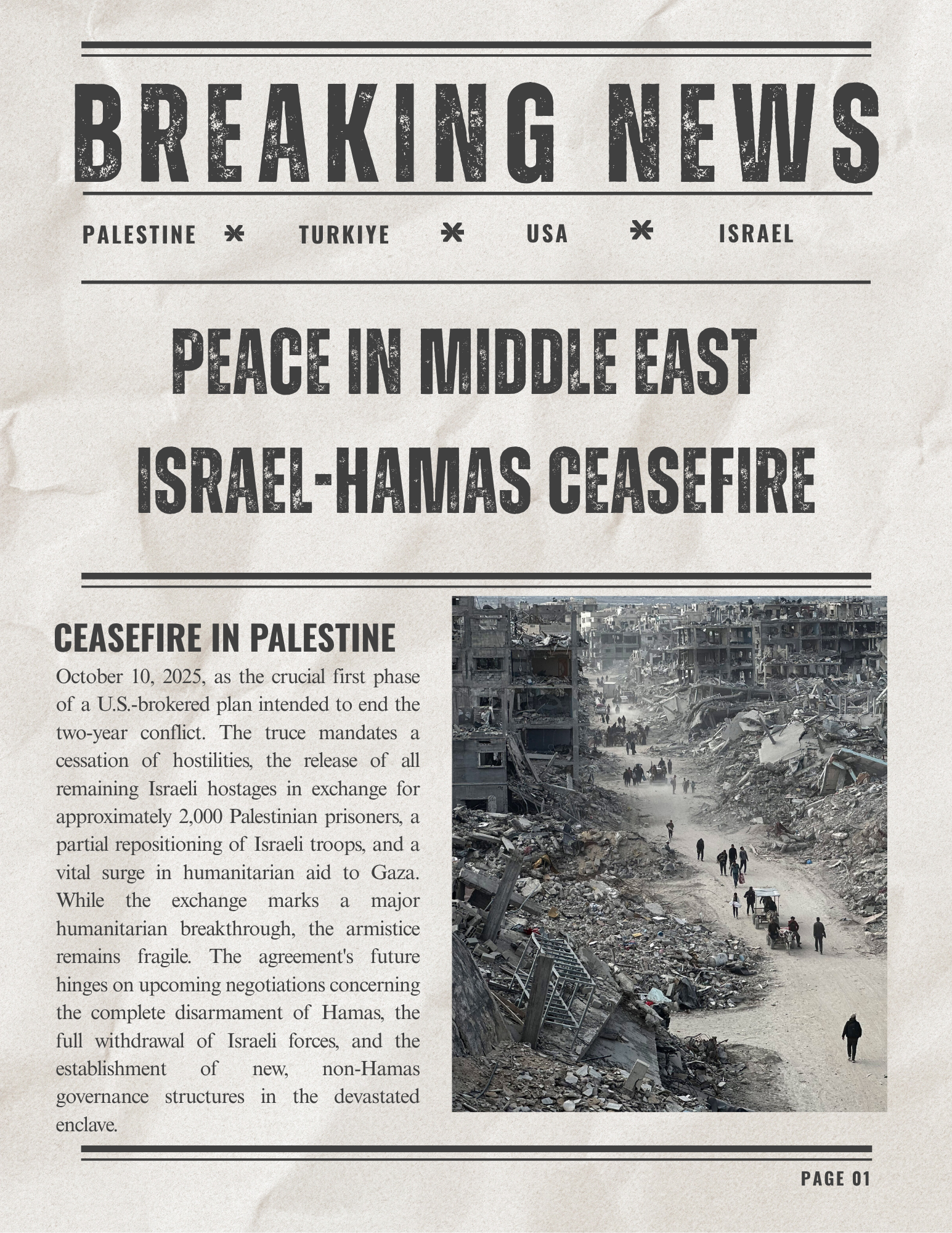 Awaited Peace in the Middle East
October 10, 2025, as the crucial first phase of the U.S.-brokered plan intended to end the two-year conflict. The truce mandates a cessation of hostilities, the release of all remaining Israeli hostages in exchange for approximately 2,000 Palestinian prisoners, a partial repositioning of Israeli troops, and a vital surge in humanitarian aid to Gaza. While the exchange marks a major humanitarian breakthrough, the armistice remains fragile. The agreement’s future hinges on upcoming negotiations concerning the complete disarmament of Hamas, the full withdrawal of Israeli forces, and the establishment of new, non-Hamas governance structures in the devastated enclave.
The successful implementation of this armistice, particularly the establishment of a post-Hamas administration, presents a security vacuum that Washington is keen to fill without deploying its own forces. This is precisely the scenario where the United States’ reliance on regional actors becomes most pronounced. Ankara, with its growing track record of military deployments and its unique geopolitical positioning, emerges as a primary candidate for a leading role in any potential multinational stabilization force. However, leveraging Turkish power is a double-edged sword, a reality that complicates the path to a sustainable peace and introduces a new set of strategic variables.
Türkiye: The Tail That Wags the Eagle
The United States’ postures in the Middle East are increasingly channeled through a set of regional surrogates whose autonomy and ambitions complicate – rather than simplify – Washington’s strategic calculus. In this account Ankara occupies a central, paradoxical role: officially a NATO ally and partner in burden-sharing, Türkiye simultaneously advances an independent projection of hard power that the United States finds useful for certain objectives (de-risking presence, managing local proxies, and securing energy and trade corridors) even as Ankara pursues geostrategic aims of its own.
This instrumental relationship is reflected in high-profile political rhetoric and practice: former U.S. President Donald Trump publicly lauded Türkiye’s “very strong, powerful army” signaling both recognition of Ankara’s military weight and a willingness to countenance Turkish leadership in contested theatres.
Parallel to Türkiye’s prominence, Pakistan, the only Muslim-majority state that possesses nuclear weapons, has re-emerged as a strategic partner for Gulf security, formalizing a Strategic Mutual Defense Agreement with Saudi Arabia that treats aggression against one as aggression against both. That pact marks a notable shift in regional security architectures and a hedge by Gulf capitals against perceived erosion of traditional U.S. guarantees.
Israel’s strike on Hamas leaders in Qatar shatters Gulf’s faith in US protection
Taken together, these developments suggest a region in which Washington is attempting to outsource influence to capable regional actors (Türkiye, Pakistan, Gulf partners), but where outsourcing carries risks: alliance drift, local revisionism, and the creation of new multilateral security constellations that may constrain U.S. freedom of action. Policy implications include the need for clearer burden-sharing frameworks, robust diplomatic channels to reconcile allied agendas, and a sober assessment of how rhetoric (e.g., praising local militaries) translates into operational leverage. Further empirical work should trace the operational links between Washington’s incentives and Ankara/Islamabad’s foreign-policy choices to determine whether U.S. strategy is shaping outcomes or merely reacting to autonomous regional realignments.
The United States is not retreating from the Middle East so much as re-sculpting its footprint: Outsourcing muscle, hedging risk, and lending rhetorical blessing to regional actors that can do on-the-ground work Washington prefers to avoid. That strategy is visible in two complementary trends:An elevated American tolerance (and sometimes encouragement) for Ankara’s muscular regional role, and a new willingness among Gulf capitals to build reciprocal security ties with external partners such as Pakistan. Together, these moves reveal a transactional U.S. posture that prizes short-term leverage while risking long-term loss of control.
From Libya to Syria to the eastern Mediterranean, Ankara has demonstrated a capacity and appetite for independent military action that complicates simple characterizations of it as a U.S. client. American leaders – including high-profile praise for Türkiye’s armed forces – have repeatedly signaled that they regard Ankara as a heavyweight regional actor whose capacities Washington can both harness and tolerate. Such public commendation matters: It lowers the political cost of Turkish adventurism for Ankara and signals to regional rivals that the United States may prefer to rely on a capable local actor over costly American deployments.
That calculus is alluring: Türkiye brings geography, logistics, and an expeditionary mindset that the United States sometimes lacks or dislikes using. But outsourcing influence in this way is a double-edged sword. Türkiye’s interests often diverge from America’s especially over the Kurds, over influence in the Levant, over energy corridors in the Eastern Mediterranean and Ankara’s assertiveness can inflame rivalries Washington depends on being contained. Put bluntly: using Türkiye as a proxy can solve an immediate problem while creating a second-order strategic headache that leaves the United States with fewer levers to shape outcomes.
The second trend deepens this uncertainty. In September 2025, Riyadh and Islamabad formalized a Strategic Mutual Defense Agreement that commits each to treat aggression against the other as aggression against both. The pact signed between Saudi Arabia and the only nuclear-armed, Muslim-majority state is not merely symbolic. It institutionalizes a form of extended deterrence outside U.S. control and signals Gulf impatience with relying exclusively on American guarantees. For Washington, a region in which allies can bind themselves to third-party security umbrellas complicates crisis management and dilutes traditional American primacy.
U.S. Policymakers and Rhetoric
Why should this worry U.S. policymakers? First, these arrangements reduce Washington’s monopoly on escalation control. When a crisis involves partners with independent commitments to one another, American diplomats may find themselves negotiating around pacts they did not craft and cannot easily unravel. Second, outsourcing to capable but autonomous actors incentivizes hedging and opportunism: if Ankara or Islamabad perceive a gap between U.S. rhetoric and willingness to act, they will act to secure perceived vital interests rather than defer to Washington’s preferences.
Finally, the reputational effect matters. Public praise from American leaders for powerful regional militaries can be read by those militaries as permission to assert themselves, not merely as flattery. An example of this is: Türkiye.
Palestine: The Next Step in Türkiye’s Extraterritorial Expansion
According to recent ceasefire negotiations, Pakistan and Türkiye are reportedly being considered for patrol duties within a proposed peacekeeping framework in post-conflict Palestine. Should this arrangement materialize, it would mark another significant expansion of Türkiye’s extraterritorial military presence which is already extending from Libya and Northern Cyprus to Azerbaijan, Syria, Iraq, Qatar, Ukraine (via the Turkish drone production facility), Somalia, Sudan, and parts of the Balkans.
The inclusion of Palestine would consolidate Türkiye’s influence across a broad strategic arc stretching from the eastern Mediterranean to the Horn of Africa. This geopolitical reach not only projects Ankara as a central security actor in the Muslim world but also reinforces its role as a balancing force within the NATO-Russia power equation.
Economically, Türkiye’s involvement aligns with its persistent quest for energy autonomy. Its ongoing exploration of hydrocarbon-rich seabeds in the Mediterranean and Black Seas, coupled with deepening cooperation with Moscow in nuclear development is a pragmatic and opportunistic pursuit of strategic leverage.
While the peacekeeping mission is presented as a stabilizing initiative, it simultaneously signals Ankara’s intent to solidify geopolitical footholds under the banner of humanitarian engagement. The emerging question is whether this new military footprint in Palestine reflects genuine peace diplomacy or another chapter in Türkiye’s broader bid for regional preeminence amid shifting global alignments.
Troubled Waters: Ankara’s Assertive Quest
The recent Israel–Hamas ceasefire has not only recalibrated the political landscape of the Middle East but also reignited strategic competition over the Eastern Mediterranean’s untapped energy reserves. Since the discovery of major natural gas fields such as Egypt’s Zohr (2015) and Israel’s Tamar and Leviathan (2009–2013), the region has emerged as one of the world’s most geopolitically charged energy frontiers. Despite these discoveries, the basin remains largely underexplored, sustaining the perception of vast, unclaimed potential beneath contested waters.
For Ankara, this renewed focus on Mediterranean energy stresses the importance of both opportunity and frustration. Türkiye’s exclusion from regional energy initiatives particularly those linking Israel, Egypt, Greece, and Cyprus has long fueled its determination to project power through maritime strategy and diplomatic assertiveness. The latest controversy involving QatarEnergy’s hydrocarbon exploration agreement off the coast of Cyprus which Ankara denounced as “unlawful” has added a layer of tension even among supposed allies. Turkish officials’ muted responses and the government’s efforts to manage public sentiment suggest a deliberate attempt to defuse a sensitive rift with Doha while preserving strategic cooperation on other fronts.
3 Qatari Officials Die in Car Crash in Egypt Before Gaza Summit
Turkish President Recep Tayyip Erdogan signed the document on Gaza ceasefire deal at the Sharm El-Sheikh Peace Summit in Sharm El-Sheikh, Egypt on October 13, 2025.
Within this shifting order, Türkiye’s engagement in the post-ceasefire peacekeeping framework in Palestine carries symbolic weight. It enables Ankara to reassert its regional relevance not only as a security actor but also as an energy stakeholder indirectly affected by the realignment of regional blocs. By extending its influence from Libya to the Levant, Türkiye seeks to translate its geopolitical reach into economic leverage, a strategy that blends pragmatic energy diplomacy with revisionist undertones.
Ultimately, the convergence of peacekeeping ambitions and energy disputes reveals a broader reality: the Eastern Mediterranean has become less a question of resource extraction than of political positioning. Türkiye’s maneuvers, from Palestine to Cyprus, illustrate a state navigating between alliance fatigue and strategic autonomy, striving to secure its share of influence in an increasingly multipolar Middle East.
If there is an uncomfortable lesson here, it is that control is not the same as convenience. Outsourcing strategy to regional powers can buy time and reduce American costs but it also cedes agenda-setting power, diffuses escalation management, and creates new diplomatic entanglements. For U.S. policymakers who care about stable influence in the Middle East, the task now is neither to reject regional partners nor to praise them uncritically, but to build frameworks that make local capacity compatible with collective restraint. That will be harder, slower, and messier than the headline-grabbing formula of “lean on allies,” but it is the only path that preserves American interests without inadvertently empowering new coalitions whose calculations Washington cannot easily control.
Stabilizer or Stakeholder?
Beneath Ankara’s peacekeeping role lies an ambition far more complex than humanitarian stewardship. Each new deployment from Tripoli to Baku, from Mosul to Mogadishu threads together a lattice of influence that blurs the line between stabilizer and stakeholder. The proposed Turkish patrols in post-conflict Palestine, framed as a contribution to peace, may in practice extend a doctrine of strategic entrenchment: securing corridors, surveillance rights, and political capital under the banner of multilateral legitimacy. For Ankara, “peace” is increasingly indistinguishable from military outposts and economic incentives. The real question, then, is whether Türkiye seeks “peace” in the Middle East, or a “piece” at a time.
As I always say. Time will show.
Related Topics
Related Posts