
Pro-Zionist Peace Activist, Editor and Commentator
Does ‘NAZA’ Promote Justice or Propaganda?
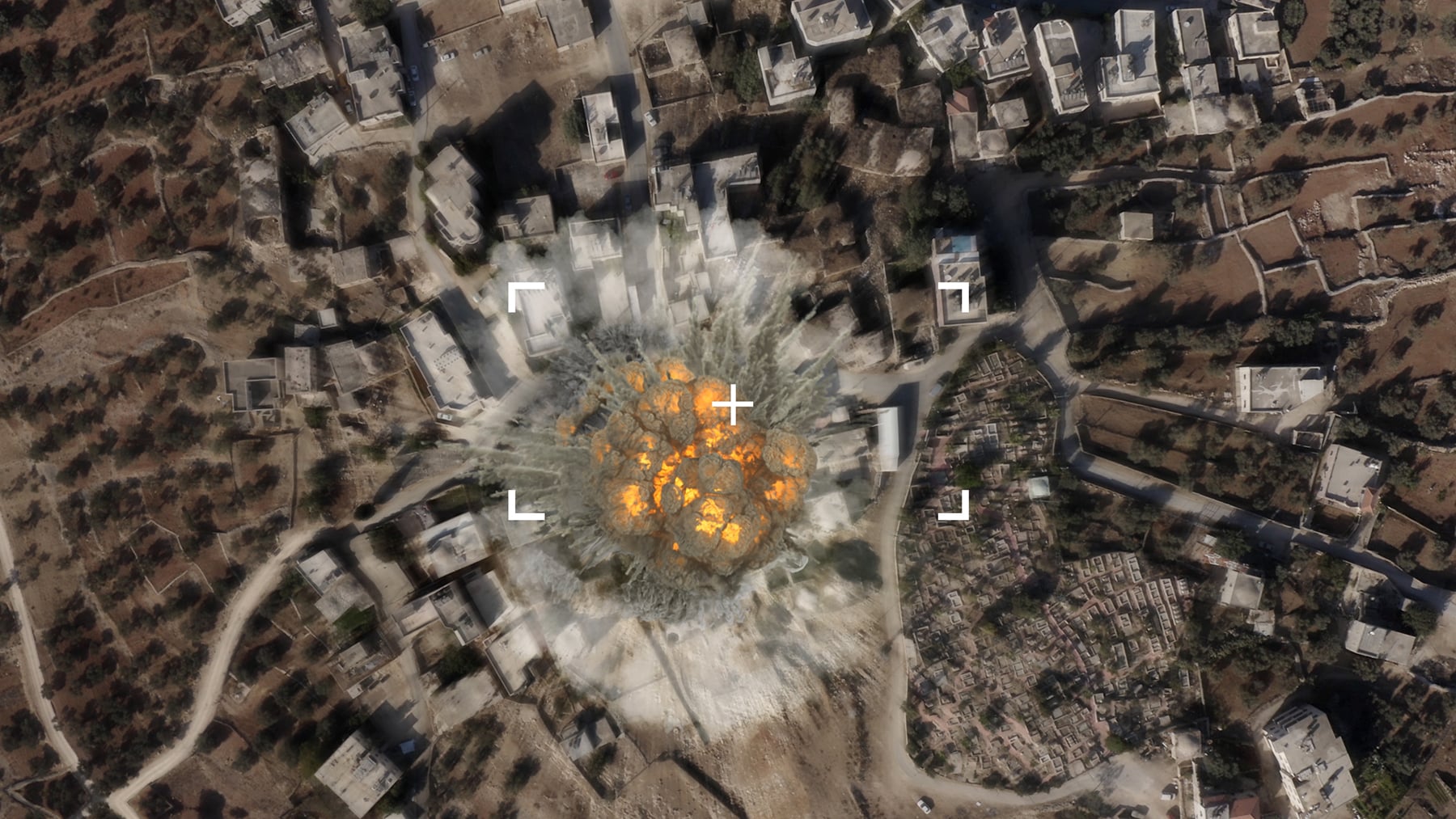
Drone view of air strike
I do not doubt that the high-tech killing methods applied by soldiers at their computer terminals are truthfully depicted. This and other testimony provided by IDF veterans interviewed anonymously (in shadow and in the dark of night) is hard to take emotionally, but it’s not the entire story of this war.
The filmmakers do not deny the events of October 7th, but pay little attention to them, except as a boomerang deployed against Israel, with video clips of Netanyahu condemning Hamas (which he had previously attempted to sustain with Qatari money, as a counterweight to the PLO) and of Pres. Herzog’s ill-advised pronouncement that there are “no innocents” in Gaza.
The filmmakers frame the material to go beyond the alleged war crimes being depicted. They indict all of Israeli society with scenes scanning Israelis going about their everyday lives in the streets of Tel Aviv, and even spying into the windows of nearby high-rise apartments as the guilt-ridden soldiers speak of atrocities.
Why otherwise include historic scenes of the founding of Tel Aviv, and pointedly indicate that part of the current city used to be an Arab village destroyed in the 1948 war? There’s no mention that Tel Aviv was founded in 1909 because Jews living in the adjoining Arab city of Jaffa felt unsafe there.
‘War Crimes’
They center their war crimes accusation on how Israel monitors all phone use in Gaza, overhearing conversations that disclose when “Daddy’s Home,” as an onscreen title puts it. A strategic decision was made to kill Hamas operatives at home, despite knowing that this would also kill their families and other nearby non-combatants, because this would efficiently eliminate Hamas fighters and officials.
The “NAZA” number, the estimate of collateral deaths anticipated in a strike, ranged from 13 for low-level Hamas members to 20 to 100s or even 500 mentioned in one unspecified instance, for higher priority targets.
What is especially hard to take is the confession of an infantryman who participated in the systematic shooting of hungry Gazans who strayed (even slightly) from rigidly prescribed pathways as they rushed toward food distribution centers.
The soldiers also spoke (sometimes emotionally) of the blood lust they felt. And some spoke of how sickened they felt when they realized they were killing whole families, including young children.
Criticisms and Counterarguments
Lt. Col. (Res.) Sarit Zehavi, in a ToI post responding to the film, contends that the NAZA figure is an estimate intended to guide IDF planners into targeting decisions meant to limit civilian casualties. There’s also a detailed critical review by Yair Miron, another lieutenant colonel in the IDF reserves, who served in the unit working to free the hostages held in Gaza; he claims that targeting decisions were vetted, often debated and sometimes canceled or modified. It’s good that there are such well-reasoned responses.
The filmmakers are accused of not attempting to verify the testimony they collected by consulting with higher ranking IDF personnel, or others in the know. Given the charged political atmosphere in Israel in this post-Oct. 7th moment, with a strong tendency to circle the wagons (especially when it comes to fighting Hamas), I’m unsure of how reasonable an expectation this is.
Considering the nature of Hamas (and Hezbollah), there are legitimate counterarguments to be made, but I think that the allegation of “ethnic cleansing” is not easily refuted, considering the devastation we see on the ground with two million surviving Gazans now squeezed into 30% of Gaza’s territory, and without even considering the years of abject misery that Gazans have been subjected to during this war and the purported ceasefire. I bridle at the charge of genocide, however, which the film invokes in a final interview.
Given how broadly the Genocide Convention is worded and applied, that concept seems to have been rendered useless. While Israel’s response to October 7th may fit the bill as it’s now defined, most Jews know that this is nothing like what occurred in the Holocaust, or similar historically immense mass murders like what befell the Armenians under the Ottomans in 1915 or the Tutsis in Rwanda in 1994. To cite just a single event during the Holocaust, for two days in September 1941, nearly 34,000 Jews were systematically shot to death in a Ukrainian ravine known as Babi Yar.
There still is the “Principle of Proportionality,” which Israel may very well have violated, a charge for which “NAZA” has provided supporting evidence in the form of testimony – even if not beyond dispute. I fervently hope that Netanyahu will one day face the consequences of his malfeasance for ignoring numerous warnings of the impending attack on October 7th, for extending the war indefinitely (even beyond the so-called ceasefire), and for pursuing an inhumane strategy of mass destruction that has focused international ire on Israel rather than Hamas.
Related Topics
Related Posts