
Don’t Trust the Headlines: Netanyahu Is Fine Even If He ‘Loses’
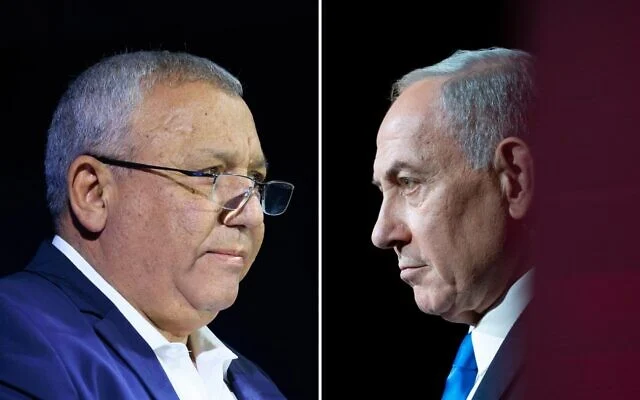
We do not get the real image from the news. Netanyahu is probably ok if Eisenkot’s party comes in first, as he knows Eisenkot almost certainly cannot form a coalition, that he himself probably can’t either, and that Israel will probably head for yet another round of election. As time passes, Eisenkot only dropping in numbers with each cycle, as the surprise “new toy” effect wares down.
Netanyahu, on the whole, has every reason to be content. He doesn’t even need a war before election day, though he still wants one. He doesn’t mind staying prime minister of an endless transition government.
The relevant question is not whether Likud remains at 32 seats. It is whether the voters who have left Likud in the polls have left the right-wing/religious electoral universe. My argument is that most have not.
Here’s the math.
2022 result:
Right bloc – 68:
Likud 32, Shas 11, UTJ 7, Religious Zionism 7, Otzma Yehudit 6, National Right 4, Noam 1
Change bloc – 47:
Yesh Atid 24, National Unity 8, Yisrael Beiteinu 6,· Ra’am 5,· Labor 4
Arab parties: Hadash-Ta’al 5
Current polls (2026)
Right bloc – 52:
Likud 20, UTJ 8, Shas 7, Otzma Yehudit 7, Religious Zionism 6, Amcha Israel 4,
Change bloc – 61: Yashar 23,· Beyachad 13, The Democrats 8, Yisrael Beiteinu 7, Ra’am 6, The Reservists 4
Arab parties: The Joint List 7
- By the current polls, Shas and UTJ supposedly drop from 18 seats in 2022 to 15 in 2026. There is no chance this is true. Where will these voters go? And of course demographically, these parties only grow. So the polls are completely wrong here.
- Likud and the broader national-religious right, Religious Zionism, Otzma Yehudit, Noam, and their adjacent voters function as one electoral ecosystem. Together, that camp held roughly 50 seats after the 2022 election; the polls now put them at 37, a loss of 13.
That isn’t credible either. These voters at best move in their own camp to Ben-Gvir or similar. And here too, demography favors the national-religious camp, not the reverse.
As Avi Maoz, the hardline MK for the Noam party put it in one Knesset debate: he has enough grandchildren to field ten basketball teams. That’s the whole story of Israel in the present and the future.
Voters don’t actually migrate between blocs. That’s a myth. The whole game is turnout. If both camps turn out at roughly the same rate, the results come out roughly the same.
That’s why Netanyahu is working to block any airlift of Israeli voters from abroad. But in my estimate, even if thousands fly in, assuming the election is held on schedule, it wouldn’t add up to half a seat at best. It’s negligible.
So the likeliest result is that Eisenkot’s party finishes first, with something like 22–23 seats, provided his campaign avoids any serious blunders. But it wins those seats largely by cannibalizing its own side, Beyachad/Yesh Atid, the Democrats, Yisrael Beiteinu, and perhaps a handful of Jewish voters drawn to a revamped Ra’am under Segalovich (the one genuinely encouraging development of this campaign).
Eisenkot’s party, like most of the “change bloc”, has a deeper problem: recruiting candidates without vetting them properly. These skeletons will come back to haunt him, possibly during the campaign, and if not then, once the Knesset convenes.
So the optimism about a weakened Netanyahu and a weakened Likud is understandable, but the votes they lose won’t leave the bloc. They’ll simply flow to Ben-Gvir, Smotrich, Shas, and UTJ.
Le’shana Tova to everyone!
Let us hope this coming year will bring less fighting outside of Israel and inside.