
This Way Up: Spiritual Means to Psychological Ends
Drawing Down the Light: How Jewish and Chinese Traditions Cultivate the Heart
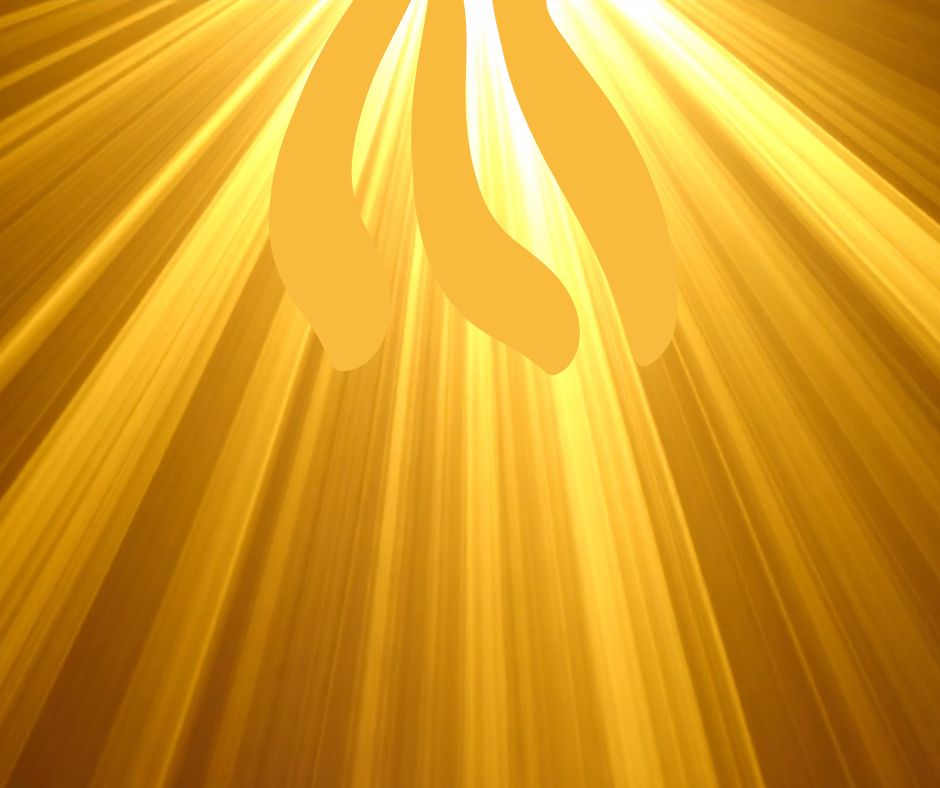
Imagining drawing down the light as drawing down the Hebrew letter Shin
In Jewish thought, one’s inner luminosity takes root if the body is properly “landscaped,” achieved via righteous deeds and a lifestyle of purity. The Tanya teaches that when a person’s actions, speech, and thought align with Torah, “the Holy One dwells within him just as He did in the Holy Temple” (Tanya, Likutei Amarim, Ch. 34). The Sefer HaChinuch likewise explains that the command to build the Mishkan (the Tabernacle) was given so that each individual might prepare themselves as a sanctuary for G-d through good deeds and purity of heart (Mitzvah 95).
When a person lives well, the Shechinah—the feminine essence of Divinity—descends, bringing clarity, peace, and blessing. As the Midrash teaches, “When Israel does the will of the Holy One, blessed be He, the Shechinah rests among them” (Shemot Rabbah 33:1). In this view, the body is a temple; when properly appointed, Divinity will assume its proper place within, perfuming life with benefits that span the physical, mental, and spiritual.
Chinese philosophy carries a remarkably similar concept. Here, the higher self—the Shen—is envisioned as a radiant spirit that descends to bring clarity, good fortune, and a pull toward one’s true destiny. Like the Shechinah, the Shen is only drawn down and anchored through virtue, righteous conduct, and living in harmony with the the balanced expression of Yin and Yang.
Both cultures recognize a challenge: the heart is easily overwhelmed by emotions. These turbulent emotions can displace the Divine presence, unsettling the innermost being. In Jewish language, this echoes King Solomon’s teaching: “Above all that you guard, guard your heart, for from it flow the wellsprings of life” (Proverbs 4:23). The heart, as King David prayed, must be continually renewed: “Create in me a pure heart, O G-d, and renew a steadfast spirit within me” (Psalms 51:12).
The Chinese tradition offers structured protocols to clear such obstructions. Claude Larre and Elizabeth Rochat de la Vallée describe this practice:
“The art of the heart is to empty the heart every day. It is to reduce what does not appear to be the natural expression of our lives, to diminish the materialistic and psychological needs; to take inspiration from the natural order, experienced in the four seasons, and also in the wisdom of past generations, as experienced, for example, within the ancient rites and rituals. It is to act in such a way that the inner disposition becomes more and more aligned with the natural order—the thought, as well as the behavior and actions. When the heart is able to take in all that is presented in openness, knowledge is able to become wisdom, the kind of wisdom that is nothing other than to know how to nourish life.”
Chinese traditions provide meditative methods for this daily clearing.
In Judaism, a parallel can be found in the bedtime prayer to be recited nightly:
“Master of the universe, I hereby forgive anyone who angered or antagonized me, or who sinned against me—whether against my body, my property, my honor, or anything of mine; whether they did so accidentally, willfully, carelessly, or purposely; whether through speech, deed, thought, or notion. May no one be punished because of me. May it be Your will that I sin no more. Whatever sins I have done before You, may You blot out in Your abundant mercies—but not through suffering or bad illnesses. May the expressions of my mouth and the thoughts of my heart find favor before You, my Rock and my Redeemer.
This practice reflects the Talmudic ideal of going to sleep without harboring grudges, as taught in Megillah 28a, where the sage Mar Zutra would forgive all who wronged him before retiring each night. Both traditions teach that clearing the heart of resentment, anxiety, and excess desire is not only a moral discipline but also a path to health and wholeness. It creates the inner space for divine light to dwell and guide.
In this way, the Jewish Shechinah and the Chinese Shen both represent a vision of the highest self—one that can only be invited into a life that is morally attuned, emotionally clear, and harmonized with the larger rhythms of creation.
The conversation between these two traditions offers profound guidance for modern seekers who wish to understand the complexities of human nature and learn how to draw the highest essence into each moment. In times characterized by turbulence and uncertainty, we can use ancient strategies to guide us. Two wisdom oriented peoples can be our guides.
Related Topics
Related Posts