Driving to the synagogue I don’t pray in
For most Israelis, Yom Kippur is not confined to the walls of a synagogue. It is the stillness of the streets, the hush that falls over an entire country, the sudden appearance of children on bicycles where cars usually race by. Even for those who don’t pray, Yom Kippur in Israel is a collective experience, something you breathe simply by living there.
But for Israelis living in the Diaspora, Yom Kippur can feel disorienting. The silence is gone, the roads are busy, and the atmosphere that defined the day back home simply doesn’t exist. Some try to recreate the experience: avoid driving, seeking a synagogue within walking distance. Others venture into local services, only to discover that the melodies, the pace, even the social codes of the prayer are foreign. I know many Israelis who, unable to bridge the gap, spend Yom Kippur at home — feeling the weight of the day but also a sense of isolation.
I know, because that was me. For my first years in the United States, I refused to drive on Yom Kippur. Instead, I stayed home, reading and reflecting alone. The day remained meaningful, but it lacked the sense of community that had always defined it for me in Israel.
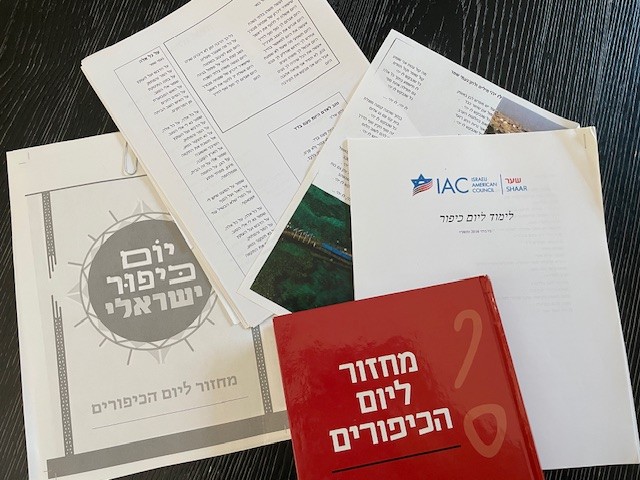
Eventually, I made a different choice. I decided it was better to drive and join others — even if imperfectly — than to be alone. In recent years, I’ve found myself at a Chabad synagogue. I bring my own Israeli siddur, slip Israeli poems into the day, and even whisper familiar songs under my breath while the congregation around me sings melodies I don’t know. In truth, I don’t fully participate in the service. But I sit there, surrounded by community, creating my own Yom Kippur within theirs.
This is, perhaps, the unexpected gift of Yom Kippur in the Diaspora. Unlike in Israel, where the day arrives almost effortlessly through the atmosphere itself, here you must build it for yourself. It takes creativity, courage, and sometimes compromise. It requires letting go of the expectation that Yom Kippur will feel exactly as it did “back home,” and embracing instead the possibility of shaping something new — rooted in memory but adapted to reality.
Driving to a synagogue I don’t quite pray in is not what I imagined for myself when I left Israel. But it has taught me something important: Jewish life outside Israel is not weaker or less authentic, just different. It asks us to take ownership, to craft meaning deliberately rather than absorbing it passively from our surroundings.
In Israel, Yom Kippur belongs to everyone. Abroad, it becomes a choice. And in that choice — lonely at first, but richer over time — I’ve discovered a Yom Kippur that is deeply personal, stitched together from fragments of Israel and threads of America, carried forward not as it was, but as it can be.