Practical Spirituality - Slow and Steady
Earning the Land: The Daughters of Tzlafchad and the Original ‘Sorting Hat’
An Essay for Parshat Pinchas and Menachem Av
As we approach the month of Menachem Av, the time when our Father in Heaven calls upon us to remember the millennia of suffering our People have endured, I ask you not to think about the past 2,000 years. Just think about the past two.
How much death? How much loss? How much sorrow packed into these last twenty-some months alone?
And just like Moshe Rabbeinu himself—when he saw, in a prophetic vision, the brutal death of Rabbi Akiva—we do not understand. Because we are human. And as long as we are alive, we cannot understand.
There is no understanding the Holocaust. Ever. There is no understanding why bad things happen. There is no making sense of October 7th. And there is certainly no single person to blame. To accuse one another—right, left, religious, secular—is worse than naïve. It is destructive. It is sinat chinam. It is the one thing our sages tell us actually causes the very violence we fear.
Not antisemitism. But Jewish division.
Not our enemies, but our own lack of national pride. Our failure to see ourselves as one People despite our differences. That—in my eyes—has always been the real danger. Not even secularism or assimilation. I’m not afraid of those. I believe in the power of the Torah itself, and its eternal promise: that it will never be forgotten. And the Torah also promises the Jews will never be destroyed, as a Nation.
But here’s what the Torah doesn’t promise: that we won’t try to destroy ourselves.
Pablo Christiani, the man who tried to turn all Europe against the Ramban? A Jew.
Karl Marx, the denier of God, father of communism and its rivers of blood? Another Jew.
And who has shaped the media world that warps our children’s minds and self-worth? More often than not, our own.
I understand antisemitism. It’s not just jealousy. If I weren’t Jewish—if I didn’t know Torah—I might resent the Jews too. Pushy. Arrogant. Wealthy. Overrepresented. The original “Karens.” You know the caricature.
Sure, we have Nobel Prizes and Rabbi Heschel marching with Dr. King. But we also have Hollywood. We have TikTok. We have disillusioned billionaires and power-hungry cynics. If I were some average Aussie bloke, maybe I’d hate those bearded weirdos too.
And still… we are the ones who suffer. Dumbfounded, we ask: What did we ever do to them?
But maybe that’s not the question. Maybe the question is: What will we now do for each other?
Torah, Suffering, and Inheritance
Suffering is a huge issue for people. Why do good people suffer? Why does anyone? Even Moshe asked, and God gave him the only answer we ever get: You cannot understand while still alive.
But the Torah offers us something deeper. In Hebrew, a trial is called a nisayon—a test—which shares a root with the word nes, meaning a banner or miracle. Because when you rise from suffering, you don’t just survive it—you become elevated by it.
That’s why the Talmud says two things are only acquired through suffering:
Torah and Eretz Yisrael.
Torah by Fire
I once learned with a chavruta named Gershon. He studied 12 hours a day, then stayed to memorize entire tractates by heart. He rarely slept in a bed, only on Shabbat. He once turned down a well-paying rabbinic job abroad—because it would mean less time for Torah. He lived like a Levi. And he inspired me more than any pulpit rabbi ever could. He sacrificed money, and he pushed his body to the limits, and that’s how the young man I knew decades ago is today a bona-fide Torah Scholar.
Israel by Embarrassment
Aliyah is not romantic. It’s humiliating. I still remember asking where to catch the sheirut (shared taxi) at Ben Gurion Airport. In my flawed Hebrew, I asked where to find the sheirutim. Everyone pointed me to the toilets.
I once tried to buy dried apricots and asked, “How much for the mishmash?” The vendor burst out laughing. “Mishmash? You mean mishmesh!” he said. “You’re mishmash, all right!”
Hebrew is hard. Israel is hard. But that’s the point. Nothing beautiful comes easy. Not Torah. Not Israel. Not a Jewish soul.
Parshat Pinchas and the Inheritance of the Land
This week’s Torah portion, Pinchas, opens with a jarring act of zealotry—but tucked beneath the sword and fire is one of the most quietly revolutionary moments in the entire Torah: the daughters of Tzlafchad stand before Moshe and demand their inheritance.
Before their case, the Torah lays out how the Land of Israel is to be divided. A census is taken—but only of men aged 20–60. The IDF, in essence. The tribe of Levi is not included, because their inheritance is not land but service. They are to live across 48 cities—including the six cities of refuge—and serve as Israel’s spiritual heart.
Moshe and Elazar, both Leviim, are the perfect agents to oversee the division. They have no stake in the outcome. No tribal bias.
And the method? Goral—a sacred lottery. Think Sorting Hat, but real. Each tribal leader draws slips from a box—one with their tribe’s name, one with a region. Miraculously, each leader draws his own portion. Then a Divine Voice confirms it. This wasn’t luck. It was prophecy.
The Daughters of Tzlafchad: Holy Chutzpah
Suddenly, five sisters appear. Their father, Tzlafchad, has died with no sons. They ask: Why should our father’s name be lost? Why should his memory vanish from the land?
Moshe doesn’t answer. He brings their case to God.
And then… the Torah pauses. A literal space in the scroll—called a petucha—signals that something holy is about to happen.
And God responds: Yes.
Yes, they inherit. Yes, they are counted. Yes, they matter.
But why didn’t God reveal this law earlier?
Because Torah responds to love. These women cherished the land. Rashi says that’s why their words were recorded for eternity. Their father may have died with the ma’apilim, who charged into the land in defiance of God’s decree. Even in error, he died trying to reach Eretz Yisrael.
I often think that the original Zionist pioneers, the atheist Jews that forced a generation of Yemenites to lose their heritage… they are like the ma’apilim – marching into Israel without the Almighty thank-you-very-much and come hell or high water!
That same group I applaud for their love of the land and their decades of toil and sacrifice to make “the desert bloom” for the rest of us. Tzlafchad seems to have had this Zionist love for Israel. He willed it, but God – for him at least, did not. However, as Tzlafchad’s daughters inherited his love for Zion, they also inherited Zion tangibly – with real estate holdings in the Land.
Each of the daughters is called by name in the Torah. This should be as significant to us as any time the Torah singles people out – or in Biblical terms “nikvu b’shamot” designated by name… which signifies importance and communal standing.
According to the Midrash, each had her own strength—cleverness, speed, precision, strategy, and
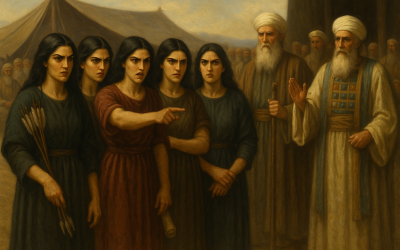
(in my imagination) one who made bows and arrows. They came as one, and they earned Torah through courage.
Rambam, Soldiers, and Sandwiches
Someone might object: “Nice story, but they didn’t fight. They didn’t storm cities. Why should they get land?”
But Maimonides, in Hilchot Melachim, rules that those who support the war effort from behind—those who sew boots, cook meals, treat the wounded—receive equal reward. It’s not about holding a sword. It’s about holding the nation together.
And So, Today…
Everyone in Israel today has skin in the game. Every family has someone they worry about. But the inheritance—the spiritual reward of the land—is not given to those who worry. It is given to those who love.
The daughters of Tzlafchad stood with what the Sages call azut d’kedusha—holy brazenness. Just like Rabbi Meir Kahane z”l. They didn’t ask for privilege. They demanded memory. They claimed their place. And they were given a chapter in Torah.
So stand.
Make sandwiches. Drive jeeps. Sew boots. Say Tehillim. Build dreams. Learn Torah. Teach children. Speak truth.
Because if you love the land, and you act on that love—your name, too, will not be forgotten.
Related Topics
Related Posts