
Eastern Christian Anger Isn’t a Verdict on Israel
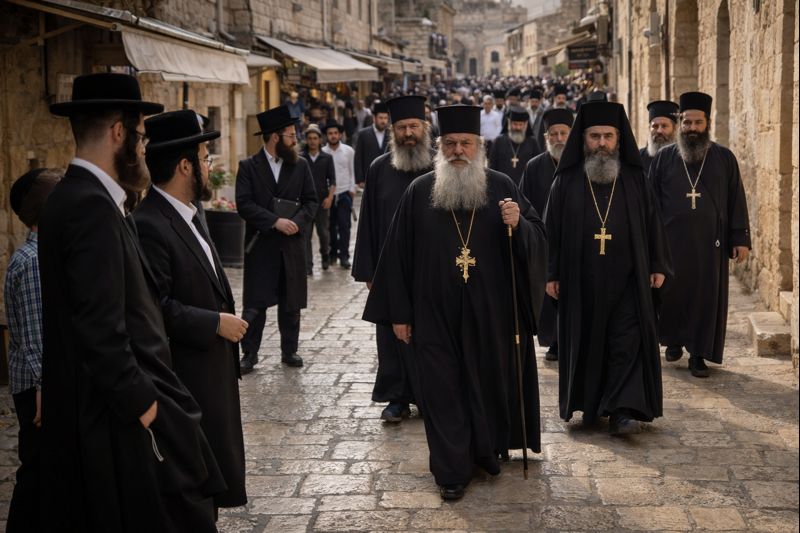
In recent days, senior Eastern Christian leaders in Israel and Jerusalem released a public statement sharply criticizing Christian Zionism. The language was forceful, and the reaction beyond the region was swift. Among Western Christians who support Israel on moral, historical, or theological grounds, the statement was widely read as a sweeping judgment — not only on Christian Zionism, but on Israel itself and the legitimacy of Jewish sovereignty.
That reading, however, misunderstands what such statements represent.
Eastern Christian critiques of Christian Zionism are not best understood as theological verdicts or moral condemnations of Israel. They are responses shaped by history, geopolitics, and proximity — by what it means to exist as a small, exposed minority in one of the most politically charged places on earth.
Eastern Christian churches in Jerusalem — Armenian, Greek Orthodox, Syriac, and others — are minority institutions operating in an environment where public positioning carries real consequences. Their leadership has long been shaped not by abstract ideological debates, but by survival under dominant political forces. As a result, their public language often reflects caution and risk management rather than doctrinal precision.
That caution, however, is frequently misread when detached from Jewish historical memory. Any serious discussion of Jewish–Christian relations must begin with an unvarnished truth: Christianity has historically been one of the greatest sources of destruction for Jewish communities. From the Crusades, which annihilated Jewish populations across Europe in the name of the cross, to the Inquisitions, which criminalized Jewish life and enforced conversion through terror, Christianity was not a neutral neighbor to Judaism. Blood libels fueled mob violence, forced conversions shattered families and erased communal continuity, and pogroms followed in the wake of Christian societies long before modern racial antisemitism emerged (historical overview: https://en.wikipedia.org/wiki/History_of_antisemitism#Christian_antisemitism).
This history is not incidental. It defines why Jewish resistance to Christian proselytization exists at all.
For Jews, evangelism is not an abstract expression of faith. It is inseparable from centuries in which conversion was demanded under threat of death or exile. That legacy remains visible in modern missionary movements that deliberately blur religious boundaries. Groups associated with Messianic Judaism and organizations such as Jews for Jesus have for decades encouraged evangelizing Jews by adopting Jewish religious dress, Hebrew prayer, and communal norms in order to present Christian theology as a form of Judaism rather than a departure from it (background: https://en.wikipedia.org/wiki/Jews_for_Jesus; https://en.wikipedia.org/wiki/Messianic_Judaism). These practices have been widely criticized by Jewish organizations and scholars as deceptive, particularly in Israel (overview: https://www.jewishvirtuallibrary.org/missionary-activity-in-israel).
In Israel, this sensitivity is magnified. Jewish sovereignty exists precisely because Jewish life proved repeatedly unsafe under both Christian and Muslim rule. The Jewish state was not founded as a platform for interfaith experimentation, but as a refuge for continuity after catastrophe. It is therefore unsurprising that missionary efforts aimed at Jews are widely rejected, and that Israeli law restricts proselytization involving material inducement or the targeting of minors — a framework regularly noted in international religious freedom reporting (U.S. State Department: https://www.state.gov/reports/2023-report-on-international-religious-freedom/israel-west-bank-and-gaza).
None of this excuses harassment of Christians in Jerusalem, which is real and unacceptable. Incidents of spitting, verbal abuse, and vandalism directed at Christian clergy and pilgrims — often attributed to a small subset of ultra-Orthodox individuals — have been documented and deserve condemnation and remediation (State Department reporting: https://www.state.gov/reports/2023-report-on-international-religious-freedom/israel-west-bank-and-gaza). Acknowledging Christian vulnerability today, however, does not require erasing Christian responsibility in the past. Both truths can coexist.
What is often missing from discussions sparked by the recent Eastern Christian statement is the demographic reality. Whatever tensions exist within Israel, Christian communities under Israeli sovereignty have not disappeared. According to Israel’s Central Bureau of Statistics, on the eve of Christmas 2023 there were approximately 187,900 Christians in Israel — about 1.9 percent of the population — and the community grew year over year (CBS release: https://www.cbs.gov.il/he/mediarelease/DocLib/2023/411/11_23_411e.pdf). Pew Research similarly notes that while the percentage of Christians declined over decades, this occurred alongside massive overall population growth; the Christian population itself has remained stable in absolute numbers and continues to sustain churches, schools, and civic institutions (https://www.pewresearch.org/religion/2016/03/08/israels-religiously-divided-society/).
This stands in stark contrast to Gaza and parts of Judea and Samaria. Palestinian Central Bureau of Statistics census data show a steadily shrinking Christian population in the Palestinian territories, with fewer than 50,000 Christians recorded in the 2017 census and a particularly tiny community remaining in Gaza (PCBS census tables: https://www.pcbs.gov.ps/Downloads/book2364-1.pdf). Bethlehem, once a Christian-majority city, has seen a dramatic proportional decline over recent decades due to emigration, instability, and social pressure (historical overview: https://en.wikipedia.org/wiki/Bethlehem#Christian_population).
This comparison does not prove a single cause. Christians leave places for many reasons, including economic pressure, insecurity, and family networks abroad. But it does complicate the narrative. Christian life has not been extinguished under Jewish sovereignty. In many cases, it has endured.
Why, then, do some Eastern Christian leaders speak so sharply about Zionism?
Part of the answer lies in institutional inheritance. The Armenian Apostolic Church, in particular, spent most of the twentieth century operating under Soviet rule. Armenia was a Soviet republic from 1920 until 1991, and Soviet policy toward Zionism became explicitly hostile after Israel aligned with the West, especially following the 1967 Six-Day War (overview: https://en.wikipedia.org/wiki/Soviet_Union_and_the_Arab%E2%80%93Israeli_conflict). Soviet anti-Zionism, often framed as anti-imperialism, frequently blurred into antisemitic narratives (https://en.wikipedia.org/wiki/Soviet_anti-Zionism). Institutions shaped by such conditions learned caution as a survival reflex, not ideological independence.
Geography reinforces this instinct. Eastern Christian institutions in Jerusalem exist in close proximity to Arab Muslim and Arab Christian populations, and their clergy and property are exposed to regional political pressures in ways Western churches are not. From that vantage point, Christian Zionism is often perceived locally not as solidarity with Jewish survival, but as a Western political force whose consequences are borne by vulnerable minorities on the ground.
Seen clearly, the recent Eastern Christian statement is not a verdict on Israel’s legitimacy, nor a moral judgment on Jewish sovereignty. It is a posture shaped by proximity and vulnerability — just as Jewish resistance to Christian evangelism is shaped by centuries of Christian power wielded against Jewish life.
These reactions are not symmetrical. Jewish suspicion of Christianity is not an abstraction or a misunderstanding to be corrected; it is a record of survival. Eastern Christian caution reflects real anxiety, but it does not carry the same historical weight.
Israel’s existence has not erased Christian life. That fact matters. Christian support for Israel does not require triumphalism, and Jewish sovereignty does not require apology. But neither can history be softened to make present discomfort easier to bear.
In Jerusalem, memory is not theoretical. It walks the streets every day. Any honest conversation prompted by the Eastern Churches’ recent statement must begin by acknowledging who has wielded power — and who has paid its price.