The views expressed herein are solely mine.
Eilat Requires Capability, Not Complacent Defenses
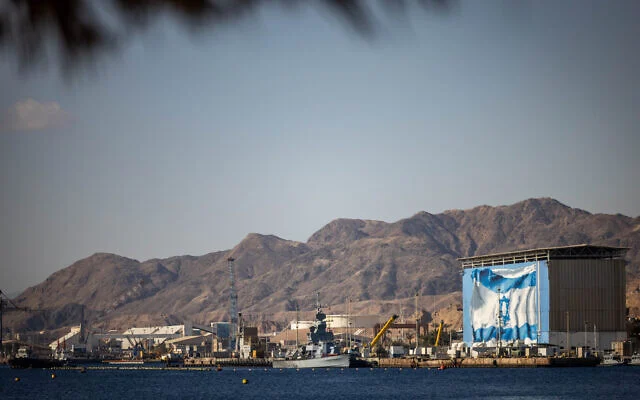
An Israeli Sa'ar 6-class corvette war ship with an Iron Dome missile battery patrols off the shore of Eilat, February 10, 2025. (Chaim Goldberg/Flash90).
Shin Bet Director David Zini has directed his agency to place Eilat’s defense at the top of its priorities. He assesses a risk of a large-scale attack on the southern city originating from Jordanian territory or the sea and potentially involving Houthi elements. The Israel Defense Forces drill scheduled for June 23, 2026, which will simulate missile barrages, maritime infiltrations, and border breaches, directly tests these scenarios.
Eilat is Israel’s only Red Sea port and its primary southern gateway for trade with Asia and the Indian Ocean. This maritime hub handles approximately 50 percent of Israel’s vehicle imports and serves as the main export route for potash and phosphates produced by Israel Chemicals Ltd. Nonetheless, since 2023, Houthi missile and drone operations have reduced annual port revenues from 240 million shekels to near zero, leaving the facility effectively paralyzed. This economic standstill leaves the city dangerously exposed, as a paralyzed port strips away a vital financial pillar for a community of 55,000 residents where tourism accounts for the overwhelming majority of remaining employment.
Eilat’s isolation—more than 300 kilometers from central Israel—creates lengthy reinforcement timelines during any sustained attack. Houthi forces have also launched dozens of missiles and drones at Eilat’s Ramon International Airport and civilian areas, with one striking the airport’s passenger terminal and a hotel and wounding 22 people in a single incident. These attacks demonstrate both persistent intent and the improved long-range reach of Iranian-backed terrorist proxies.
October 7 proved that the absence of a single confirmed operational directive does not eliminate risk when capability, doctrine, and structural exposure converge. Public records show that Hamas conducted large-scale, visible training and border preparations in the preceding years; intelligence assessments failed to translate those indicators into preventive action.
Comparable patterns now surround Eilat: sustained Houthi pressure on Israeli territory and shipping, Iranian-axis coordination across multiple domains, and exploitable gaps created by geography and multi-vector access. To ignore these cumulative indicators is to repeat the exact analytical failure that preceded the southern breach. Hence, Zini’s prioritization reflects classified pattern analysis and post-October 7 adjustments that treat assessed risk from capable enemies as sufficient grounds for elevated preparation.
Israel already possesses scalable, combat-ready defense systems capable of rapid deployment. Chief among them is the Iron Beam—the world’s first operational directed-energy air-defense system. Now entering full service, this high-energy laser offers a fraction of the cost per intercept compared to traditional kinetic systems. To capitalize on this edge, the Ministry of Defense must accelerate the deployment of autonomous drone hives for persistent border security. Expanding this architecture to Eilat’s maritime approaches and the Jordanian border—and fusing it with underwater acoustic sensors and AI-driven battle management—will unlock an unblinking, rapid, and autonomous response network.
Simultaneously, Israel should integrate the Eilat sector’s Iron Beam battery with existing Arrow, David’s Sling, and Iron Dome systems to provide layered, cost-effective counter-swarm defense for the port and urban areas. The Jewish state should also immediately expand the drone-hive program to deliver 24/7 autonomous intelligence, surveillance, reconnaissance, and engagement coverage over Red Sea approaches and the eastern border, creating a forward command node under Southern Command that incorporates Shin Bet hybrid-threat fusion and automated initial-engagement protocols.
Moreover, Jerusalem must complete rail infrastructure upgrades that enable rapid cargo surges from Eilat to Ashdod and Haifa, and formalize contingency shipping and transshipment agreements with United Arab Emirates ports and other Abraham Accords partners to maintain trade continuity during disruption. The Israeli government should also mandate quarterly multi-domain exercises for the Eilat theater with measurable performance standards: detection-to-engagement timelines under 60 seconds and full reinforcement arrival within four hours under simulated conditions of isolation and degraded communications.
Finally, pursuing targeted U.S. co-development funding for autonomous systems and directed energy in exchange for joint operational data, while expanding real-time intelligence sharing on Houthi maritime patterns with the Abraham Accords states, will transform this into a cutting-edge geostrategic policy.
Zini has identified a structural vulnerability and ordered action within his mandate. The responsible course is to align that prioritization with resources, timelines, and measurable capabilities before the scenario shifts from planning assumptions to operational reality.
The cost of preparation is counted in budgets and drills. The cost of repeating prior assessment failures is counted in lives and strategic isolation.
Related Topics
Related Posts