Engineered Mourning: Power, Media, and Geopolitics
A Funeral as Authoritarian Performance
Ali Khamenei’s funeral is not merely an act of mourning. It is an authoritarian performance designed to transform vulnerability into power.
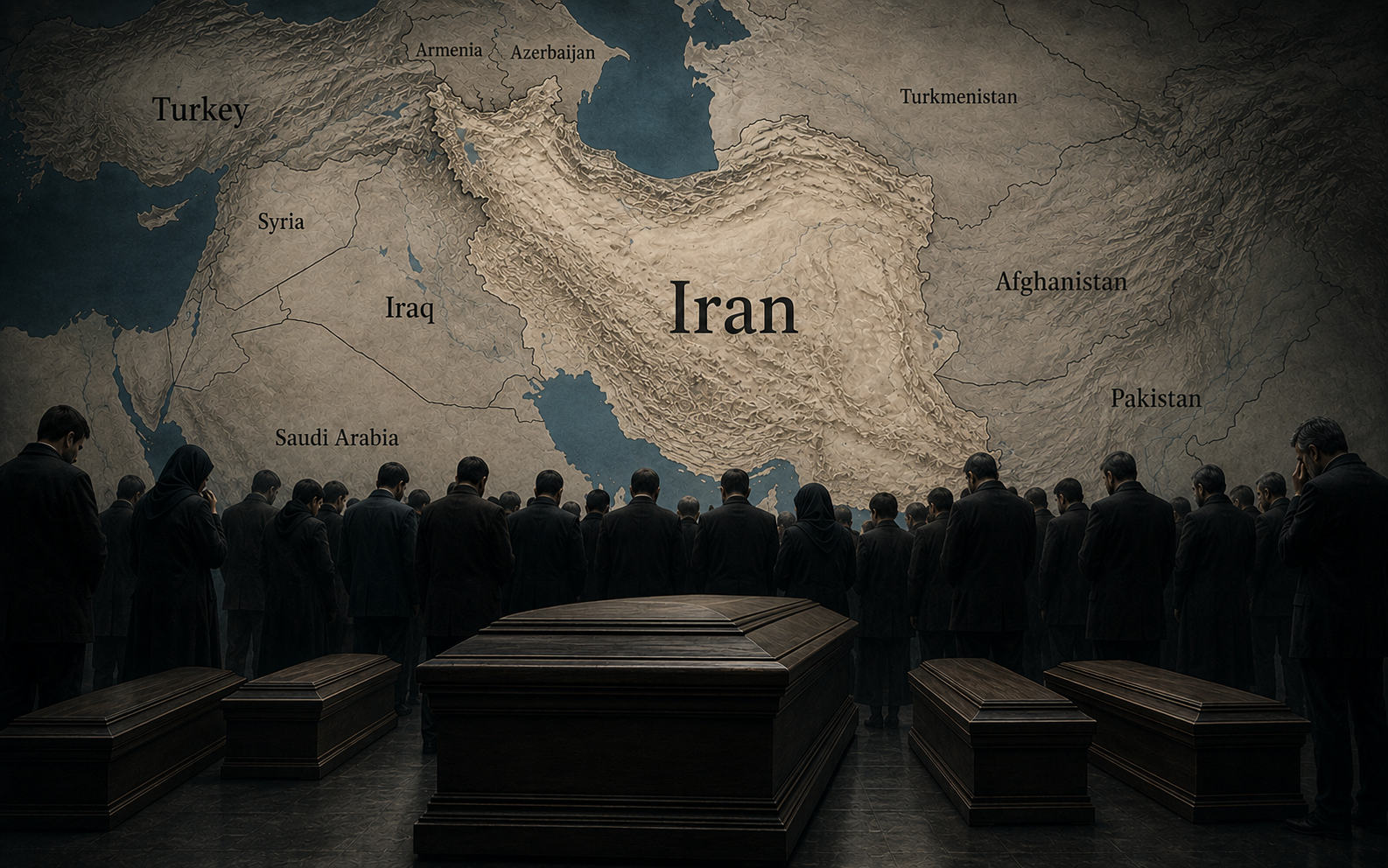
The Islamic Republic has placed its former supreme leader’s body at the center of a managed spectacle of loyalty and continuity. Crowds filed past the coffins of Khamenei and members of his family. Three of his sons appeared beside them, while Mojtaba Khamenei — the presumed heir — remained absent.
Authoritarian funerals are rituals of regime reproduction, meant to show that the leader may die but the system survives, and that grief signifies loyalty. The Islamic Republic is trying to turn strategic shock into a visual claim of political continuity.
The spectacle is not national legitimacy. Those gathered were mainly regime loyalists, mobilized personnel and supporters within its ideological networks. Heavy security, organized attendance and regime-linked supporters from abroad point to an engineered gathering, not spontaneous national mourning.
But symbolism has limits. The system’s central figure was killed. Members of his family died with him. Senior regime figures were removed. The succession remains unsettled.
No public appearance has confirmed Mojtaba Khamenei’s condition or authority. In a system where power must be visible, the absence of the presumed heir is a structural weakness.
The regime’s continued aggression also undermines attempts to portray the funeral as a self-contained moment of national grief. Even as mourning processions were staged, the regime continued threatening commercial shipping in the Strait of Hormuz.
The contrast is revealing. The same state demanding recognition of its grief was endangering civilian navigation through a vital waterway. The funeral and the maritime attacks reflect the same method: martyrdom at home, intimidation abroad and the claim that the regime can still impose costs.
From Factional Politics to Coercive Rule
For decades, reformists and hard-liners were presented as competing currents, creating the illusion of movement within a closed system. Khamenei once called them the two wings of the Islamic Republic. That metaphor has lost its meaning.
Both camps benefited from the same revolutionary order, economic privileges and clerical supremacy. Sovereignty belonged not to the people, but to the ruling structure.
At this stage, the question is who can preserve the regime after leadership decapitation and amid public rejection. The likely outcome is a merger between the regime’s broken political wings and its remaining pillars of coercion and clerical justification.
When a regime loses legitimacy, it becomes more dependent on coercive institutions and control over resources. The clergy supplies the language of martyrdom. The Islamic Revolutionary Guard Corps controls the harder instruments of power: weapons, intelligence, prisons, security networks and economic leverage.
The attacks on commercial shipping show that those instruments remain operational. Leadership losses have not eliminated the regime’s capacity to disrupt trade and endanger civilian crews. The Islamic Republic may be weakened, but it remains dangerous.
Maritime aggression also serves as a negotiating instrument. It creates insecurity, threatens a strategic waterway and turns restraint into something the regime can trade for concessions. This is bargaining through disruption, not conventional diplomacy.
If negotiations with the United States lead to the release of frozen assets or renewed oil and gas sales, the consequences would extend beyond economic recovery. Revenue can finance security forces, surveillance, prisons, propaganda, militias and external armed networks.
A weakened authoritarian regime supplied with fresh resources may not moderate. It may rebuild repression at home while financing instability abroad. The attacks in the Strait warn against assuming that economic relief will produce political restraint.
The Iranians Beyond the Regime
The most important political actor in this crisis is not the funeral crowd. It is the Iranian people that no longer accepts the Islamic Republic’s claim to rule.
For many Iranians, the conflict began in 1979, when the revolutionary state turned its violence inward. Women, students, workers, doctors, nurses, minorities, dissidents, journalists and ordinary citizens have lived under a system that treats freedom as a threat.
A state that governs through coercion at home carries the same logic abroad. The Islamic Republic is not merely a regional actor or nuclear problem. Its proxy networks, missile programs, attacks on commercial shipping and confrontational diplomacy extend the same repression imposed on Iranian society.
The funeral processions and the attacks in the Strait are not contradictory. At home, ritual manufactures consent; abroad, missiles, militias and maritime disruption manufacture leverage.
That is why Khamenei’s death is not regarded by many Iranians as a national tragedy. It exposes the record of a regime that militarized the state, consumed national wealth, isolated the country and drew Iran into permanent confrontation.
The Islamic Republic wants orchestrated mourning to be interpreted as national unity. Some Western reporting has echoed that framing, treating managed crowds as collective grief while giving insufficient attention to the institutions that organized the spectacle and continued threatening civilian shipping.
Regime loyalists, mobilized personnel and foreign-linked supporters cannot credibly be presented as the collective voice of Iran. Nor should a state-managed funeral obscure the regime’s dependence on force — against Iranians, its neighbors and international commerce.
Khamenei’s coffin is not Iran’s future. It is the symbol of a regime attempting to convert defeat into ritual while demonstrating that it can threaten beyond its borders.
Iran’s future belongs to those who have moved beyond the Islamic Republic’s factions, slogans, maritime threats and staged ceremonies — and who now seek an end to the regime itself.