Geopolitical Analyst: Bridging Somaliland & Israel to the world
Ethiopia’s Red Sea Strategy and the Washington Battle Over Somaliland
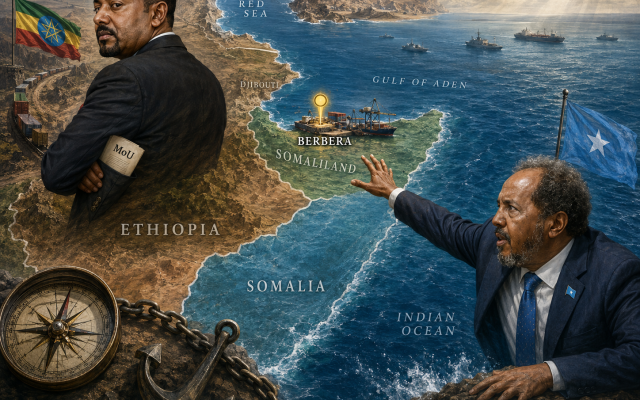
Ethiopia’s Strategic Ambiguity: The MoU Under the Sleeve
Mogadishu says the Ankara Declaration has overtaken the 2024 Ethiopia–Somaliland (MoU) deal. Addis Ababa still speaks about sovereign access to the sea, Berbera remains outside Somalia’s control, and President Irro’s U.S.-bound diplomacy is pushing the recognition contest toward Washington.
Somalia wants the January 2024 Ethiopia–Somaliland memorandum of understanding (MoU) treated as a closed chapter. Ethiopia has never quite said that.
That gap is becoming more visible as Mogadishu desperately continues to offer Addis Ababa commercial sea access under “Somali sovereignty” while Ethiopian officials deliberately and ambiguously continue to speak in much broader terms about a sovereign Red Sea outlet.
The Ankara Declaration lowered the temperature between Somalia and Ethiopia. It restored dialogue and gave both governments a way out of a dangerous confrontation. What it did not do was put an Ethiopian ship at a Somali port, produce a commercial corridor, or formally erase the agreement Addis Ababa signed with Hargeisa.
Now the dispute is moving into a new phase. President Abdirahman Mohamed Abdullahi Irro left Hargeisa on September 3, on a U.S.-bound trip via Dubai. At the same time, Mogadishu is intensifying its own diplomacy with Washington and other partners to prevent Somaliland’s recognition campaign from gaining further ground. The diplomatic struggle over Somaliland is increasingly tied to Ethiopia’s unresolved search for the sea.
Ankara bought time. It did not deliver a port.
Somalia’s State Minister for Foreign Affairs, Ali Mohamed Omar, has argued that the Ankara Declaration is now the governing framework for relations with Ethiopia. In Mogadishu’s reading, the old argument over whether the Somaliland memorandum is suspended, abandoned or technically alive is no longer useful. Ethiopia can obtain dependable commercial access through Somalia without touching Somalia’s territorial claims.
That is a coherent diplomatic position. It is also incomplete and misleading.
The December 2024 Ankara Declaration reaffirmed the sovereignty, unity and territorial integrity of Somalia and Ethiopia. It also recognized Ethiopia’s need for secure access to the sea and envisaged commercial arrangements negotiated under Somali sovereign authority. The first technical talks followed in February 2025 under Turkish mediation.
But the declaration did not publicly cancel the Ethiopia–Somaliland MoU. No Ethiopian instrument cancelling it has been released. No tripartite settlement involving Hargeisa exists. And nearly two years after Ankara, there is still no announced Ethiopian port agreement with Somalia, no named corridor, no published lease, no tariff schedule and no implementation timetable.
Ankara therefore looks more like a diplomatic suspension bridge than a final settlement. It prevented the 2024 crisis from becoming something worse. It did not resolve the strategic problem that produced the crisis in the first place.
Ethiopia is asking for more than cheaper freight.
The Somali offer assumes that Ethiopia’s problem can be solved by giving it ordinary commercial access to a Somali port. Addis Ababa’s own language suggests a larger ambition.
Ethiopia depends heavily on the Djibouti corridor for external trade. Diversifying that dependence is an obvious economic objective. Yet Ethiopian officials have increasingly described Red Sea access as a matter of sovereignty, national security and long-term state power, not simply commercial logistics.
Prime Minister Abiy Ahmed’s security adviser Kenea Yadeta said in June that access to the sea is fundamentally a sovereignty issue. Ethiopian officials and state media have repeated the language of a sovereign sea outlet. The Red Sea is being discussed alongside the Nile as part of Ethiopia’s strategic future.
That rhetoric does not prove Addis Ababa intends to reactivate the 2024 Somaliland deal. It does show why a commercial port controlled by Mogadishu may not satisfy the whole Ethiopian agenda.
For Ethiopia, access is about resilience, bargaining power and its place in the Red Sea system. A state of more than 120 million people does not want a single external artery controlling nearly all of its maritime trade. It also does not want its return to the coast reduced to a revocable commercial favor from another government.
Berbera is the problem Somalia cannot talk around.
Mogadishu has a stronger international legal position. Most governments and international institutions still recognize Somalia within its inherited borders. But sovereignty on diplomatic paper is not the same as control on the ground.
Somalia does not administer Berbera. It does not operate the port, collects its customs revenue, manages the Berbera Corridor or decides which foreign partner can use the terminal. Those powers are exercised by Somaliland authorities.
This is the practical weakness in Somalia’s offer to Ethiopia. Mogadishu can promise maritime access under “Somali sovereignty”, but it cannot hand Ethiopia Berbera unless Hargeisa agrees, and Hargeisa is not.
And Berbera is not an imaginary asset waiting for development. DP World has expanded the deep-water terminal, increased container capacity and tied the port to an overland corridor designed with the Ethiopian market in mind. Somaliland, for its part, continues to say that Berbera remains open to an Ethiopian arrangement.
Geography matters here. A port on Somalia’s Indian Ocean coast is not automatically equivalent to a Gulf of Aden gateway simply because both reach the sea. Distance from Ethiopia’s economic core, road infrastructure, security, operating capacity and strategic orientation all affect the value of an access deal.
Somalia can make the legal argument. Somaliland controls the port Ethiopia is interested and has spent years studying.
The MoU looks dormant, not discarded.
`Mogadishu would like the 2024 memorandum treated as politically dead. Hargeisa has continued to insist that it remains intact. Addis Ababa has chosen diplomatic ambiguity.
That ambiguity serves Ethiopia well.
By working through Ankara, Abiy Ahmed repaired relations with Somalia and avoided an expensive regional confrontation. By refusing to publicly renounce the Somaliland MoU, Ethiopia preserves leverage. Berbera remains available as a strategic alternative if negotiations with Mogadishu fail to produce something useful or Somaliland’s international recognition gains strategic status.
The original MoU may never be implemented in the exact form announced in January 2024. Somaliland has a different president. Israel has since recognized Somaliland. Red Sea security has deteriorated. The regional balance has shifted.
A future Ethiopia–Somaliland bargain could therefore look different: commercial access, corridor rights, equity participation, security cooperation or recognition could be rearranged into a new package. The old document matters less than the strategic logic behind it.
That logic is still alive.
Israel changed the diplomatic risk for Ethiopia.
Ethiopia’s biggest political obstacle in 2024 was not Berbera. It was recognition.
Recognizing Somaliland then would have made Ethiopia the first UN member state in the modern period to take that step. Addis Ababa faced intense pressure from Somalia, the African Union, Arab states and other partners. The diplomatic cost was high enough to encourage Abbiy to seek a way out through Ankara.
Israel’s recognition of Somaliland on 26 December 2025 changed that calculation. Ethiopia would no longer be crossing the line alone.
The African Union and the Organization of Islamic Cooperation still oppose recognition, and Washington has not changed its formal position. Those constraints remain serious. Yet precedent matters in diplomacy. Once one state breaks a taboo, the next government considering the same move faces a different political landscape.
For Addis Ababa, that makes patience valuable. Ethiopia can watch how Israel’s decision develops, how Washington responds to Somaliland, and whether additional states begin treating Hargeisa as a separate strategic actor before making its own move.
Washington is becoming the next diplomatic front.
Irro’s trip to the United States comes at a sensitive moment. Somaliland is arriving with more diplomatic weight than it carried when the Ethiopia MoU was signed.
It now has formal recognition from Israel, an embassy in Jerusalem, a growing security argument built around Berbera and Bab el-Mandeb, and supporters in the U.S. Congress who want Washington to reconsider the traditional Somalia policy.
None of this means American recognition is around the corner. The United States still formally supports Somalia’s territorial integrity. But Washington is taking Somaliland more seriously as a Red Sea security and commercial partner, and congressional legislation calling for recognition has kept the issue alive.
Mogadishu understands the risk. Somali officials have acknowledged direct engagement with the Trump administration over Somaliland and have sought support from Arab and Islamic partners to contain the recognition campaign. Reports also indicate that Somalia is sending high senior officials to Washington as Irro begins his own U.S. outreach.
Mogadishu still holds the UN seat, enjoys African Union backing and has broad support from the OIC. Those are formidable diplomatic assets.
But Somalia is now fighting on two levels at once: defending the legal principle of territorial integrity while trying to prevent foreign governments from treating Somaliland as a strategic partner in practice. Israel has already crossed that line. Washington is the arena Mogadishu most afraid of and wants to keep closed for Somaliland.
Why Ethiopia will be watching Irro’s visit.
Every gain Somaliland makes in Washington affects Ethiopia’s room for maneuver.
If U.S.–Somaliland ties deepen substantially, even without immediate recognition, Addis Ababa would face a less isolated choice over Berbera. If recognition eventually broadens beyond Israel, the diplomatic cost of an Ethiopian move would fall further.
That is why Ethiopia has little incentive to throw the Somaliland option away. Ankara gives Addis Ababa a working relationship with Somalia. The unfinished MoU gives it leverage. Berbera gives it a real alternative to Djibouti. Ambiguity allows Ethiopia to retain all three.
Somalia, by contrast, needs to turn its legal advantage into an actual maritime proposition. If Mogadishu wants Ethiopia to forget Berbera, it has to offer something commercially credible, strategically useful and politically durable. A declaration alone cannot compete indefinitely with a functioning deep-water port and an existing corridor toward Ethiopia.
The gap between Somalia’s recognized sovereignty and Somaliland’s effective control of Berbera is therefore not a technical detail. It sits at the center of the entire dispute.
A race between diplomacy and geography.
The Ankara Declaration was a real diplomatic achievement. It reduced the danger of an Ethiopia–Somalia confrontation and gave both governments room to repair relations. Its weakness is that it postponed the hardest part.
Ethiopia is still landlocked. Berbera is still controlled by Somaliland. Somalia still cannot deliver that port on its own. Addis Ababa is still talking about sovereign access to the Red Sea. And Hargeisa’s international position is stronger than it was when the MoU was signed.
That leaves Mogadishu with a narrow strategic task: give Ethiopia a credible alternative before Somaliland’s recognition campaign makes a return to Berbera easier for Addis Ababa politically.
Ethiopia can afford to wait. It can negotiate with Somalia, maintain ties with Somaliland and watch Washington at the same time. Somalia has less room for delay because every step that normalizes Somaliland internationally weakens the assumption that the Ankara framework alone can permanently contain the 2024 MoU bargain.
The MoU has not disappeared. It has been pushed into the background while Ethiopia studies its options.
For now, Addis Ababa is keeping it under the sleeve.
Related Topics
Related Posts