Geopolitical Analyst: Bridging Somaliland & Israel to the world
The UN Mission Ends. Somalia’s Failed State Remains.
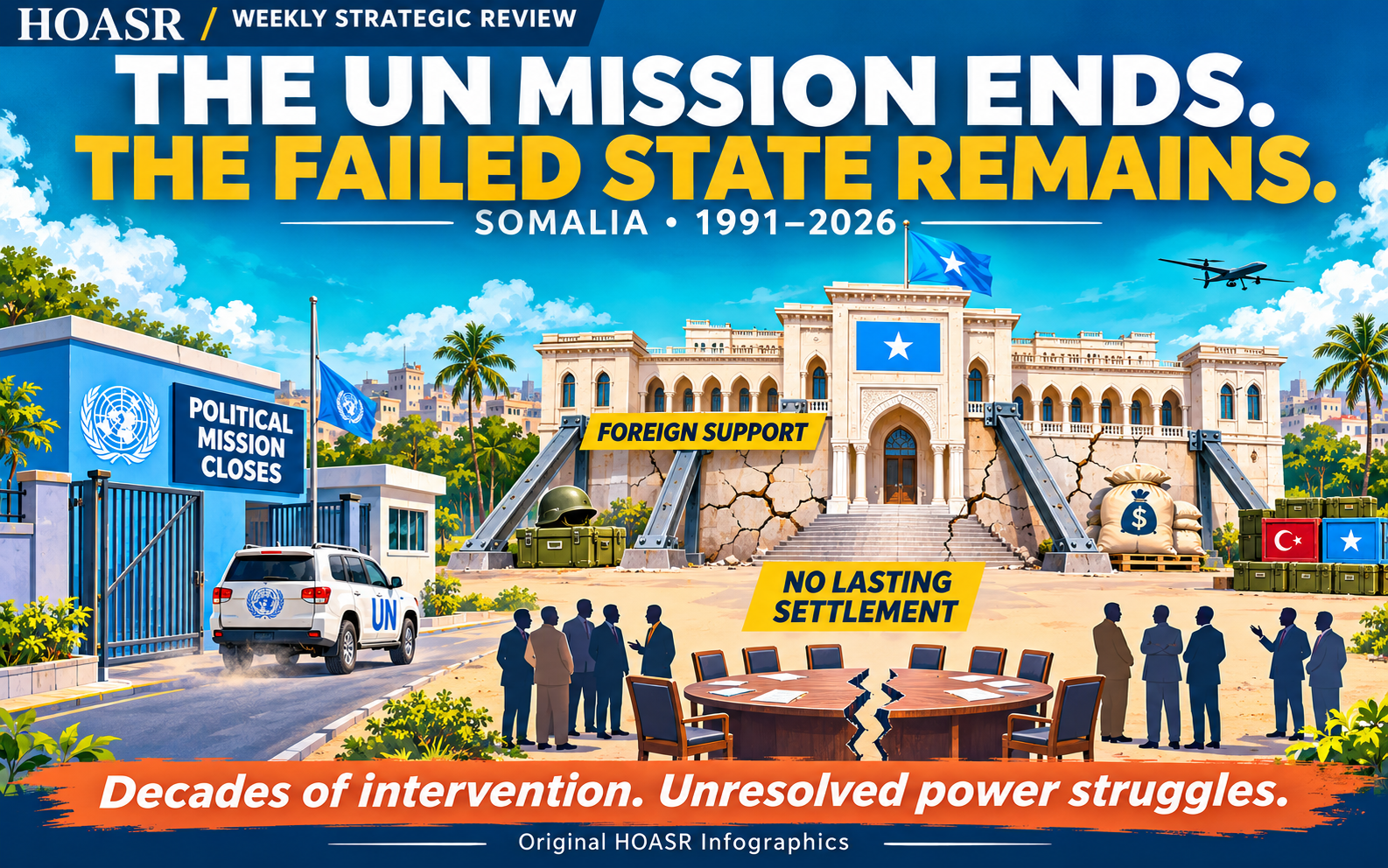
A symbolic HOASR editorial illustration examining the UN political mission’s closure, Somalia’s dependence on foreign support and the absence of a lasting political settlement. HOASR Original Infographics
How foreign protection and concentrated presidential power leave Somalia exposed to renewed collapse
The UN political mission has ended, but Somalia’s failure to build a state that can stand without outside protection remains. After thirty-five years, its recognized government still depends heavily on foreign troops and financial support. It has not defeated al-Shabaab, restored nationwide direct elections or secured an accepted division of power with the regions.
Foreign assistance has kept the federal government alive without making it politically self-sustaining. Military support has also strengthened a presidency accused of using central power against regional rivals. As external protection and funding are reduced, those unresolved struggles become more dangerous. The closure can contribute to renewed breakdown by removing support from a political order that has never learned to function reliably without it.
Somaliland makes that failure harder to explain away. Over the same period, it rebuilt institutions, held repeated direct elections and transferred power between rival parties without international recognition from any UN member state for 34 years. Somalia retained recognition and received prolonged international support yet remains divided and dependent. That comparison belongs at the center of any honest judgment of the international state-building project.
Foreign backing has failed Somalia before
Somalia’s present dependence has a history. The Somali Republic, formed in 1960, had civilian governments before the military coup of October 1969 brought Mohamed Siad Barre to power. Barre first relied on Soviet support, then turned towards the United States after the Soviet Union backed Ethiopia during the 1977–78 Ogaden war. The US history records those shifts. Outside powers supported a strategically useful government whose domestic foundations were becoming weaker.
Military defeat was followed by repression and expanding armed opposition. Barre used loyalty and patronage to protect his position, while communities associated with his opponents suffered collective punishment. Government attacks devastated Hargeisa and Burao in 1988. Bradbury and Healy’s historical account explains how declining foreign support at the end of the Cold War accelerated the collapse of a regime already losing control.
When Barre fled Mogadishu in January 1991, the groups that removed him had no accepted agreement on the state that would replace him. Armed rivals fought over the capital and the resources left behind. Institutions disintegrated, civilians were displaced and famine followed. Somaliland’s declaration in May 1991 began a separate political reconstruction, while efforts to restore a central government in Somalia continued through decades of factional war.
The relevant warning from that history is the gap between the power of a ruler and the strength of a state. A president can acquire weapons, loyal units and foreign backing while losing the consent needed to govern beyond his immediate supporters. As money becomes scarce, those weapons can be turned inward. The parallel with Barre lies in that pattern of dependence and coercion; although today’s government operates in a different institutional setting, it is not immune to the same danger.
Mission after mission left the central problem unresolved
The UN record begins with UNOSOM I in 1992 and UNOSOM II in 1993. The intervention helped deliver food and saved lives but failed to establish a lasting political settlement. American troops left in 1994, and the UN military operation withdrew in March 1995. The rival factions remained armed, and the national state remained dysfunctional.
The UN political office established in 1995 supported successive attempts at reconstruction. The Arta process produced a transitional government in 2000; negotiations in Kenya produced a transitional federal government in 2004. A provisional constitution and federal government followed in 2012. UNSOM took over in 2013, and UNTMIS began its final transition in 2024. The institutional names changed while the struggle over who could legitimately exercise power continued.
The African Union followed its own succession of missions: AMISOM from 2007 to 2022, ATMIS from 2022 to 2024, and AUSSOM from January 2025. The AU history describes the repeated effort to transfer security responsibilities to Somali forces. Foreign troops fought and died, major towns were recovered, and governments were protected in security compounds Yet a new mission was still needed when the previous transition ended.
These operations achieved important immediate results. Their failure lies in the larger political outcome: Somalia still lacks a dependable national settlement and remains unable to sustain essential security functions on its own. Successive handovers missions have repeatedly exposed that weakness. After more than three decades, another transition cannot be judged by its closing ceremony alone.
Türkiye has strengthened the presidency more than the Political settlement. Türkiye is now central to this story. Its relationship with Somalia extends from humanitarian to military training, equipment and intelligence cooperation. The Africa Center’s security assessment documents training for infantry and paramilitary police with supplies including drones, helicopters, armored vehicles, and intelligence support. These capabilities give the federal government resources that many of its domestic rivals cannot match.
The European Union Agency for Asylum’s actor profile identifies the eliteTurkish-trained Gorgor military units and Haramcad police alongside other Somali forces. It also records Türkiye’s expanded combat presence and deployment of fighter jets and other equipment. On 26 October, Somali reporting described further army-to-army talks in Ankara. On 29 October, another announcement concerned warships carrying military supplies, although their contents and intended recipients were not disclosed.
The military partnership changes the balance between Mogadishu and its political oponents and regional rivals. When a presidency has access to outside military support while its authority is disputed, it has more room to resist concessions and attempt to impose decisions. In my assessment, that weakens the pressure on the president to compromise. It does not require Ankara to make every decision: the equipment, training and security backing already give the presidency greater prerogative to act.
Aweis Ahmed’s Chatham House analysis, published on 16 October, describes opposition concerns over Türkiye’s backing for the federal government. It also discusses reports of Turkish aircraft being involved near Baidoa, which Ankara had not confirmed. Türkiye rejects allegations of political interference and presents its support as institutional and counterterrorist. Direct Turkish air operations against political opponents remain unconfirmed.
The deeper criticism does not depend on proving a secret order from Ankara. A security partnership can protect the presidency and give it greater coercive power while failing to secure consent for its rule. In that setting, building military capacity may help preserve the officeholder without resolving the conflict over his authority. A better-equipped government can still be a politically weaker state.
The original mandate ended and the dispute remains
Hassan Sheikh Mohamud remains in office beyond the end of his original four-year term in May 2026, relying on a disputed extension to May 2027. The government says the constitutional changes are valid; opposition leaders and key regional administrations reject that position. Chatham House places the term-extension dispute at the center of the current crisis. It describes the presidency as simply enjoying another ordinary year in office without acknowledging the conflict over the basis of its power.
The federal army’s intervention in Baidoa during the confrontation with South West’s leadership, documented in the EUAA’s security review, shows how political disputes have moved into military operations. At Leego on 26 October, al-Shabaab ambushed a federal convoy moving during an operation against opposition forces. The Africa File examines that connection. Claims of opposition coordination with the militants remain contested, but the cost of fighting on competing fronts is already obvious.
The president has proposed talks for 14–18 November. The court dispute also provides another possible route through the crisis. Invitations and petitions, however, have not yet produced an accepted settlement. Presidential power has expanded faster than political consent, while military confrontation continues.
Thirty-five years without restoring a national direct vote
Somalia held direct national elections before the 1969 coup. Since the central government collapsed in 1991, it has not restored nationwide direct elections for its national legislature. Leaders have instead emerged through indirect arrangements involving clan representation and parliamentary selection. The democratic deficit begins with the public’s limited role in choosing their own president.
Municipal elections in Mogadishu in December 2025 were a real, limited development, recorded by Reuters. They did not amount to a nationwide election or resolve the federal dispute over the national process. International IDEA records continuing disagreement over the constitutional changes. The government’s promise of universal suffrage remains difficult to separate from its effort to extend and concentrate executive power.
Somaliland provides the comparison that Somalia’s defenders too often avoid. It held presidential elections by direct popular vote in 2003, 2010, 2017 and 2024. The electoral record documents the earlier contests; the UCL mission found that the 2024 election ended peacefully, with an opposition victory accepted by the parties. The public could remove an incumbent through a vote rather than wait for outside mediators to rearrange political offices.
Somaliland’s record includes serious shortcomings. Elections have been delayed, including the 2026 parliamentary poll, while Freedom House has documented restrictions on civil liberties. Those problems require criticism of their own. They do not erase the central comparison: Somaliland has repeatedly demonstrated a capacity for direct presidential elections and peaceful changes of governing party that Somalia has not matched at the national level since 1991.
Recognition and aid have not produced a self-sustaining state
Somalia retained its UN membership, diplomatic recognition and access to international institutions throughout these decades. Somaliland pursued political reconstruction for during the same period without recognition by a UN member state. It received development assistance and diaspora support but did not rely on the foreign peacekeeping structure sustaining the government in Mogadishu. Recognition gave Somalia major advantages; but it failed to turn those advantages into effective government.
Financial dependence remains a basic weakness. The World Bank’s October findings say domestic revenue is still insufficient to finance core state functions. The Bank also recognizes some progress in rebuilding fiscal institutions. That progress has not removed the dependence on external support, nor resolved the disputes over revenues and responsibilities between Mogadishu and the regions.
The IMF’s October assessment credits financial discipline and reforms. Such gains are real, but a government can satisfy parts of a financial reform programme while remaining politically divided and militarily dependent. The public costs are visible in the UNICEF account of health and nutrition facilities closing after aid cuts. Global funding decisions have causes beyond Somalia’s conduct, yet the inability to replace basic services shows how little protection the state can offer when outside money falls.
The foreign lifeline is being reduced
International frustration is visible in decisions about support. A July US diplomatic note reviewed by Reuters criticized political infighting, inadequate security reform and the failure to sustain gains despite prolonged support. September reporting described Washington’s acceptance of a further twelve-month winding down of UN logistical support, expected to start in January 2027, subject to later Council discussions. Even though time changed the immediate danger; it did not restore confidence in indefinite support.
The UN political mission closed on 31 October. Uganda then announced a phased withdrawal, beginning with its bilateral troops and extending to all Ugandan forces by the end of 2027, according to its reported plan.
Other UN bodies and foreign forces remain, and no single date has been set for all assistance to end. The warning is about a weakening of the support system, not an international departure already completed.
The UN itself continues to describe the transition positively and calls for sustained help. That language coexists with decisions by important partners to limit their future commitments. Patience is running out unevenly, rather than through a single international decision to abandon Somalia. Replacing one sponsor with another may keep the government supplied while leaving its dependence intact.
Withdrawal can expose the conditions for another collapse
My assessment is that the present transition increases the risk of deeper internal war because it removes protection faster than Somalia has resolved its struggle over power. The danger is not confined to an al-Shabaab advance towards Mogadishu.
A presidency with well-equipped units but weaker finances may try to preserve its position through force, while regional rivals hold on to their own armed militias. Military strength at the center can then produce resistance across the country rather than a functioning national state.
This is where the comparison with Barre becomes most troubling. Foreign assistance can help a ruler postpone the cost of political exclusion. When that assistance falls, the ruler still possesses weapons but has less resources with which to maintain alliances and public services. Repression, defections and competing claims to authority can follow. That is a plausible scenario to another state collapse, but not exactly as it did in 1991.
Meanwhile, Ethiopia would face the consequences along its border while dealing with its own wars. The Critical Threats Project’s October assessment reports fighting in Tigray, Amhara and Oromia, making it unsafe to assume that Addis Ababa could fill every security gap in Somalia.
The Scoop: Another mission has ended; the failed political project remains.
The failure of Somalia’s state-building project should be judged by what remains after the mission leaves. A government still dependent on foreign protection, unable to finance essential functions and fighting over the legitimacy of its own presidency has not completed that project.
The international system has preserved its formal standing for decades. It has been far less successful in producing a state that can govern with consent and survive without repeated external rescue.
Türkiye’s military support can strengthen the presidency while leaving that central failure unresolved. The Somaliland comparison shows that direct elections and negotiated transfers of power are possible in the same regional setting.
Somalia’s prolonged failure cannot be explained indefinitely by geography, insecurity or the absence of international opportunity. Its political leadership and the foreign model that has sustained it bear responsibility for the outcome.
On the current course, I see little reason to expect another orderly transition to solve what previous missions could not achieve. The ending of the UN mission is more likely to expose Somalia’s weakness and contribute to deeper fragmentation than to mark the arrival of a self-reliant state. Total collapse is not a certainty, but it is a serious consequence of the direction already visible.
Another mission has ended; the failed political state remains.
Related Topics
Related Posts