Geopolitical Analyst: Bridging Somaliland & Israel to the world
Hargeisa and the Failure of Mogadishu’s Claimed Diplomatic Veto
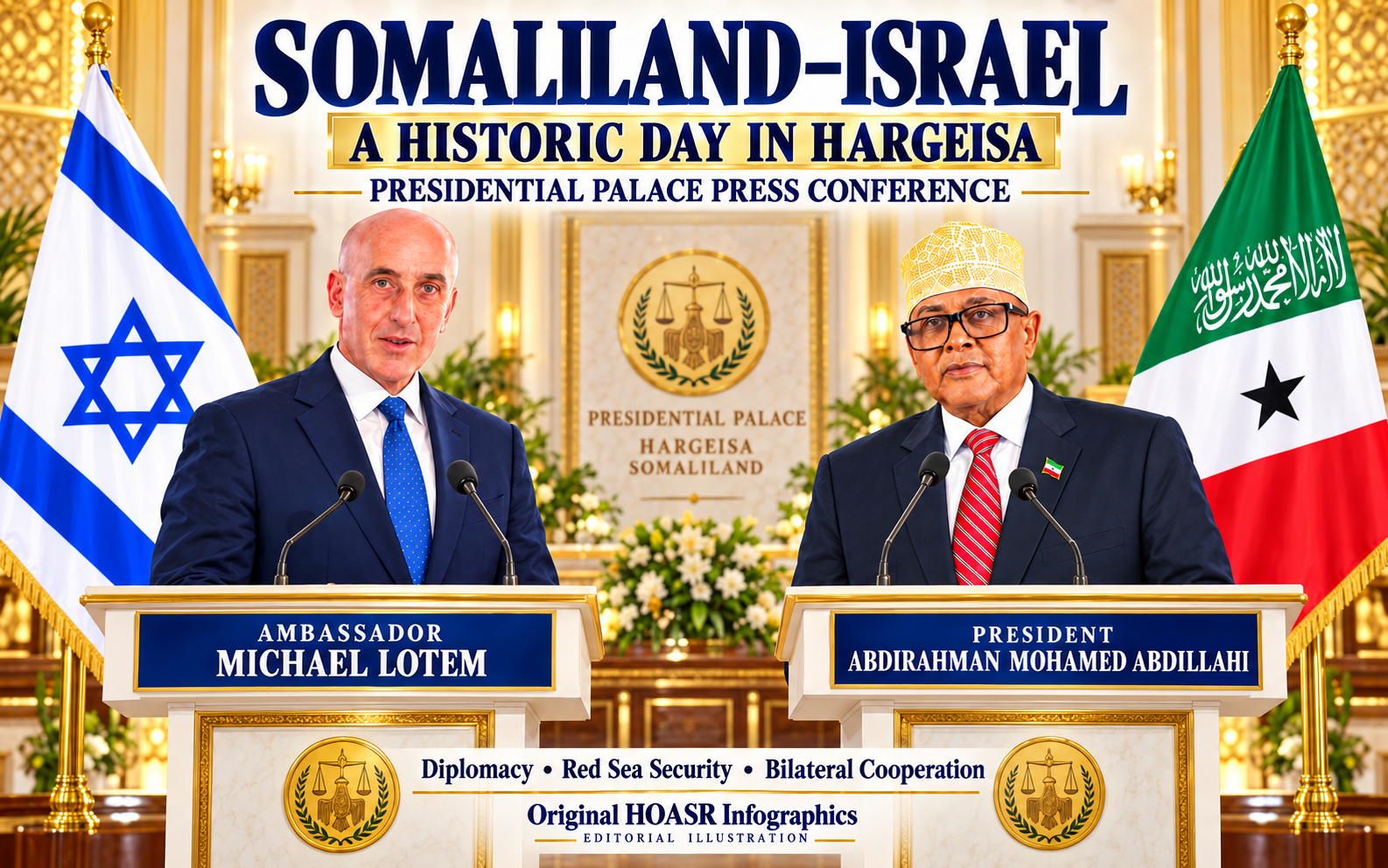
President Irro and Ambassador Michael Lotem depicted at the Presidential Palace press conference in Hargeisa. Original HOASR Infographics.
Israel-Somaliland: “A Relationship Between Two Brave Allies”
The Press Conference pictures from Hargeisa confront Somaliland’s opponents with a practical failure. After months of objections to Israel’s recognition of Somaliland, Israeli Ambassador Michael Lotem has presented his credentials to President Abdirahman Mohamed Abdillahi “Irro,” and preparations for an embassy have advanced to a cornerstone ceremony.
The available accounts describe a completed diplomatic programme without reporting a security disruption to those events. Mogadishu’s claim that foreign governments must pass through its authority has failed to prevent a recognizing state from dealing directly with Hargeisa.
The sub-headline phrase, “a relationship between two brave allies,” is how the seasoned Israel diplomat, Ambassador Lotem, described the relationship which captures the political choice at the center of this partnership.
Israel has continued implementing recognition despite regional opposition, while Somaliland has continued receiving its partner despite the warnings surrounding that decision. The Foreign Ministry confirmation reported by Ynet moves the story beyond anticipated visits and promised representation. The relationship now has an accredited ambassador and a publicly announced embassy project.
The Warnings Have Met a Practical Test
The opposition to recognition has relied heavily on predictions of destabilization. The African Union Commission condemned the appointment of an Israeli envoy, while the Organisation of Islamic Cooperation’s January resolution presented recognition as a threat to regional peace and urged restrictions on dealings with Somaliland outside Somalia’s sovereignty framework.
A separate joint statement published by Pakistan’s Foreign Ministry condemned the ambassador’s appointment in April. The danger argument has therefore operated alongside a sustained effort to prevent recognition from becoming normal diplomatic practice.
Hargeisa has supplied evidence against the claim that these objections must determine every partner’s conduct. Israeli Foreign Minister Gideon Sa’ar visited in January, and Lotem has now completed the credentials stage of the relationship.
The reports reviewed describe both diplomatic engagements without identifying an attack that prevented their completion. Somaliland’s institutions have demonstrated the capacity to receive a politically sensitive visitor and carry through the business of government.
That record weakens the political use of the Pandora’s box argument. Al-Shabaab and other armed actors remain genuine threats, and successful visits cannot establish permanent immunity from violence.
But predictions of danger cannot indefinitely substitute for evidence that peaceful engagement is impossible. When a warning becomes a demand that a functioning government be denied all external relationships, it serves a political campaign of exclusion as well as any legitimate security concern.
A Sovereign Practice Returns to Hargeisa
The historical significance reaches back to 26 June 1960. Somaliland became independent from Britain as the State of Somaliland before joining the former Italian-administered territory on 1 July to form the Somali Republic.
The southern territory’s passage out of trusteeship is recorded separately in United Nations General Assembly Resolution 1418. Somaliland’s official historical record sets out that sequence and the restoration of independence in 1991.
Those dates explain why an ambassadorial ceremony carries such emotional and political force. Somaliland’s independence preceded the union; its demand for recognition draws on that separate history as well as the institutions rebuilt since 1991.
President Irro’s reception of an accredited Israeli ambassador gives visible expression to the restored sovereignty that Somaliland has asserted for thirty-five years. A foreign government that recognizes it is now conducting the formal business of state with its president in Hargeisa.
The official diplomatic visit is especially important in describing this milestone accurately. Somaliland has hosted foreign representatives and maintained external relationships for years.
This ceremony concerns an Israeli ambassador accredited under explicit recognition of Somaliland’s independence. Its historical weight comes from that sovereign relationship and the decision to put it into operation.
Hargeisa Demonstrates Authority That Mogadishu Claims
The immediate evidence concerns control where the diplomacy occurred. Somaliland’s authorities received the envoy organized his access to the presidency and provided the security framework within which the engagement proceeded.
The public record presents a direct bilateral relationship, independent of the authorization that Mogadishu insists is necessary. Foreign capitals can see an administration capable of performing the practical functions associated with receiving diplomatic representation.
They do not turn Mogadishu’s asserted authority into demonstrated administration of Hargeisa or Berbera. The coastline makes this distinction strategically consequential. Somaliland describes an approximately 850-kilometre coast, and its Coast Guard operates from Berbera.
In an interview with the EU-supported CRIMARIO programme, a Somaliland Coast Guard official described that maritime security responsibility alongside limitations in assets and operational reach. External security cooperation can strengthen institutions already undertaking maritime security, giving partners a practical reason to engage the authorities responsible for it.
The Claimed Veto Has Failed in This Relationship
Mogadishu retains only diplomatic influence and the support of governments and organizations that reject Somaliland’s recognition. It can lobby potential partners, challenge agreements and increase the political cost of engagement.
But a claim to exclusive authority over Somaliland’s foreign relations has now encountered a state prepared to reject that premise in its own dealings. Israel has recognized, visited, appointed an ambassador and proceeded toward establishing an embassy.
The El-Alamein declaration of 4 October showed Egypt, Eritrea, Somalia and Sudan explicitly opposing recognition of, or support for, Somaliland. Their position remains politically consequential. The completed ceremony also shows that opposition has not secured universal compliance.
For other capitals, Hargeisa supplies a concrete example of direct engagement surviving the objections raised against it.
The warning conveyed to Somaliland’s opponents is consequently political and practical. Their ability to demand exclusion exceeds their ability to enforce it in every bilateral relationship.
The images from Hargeisa allow foreign officials to compare the language of a claimed veto with the conduct of diplomacy that has proceeded despite it. A policy presented as universally binding has become visibly contestable.
Red Sea Cooperation Gives Recognition Continuing Purpose
The reported remarks of both leaders explain why the relationship is being sustained. Accounts based on the Presidency’s statement identify security and defense alongside trade, investment, technology, healthcare and education. Irro emphasized Somaliland’s Gulf of Aden position and proximity to the Red Sea corridor. Lotem pledged to turn cooperation into practical results saying the relationship is “between two brave allies”.
Their security concerns therefore supply a continuing purpose beyond the ceremony itself. Somaliland can contribute local institutions, access and regional knowledge, while cooperation with Israel offers the prospect of additional expertise and capabilities.
The significance lies in two governments discussing the security environment through their own bilateral channel. No published mutual-defense treaty or automatic military guarantee has been established by the ceremony, and the scope of future commitments will depend on the agreements actually concluded.
This also exposes a weakness in the demand that recognition await a perfectly safe region. Maritime insecurity makes capable local partners more valuable. Treating Somaliland’s unresolved status as a reason to exclude its authorities from cooperation can obstruct engagement with institutions already carrying security responsibilities.
Hargeisa’s argument gains force when recognition helps partners address practical problems that continued diplomatic ambiguity leaves unresolved.
Ethiopia Faces a More Concrete Precedent
Ethiopia has particular reason to study these pictures. Berbera offers a neighboring maritime route, while Somaliland offers an established government with which Addis Ababa has long dealt with. Israel has demonstrated that recognition can be followed by a working diplomatic relationship despite regional opposition. That gives advocates of Ethiopian recognition a stronger practical example than a proposal awaiting its first test.
Ethiopia’s own reservations still require an honest account. In an October interview reported by Addis Standard, its ambassador to Israel argued that recognition could provoke demands for Ethiopian troops to leave Somalia and create opportunities for Al-Shabaab.
Somaliland representatives rejected that assessment. The concern involves the consequences for Ethiopian deployments inside Somalia, which a successful ceremony in Hargeisa cannot resolve by itself.
The ceremony nevertheless increases pressure for a more balanced calculation. Addis Ababa can now examine an implemented relationship alongside the possible costs of remaining dependent on arrangements vulnerable to regional pressure.
Ethiopia could become a consequential next recognizer because of its geography and interests. The evidence supports a stronger case for that choice, while the decision and timing remain Ethiopia’s to determine.
Trump Named a Distinction the Ceremony Makes Visible
President Donald Trump’s October description of Somaliland as “a totally different country” from Somalia drew attention to the separate political reality that Hargeisa has long argued foreign policy should acknowledge.
Lotem’s reception gives that separate distinction a visible diplomatic expression. A foreign ambassador presented credentials to Somaliland’s president under a relationship founded on recognition. The pictures show a government acting through institutions separate from Mogadishu’s.
Trump’s remarks did not themselves establish United States recognition, and Israel’s ceremony cannot substitute for an American decision. The connection is political: his distinction becomes easier to understand when the world sees Somaliland conducting formal diplomacy in its own capital.
International audiences are being offered evidence of a functioning relationship that official ambiguity has often obscured. Washington’s future choice will be made against that resilient public record.
The Scoop
In my earlier editorial, “Israel Comes to Hargeisa as Somaliland Opponents Close Ranks,” I argued that Israel was translating recognition into practical commitments despite mounting regional opposition.
Ambassador Michael Lotem’s presentation of credentials now gives that argument a visible institutional form. The ceremony strengthens the central finding of that editorial: Mogadishu’s objections have failed to prevent a recognizing state from conducting diplomacy directly with Hargeisa.
Somaliland’s opponents must now explain their warnings against the evidence of a relationship that continues to advance.
The ceremony has changed the evidence available to the recognition debate. Opponents can continue arguing that engagement is dangerous, but they must now account for an accredited ambassador, a completed diplomatic programme and an embassy project moving forward.
Hargeisa has demonstrated that a recognizing partner can conduct official business directly with its government. Mogadishu’s objections have remained objections after objections with no teeth to bite since Israeli recognition and throughout its processes.
The historic achievement is Somaliland’s exercise of a sovereign diplomatic practice in public, backed by a partner willing to sustain the relationship. It strengthens the case for Ethiopia and other governments to judge Hargeisa through its institutions and demonstrated conduct.
It also gives substance to the separate distinction Trump drew between Somaliland and Somalia. Recognition has produced a working relationship between two “brave allies” that Somaliland’s opponents have been unable to prevent.
Related Topics
Related Posts