
From Kibbutz to the global stage
Europe Moves as the World Starts Its Largest Planetary Defense Drill — 3I/ATLAS
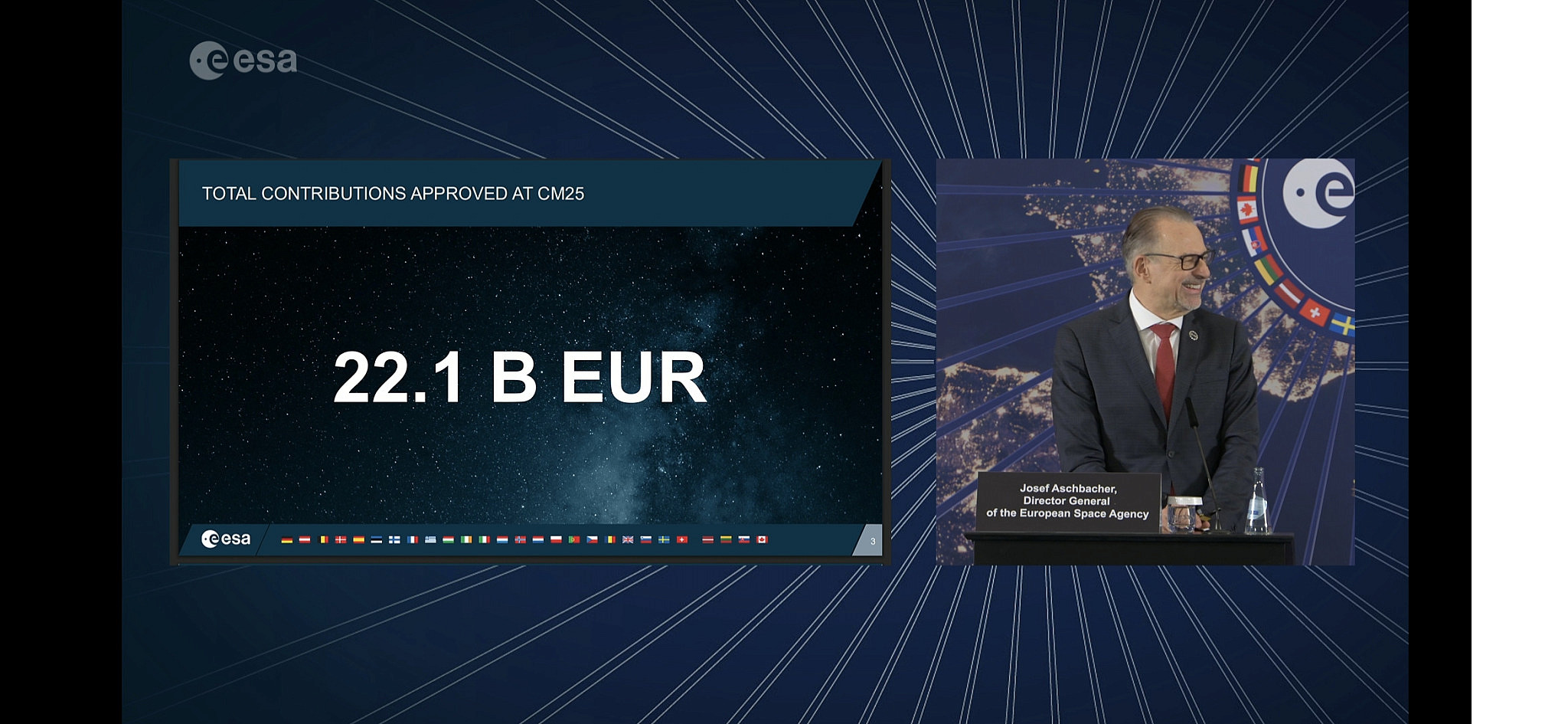
The image included in this article was captured from the official ESA live stream. At the center is ESA Director General Josef Aschbacher presenting the newly approved €22.1 billion budget. To his right stands Germany’s Minister for Science, Technology and Space, representing the host nation. To his left stands Italy’s Minister of Science, who chaired the Ministerial Council.
Europe Moves Ahead as the World Starts Its Largest Planetary-Defense Drill — 3I/ATLAS.
In a world where space phenomena are rapidly shifting from scientific curiosity to strategic concern, Europe chose this week to make history. One day before the largest planetary-defense exercise ever conducted, the European Space Agency (ESA) approved a record budget of €22.1 billion — a move that positions Europe at the forefront of the global system preparing for threats that may emerge from space.
A Planetary-Defense Exercise Unlike Any Before:
Tomorrow marks the beginning of the largest and most extensive planetary-defense exercise in human history — an international drill centered in part around 3I/ATATLAS, which is approaching Earth at nearly 60 km/s, and which is expected to begin moving away again around December 19.
This exercise will engage nearly all major space agencies and dozens of scientific and research institutions.
The object itself is foreign and mysterious. Most scientists believe it is a comet, though a minority suggests otherwise. Its estimated size — roughly comparable to Manhattan — and its five-month journey since discovery, moving between Mars, Jupiter and Venus, has left its mark not only on science but also on the public psyche and geopolitical atmosphere.
ATLAS Exposed a Critical Gap: Public Communication Is Missing:
One of the most revealing aspects of the current situation is not scientific, but psychological and communicational.
The global planetary-defense system lacks any coordinated public-guidance mechanism.
No international body is responsible for explaining uncertainty, risk levels or sudden anomalies to the public.
The confusion surrounding 3I/ATLAS exposed this weakness in real time.
ATLAS has effectively given the world’s space agencies a critical lesson:
A planetary-defense exercise must include training for public communication, behavioral guidance and psychological resilience.
Without this component, even a harmless comet can trigger unnecessary fear or misinformation.
Public Questions Exposed the Vacuum:
In the past two days, after I published the official UN/IAWN announcement, I received two recurring questions from readers:
- If there is no danger, why conduct an exercise linked to tracking ATLAS?
- If the comet is far away, what happens if it suddenly changes direction?
With no official authority addressing these concerns, I chose to offer reassurance.
UN/IAWN has stated officially that 3I/ATLAS poses no threat to Earth, and that the purpose of the campaign is training, observation and scientific learning.
Part of such an exercise is the public-information and psychological component: preparing populations to understand uncertainty, trust scientific processes and behave responsibly in situations where information is still incomplete.
The HiRISE Image and the Need for Rapid Transparency:
NASA’s blurred HiRISE image from November 19 — taken from Mars — stirred disagreement among scientists. Some interpreted faint markings as potential probes; others suggested an unidentified phenomenon caught by chance.
NASA and the US Department of Defense have committed to public transparency, and in moments of uncertainty, rapid data releases may be essential.
Understanding how to guide the public is now clearly part of planetary-defense readiness.
A Global Realignment: ESA, China, the U.S., India and Israel:
This week, China announced expanded international cooperation; the United States revealed classified contracts to advance the “Gold Dome” space-security architecture.
But it was ESA’s Ministerial Council in Bremen — held just one day before the planetary-defense exercise — that captured global attention.
Alongside EU members, ESA was joined by Canada, the UK, Switzerland and Norway, reaching 28 participating nations.
The agency approved a historic three-year budget of €22.1 billion, with Germany contributing nearly €5 billion and Canada increasing its share by 400%.
Europe is striving for strategic autonomy in space, while still valuing cooperation with NASA, Japan, South Korea and Australia.
Luxembourg, contributing €500 million, recently signed a space-cooperation agreement with India — potentially opening an entryway for India-EU commercial space programs under ESA frameworks.
India is strengthening its ties with Europe, while commercially collaborating on alternatives to IMEC, the East–West trade routes involving Saudi Arabia and the United States.
Israel also plays a strategic role:
The Haifa Port, jointly operated by India and Israel, is pivotal for IMEC and alternative India–Europe corridors.
India’s commerce minister visited Israel last week with 60 business leaders, and the Israeli prime minister is scheduled to visit India next month — and space and IMEC cooperation is unlikely to be absent from the agenda.
Italy, meanwhile, emphasized its cooperation with Germany and France on European lunar-lander programs and broader international partnerships.
European Space Security Takes Center Stage:
Space security received long-promised funding under decisions made in August by the European Council of Ministers — decisions publicly criticized by the US State Department.
Governments proposed €1.2 billion for a new military-grade satellite network, “European Space Resilience”, to be co-funded with the EU.
Additional defense-related budgets will follow standard approval mechanisms.
Final Analysis: Space Is Becoming the New Geopolitical Arena:
After the ESA Ministerial in Bremen, it is clear that the geopolitical landscape in space is entering a dynamic and transformative phase.
Space is no longer solely a scientific domain — it is becoming a driver of international strategy, influencing global security, economics and diplomacy.
As the planetary-defense exercise begins and the world tracks 3I/ATLAS, one lesson stands out:
Even a harmless comet can reshape global policy, expose systemic gaps, accelerate cooperation and redefine the balance of power.
The image included in this article was captured from the official ESA live stream. At the center is ESA Director General Josef Aschbacher presenting the newly approved €22.1 billion budget. To his right stands Germany’s Minister for Science, Technology and Space, representing the host nation. To his left stands Italy’s Minister of Science, who chaired the Ministerial Council.
Related Topics
Related Posts