
Even If Iran Fires All Its Missiles, We Can ‘Afford’ the Price–But to What End?
It is very difficult to write the following sentences.
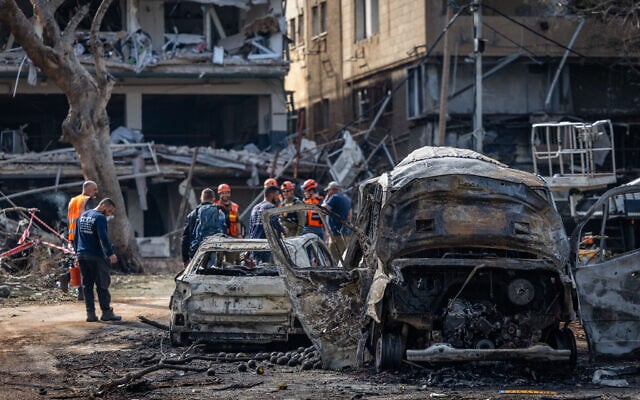
In three nights of missile attacks on Israel, 24 civilians were killed and hundreds wounded. Several dozen of them are in moderate to serious condition.
According to security sources, so far the Iranians have launched 380 missiles at Israel over three nights. It appears roughly that 10–15% of the missiles are not intercepted.
Estimates suggest Iran possesses about 2,000 ballistic missiles. If these numbers are accurate, the Iranians have already fired about 20% of their ballistic missile arsenal. Additionally, the security establishment reports that our forces have managed to hit missile stockpiles and about a third of the launchers (thanks to the Americans).
If these figures are correct, at the current rate of fire, the Iranians have enough missiles for another 12–14 days. At a lower rate, they could stretch this out for a few more nights.
We also see that the Iranians do not have a real air force. Our pilots are successfully dealing with anti-aircraft systems and are not required to engage in air battles with Iranian planes. This suggests that the Iranians have no other significant means except for their destructive ballistic missile array.
Another conclusion is that even if the Iranian fire continues at this rate, and if the public follows safety rules and stays in protected spaces (a word of praise to the Home Front Command for its performance so far), even if each night the missiles claim the lives of ten victims, over twenty days of fire this would mean about 200 dead. This is still just one-sixth of the number of victims of the horrific massacre on October 7—1,163 men and women.
This is a terrible and dreadful arithmetic, but it is essential for decision-makers.
Every victim is a tragedy. Each is a world unto themselves, with family and loved ones. It is a very heavy and painful price to pay. But among decision-makers, and perhaps even the public, this is not an unreasonable price for a country of 10 million people that wants to remove a major threat. Certainly for a country which, after the terrible massacre, allowed this government and its leader to remain in office.
Even if this is a blood price the people of Israel can bear, for what?
The nature of the threat is different, and the destructive potential of a sustained attack, especially if critical infrastructure is hit, could be much worse. It can be seen (for those following Arab networks) that the Iranians have been very accurate so far. You will not hear this in Israeli news broadcasts for obvious reasons, but the accuracy is high and each missile causes significant damage. Given this high accuracy, the question arises: why do they choose to target innocent civilians in Tel Aviv, Rishon Lezion, and Haifa, rather than, as Israel does, try to reach decision-makers—in Iran’s case, those responsible for the ongoing war in Gaza (allegedly the main reason for the Iranians)? These people do not live in Rishon Lezion, Petah Tikva, or Haifa. This is an unnecessary war that almost daily costs the lives of our soldiers and hostages for nothing.
But the million-dollar question is: what can Israel achieve in such a war? Eliminate the nuclear program? Overthrow the regime? Both goals are apparently unattainable. Among other reasons, because during war, the public tends to rally around the government, even if it deeply dislikes it in daily life. We see this here as well, with opposition and protest camp members enlisting in the “just war” against the great devil from Iran.
The same goes for damage to Iran’s nuclear program. Just as in the past, scientists killed by Israel were replaced, and Hamas leaders killed were replaced by even more fanatic and violent leaders, it is likely the same would happen here. Moreover, Iran has the resources to acquire nuclear weapons by purchase, if not by self-development.
Thus, it is doubtful what political or security achievements can be gained here. Certainly after the elimination of Hezbollah in a brilliant operation and the fall of Assad’s regime in Syria. Israel’s most effective “weapon” in the ongoing war with Iran is actually a peace agreement with Lebanon.
The destruction to Israel is not only the physical damage from missile strikes. War expenditures run into tens, maybe hundreds of billions; compensation for physical damages in many billions; medical expenses for treating thousands of physical and mental casualties, and more. Beyond that, in the short and medium term, who will want to come to Israel and do business? Establish a tech development center, come for vacation, or film a movie? How many productive people will choose to leave as soon as the skies open? These are enormous damages whose extent and meaning are not yet fully understood.
So what did Netanyahu want to achieve? The timing and his persona raise suspicion that this is about personal interests. As in most past cases.
And regarding Netanyahu’s “exit point”—since when does Netanyahu have exit points? His usual “exit point” is his belief and skill that he can lie his way out of almost any situation. So far, it has worked for him.
The price Israel pays is heavy, but it is not inevitable or unacceptable for a country seeking to defend itself from an existential threat. However, war is not decided only on the battlefield, but also in the economic, social, and political arenas. Only responsible leadership can lead Israel to a safer future—not through short-term political maneuvers or moves aimed at personal survival that endanger many citizens, with no horizon or purpose.