
I write what I see
Excusing Murder and Inheriting Palestine
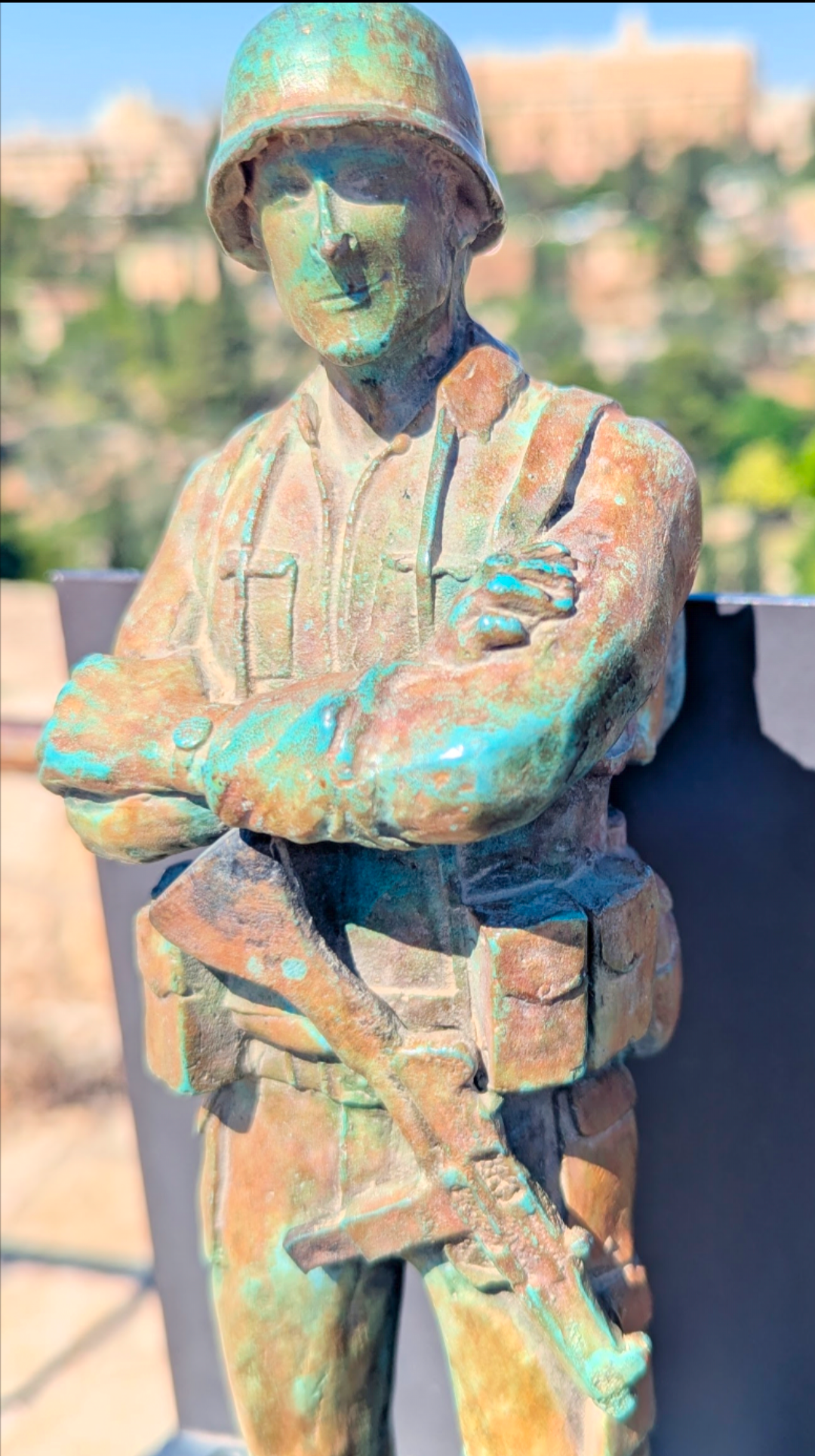
A bronze figure commemorating Jerusalem's defenders, on the Old City's Ramparts Walk. Jewish history did not begin in 1948, nor did the struggle to defend Jewish lives. (Photo courtesy Ilana k. Levinsky)
Hamas is granted an entire history to explain its violence, while Jews are denied the history that explains their very presence. And somehow, this passes for serious scholarship. I would love to know who gave these academics the authority to decide where one people’s history begins and another’s expires.
We are repeatedly instructed to examine generations of Palestinian grievances preceding October 7, to understand the circumstances that supposedly drove Hamas to violence. But when Jews invoke their own history, the discussion frequently comes to an abrupt halt.
Apparently, three millennia of Jewish history, and the inconvenient fact that Jews never actually disappeared from the land, are still insufficient to establish that we belong there.
In October 2024, Eman Abdelhadi, a sociologist at the University of Chicago, appeared on a podcast discussing growing support for violent Palestinian resistance at American universities. The conversation reflected a wider debate in which occupation, dispossession and historical injustice are invoked to explain the legitimacy of armed struggle.
I have a question for those who insist that history is indispensable to understanding Palestinian violence. How far back are you prepared to go?
Because before accepting the portrayal of Jews as foreigners who arrived in Palestine, stole somebody else’s country and proceeded to defend their conquest, perhaps we should establish whether they were foreigners in the first place.
Long before the modern State of Israel existed, there were the kingdoms of Israel and Judah. Conquest, displacement and centuries of diaspora scattered Jewish communities across the world, while Jewish life continued in their ancestral homeland under successive foreign rulers.
The Jewish connection to that land survived in language, literature, religious practice and correspondence. Jews prayed towards Jerusalem for centuries before Theodor Herzl was born.
In medieval Spain, Yehuda Halevi wrote of his heart being in the East while he remained in the West. His longing for Zion preceded modern political Zionism by centuries. The Cairo Geniza, preserved for nearly a thousand years in a synagogue in Old Cairo, offers something even more remarkable: an intimate record of Jewish life across Egypt, Palestine and the wider Mediterranean. Its thousands of surviving letters, marriage contracts, legal documents, business accounts and personal correspondence reveal how ordinary Jews lived, worked, married, traded and maintained connections across the region. One eleventh-century letter even describes an earthquake that devastated communities from Ramla to Jerusalem and Tiberias. These are the records of people who actually lived that history, centuries before anyone was arguing about Zionism. All of this existed long before the Balfour Declaration.
The evidence is not confined to manuscripts either. Jerusalem was Yerushalayim long before it became known in Arabic as al-Quds. Hebron was Hevron centuries before it was called al-Khalil. The Arab conquest of the seventh century did not erase the Jewish civilisation that preceded it, any more than the subsequent Arabisation of the region could erase that history.
Perhaps even more extraordinary than the archaeological evidence is what happened to the Jews who were driven from their homeland. Scattered across continents, speaking different languages and living under different rulers, they nevertheless preserved a common identity and an astonishing attachment to the land they had lost. Jews in Yemen, Poland and Morocco might never have met, yet their prayers turned towards Jerusalem, their festivals recalled the history and agricultural seasons of ancient Israel, and every Passover concluded with the hope of returning to Jerusalem. For centuries, generations who had never set foot in the land passed that longing on to their children.
And yet when a Palestinian says that an olive grove has been cultivated for generations by his family, this without question is accepted as evidence of ancestral belonging, while Jewish existence in Palestine coupled with this extraordinary continuity of Jewish identity in the diaspora is dismissed as irrelevant. Well, it takes an extraordinary feat of historical denial to declare Jews as foreigners in a land where they never ceased to live, and then invoke that fiction to dignify violence against them as resistance.
Apparently, a few generations establish belonging, while three millennia and a continuous Jewish presence can be brushed aside with one word: colonisers.
Even raising the question of when Palestinian nationalism emerged can invite accusations of extremism, as though historical chronology itself were an act of provocation. Modern political Zionism emerged in the nineteenth century, but it did not create the Jewish people. Their collective identity, language, religious institutions and attachment to their ancestral homeland had existed for millennia. The aspiration to return to Zion had survived across continents and generations, long after Jewish sovereignty had disappeared.
Palestinian nationalism followed a different historical course. It emerged as a distinct modern political movement among Arabic-speaking communities living in the region during the late Ottoman period and under British rule. Their affiliations had encompassed family, village, religion, Arab identity, Ottoman allegiance and, for some, the wider political geography of Greater Syria.
There was no comparable centuries-long Palestinian national movement sustained in exile by the aspiration to restore an ancient Palestinian state.
That distinction concerns the history of national consciousness, not whether Arabic-speaking families lived in the region. Of course they did. But why is the nineteenth-century development of political Zionism so frequently treated as though it marked the birth of Jewish peoplehood itself, while Palestinian nationalism is readily understood as the political expression of an inherited identity? And how did Zionism, the movement for Jewish national self-determination in the land of Jewish historical origins, become a word that most people now invoke as though it were morally interchangeable with Nazism?
Which brings me to Professor Edward Said, the influential Palestinian-American scholar who taught English and Comparative Literature at Columbia University for four decades and whose intellectual legacy continues to shape discussions of identity, colonialism and dispossession.
His daughter Najla wrote Looking for Palestine, a memoir exploring her inherited Palestinian identity while growing up in New York.
Yet in a 2025 conversation with journalist Rania Khalek, she questioned Jewish friends who regarded Israel as their home, pointing to their families’ European origins and challenging the basis of their connection to the country. She also characterised people who continued defending Israel as sociopaths.
I find the contradiction extraordinary.
Here is a woman who has written extensively about discovering an inherited Palestinian identity while growing up thousands of miles from her father’s birthplace, yet she questions the ancestral connection of Jews whose families spent generations outside theirs.
Would a Jewish family from Baghdad have a more legitimate connection than one from Warsaw? What about Jews from Yemen, whose communities existed long before Islam?
At what point does exile extinguish ancestry?
And if Najla Said can inherit Palestinian identity while growing up in America, why should a Jew’s ancestral identity disappear after generations in Europe?
The question becomes still more interesting when inherited identity enters the political discussion about return. Palestinian descendants born abroad speak of homes and villages they have never personally known, drawing upon memories passed through generations. Yet Jews whose ancestors maintained a connection to Israel through centuries of exile are frequently characterised as foreign settlers when they speak of returning.
An inherited identity does not automatically settle a legal claim to citizenship or territory. But it is peculiar to recognise the endurance of one people’s connection through displacement while treating another’s as something that must have expired. One would expect rather more intellectual curiosity from people so deeply invested in the complexities of belonging.
And the consequences of this selective history extend well beyond a disagreement over ancestry. Once Jews are characterised as foreigners who arrived in somebody else’s country, their national aspirations can be presented as colonial conquest. Their efforts to defend their homes and, eventually, their state can then be portrayed as the perpetuation of an original injustice.
This is where the history preceding 1948 becomes particularly important. Jewish communities were well established in Jerusalem, Hebron, Safed and Tiberias long before Israel declared independence. By the late nineteenth century, Jews constituted a majority of Jerusalem’s population. The British census of 1922 recorded 83,794 Jews throughout Mandatory Palestine, including 33,971 in Jerusalem alone.
These were communities with homes, businesses, synagogues and institutions. They had not materialized in 1948. Nor were the Jews arriving during successive waves of aliyah merely Europeans searching for somewhere attractive to settle.
Many were escaping pogroms and persecution. Others came from Yemen, North Africa and elsewhere, motivated by religious conviction and the aspiration to rebuild Jewish national life. They were travelling towards a country that had remained central to Jewish identity for centuries, joining Jewish communities already living there.
And Jews were hardly the only people migrating into Palestine. The British Hope Simpson Report of 1930 documented Egyptian labourers and unauthorised immigration from neighbouring Syria. Most Arab population growth during the Mandate came from natural increase, but movement across the region’s borders was also part of its history.
It is curious how readily Jewish immigration becomes evidence of historical illegitimacy in arguments that overlook the ancestral connection those immigrants already possessed.
In 1922, the League of Nations Mandate formally recognised the historical connection of the Jewish people to Palestine and the grounds for reconstituting their national home there. It also required protection of the civil and religious rights of the country’s non-Jewish communities.
The League of Nations did not create Jewish history, but it certainly acknowledged a connection that had survived centuries of exile and persecution.
Now consider what was happening to the Jews already living in Palestine. The violence of 1920 and 1921 helped prompt the establishment of the Haganah, organised to protect Jewish communities. In 1929, Arab rioters murdered 67 Jews in Hebron, devastating a community with centuries of history. During the Arab Revolt of 1936–1939, the British recruited Jewish auxiliary policemen, the Notrim, to guard settlements and infrastructure.
All this happened before Israel declared independence. There was no Israeli army, yet Jewish residents were already having to organise their own protection.
Once we begin with 1948 and those experiences disappear. Jewish military organisation suddenly enters the narrative without the communities it was established to protect or the violence that preceded it.
Meanwhile, European Jews were desperately trying to escape Nazi persecution. In May 1939, Britain issued its White Paper restricting Jewish immigration to Mandatory Palestine to approximately 75,000 over five years. Under the announced policy, further Jewish immigration after that period would require Arab acquiescence.
At a time when European Jews were searching desperately for refuge, their future entry into the Jewish national home was being made dependent upon the agreement of Arabs. Among the most tragic episodes associated with those immigration restrictions was the fate of the Struma. In February 1942, hundreds of Jewish refugees aboard this ship were desperately attempting to reach Palestine. Stranded in Istanbul, with a disabled engine and nowhere permitted to disembark, they were eventually towed into the Black Sea by Turkish authorities. On February 24, a Soviet submarine fired a torpedo into the vessel, sinking it and killing hundreds of Jewish refugees who had been trying to escape Nazi persecution. Only one passenger survived.
Where were those people supposed to go? What were Jews already living in Palestine supposed to make of an administration restricting refuge while their relatives were being systematically murdered? This was the world in which Jewish underground organisations intensified their struggle against British rule.
In 1946, the Irgun bombed the wing of Jerusalem’s King David Hotel housing British administrative and military headquarters. Ninety-one people died, including civilians. The organisation maintained that evacuation warnings had been issued, although the circumstances surrounding those warnings remain disputed. For my family, this history is not entirely abstract. My great-grandmother served as a courier for the Jewish underground.
I wonder how many contemporary champions of armed resistance have seriously examined what these Jews believed they were resisting, or whether their enthusiasm for historical context begins and ends with the Palestinian cause.
And here Nelson Mandela makes a particularly interesting appearance. I recently watched footage of a demonstration in France in which a woman invoked Mandela to argue that revolutionary change always requires violence.
Mandela has become a remarkably convenient historical reference. Invoke his name, mention apartheid, and armed resistance apparently acquires an automatic moral legitimacy. But what did Mandela actually say?
At his famous 1964 Rivonia Trial, he distinguished between sabotage, guerrilla warfare, terrorism and open revolution. His organisation, “Umkhonto we Sizwe,” initially chose sabotage, with instructions intended to avoid the loss of human life. There is also a fascinating detail in that speech. Mandela acknowledged that his organisation had borrowed the terms High Command and Regional Command from the Irgun, the Jewish underground organisation that fought British rule in Palestine. I wonder how many protesters invoking Mandela know that.
Mandela supported Palestinian self-determination and advocated Israeli withdrawal from territories captured during the Six-Day War. In a 2001 speech at the University of Maryland, Mandela stated that the Arab states had sought Israel’s destruction in 1967 and acknowledged Israel’s military response, even while advocating withdrawal from territories captured during the war. In August 1993, addressing the South African Jewish Board of Deputies, he recognised Zionism as Jewish nationalism alongside Palestinian nationalism and affirmed Israel’s right to exist within secure borders.
This was Nelson Mandela, whose name is so frequently invoked as a moral authority on resistance.
He supported Palestinian national aspirations without declaring Jewish national aspirations illegitimate. He recognised Israel’s right to exist while criticising its policies. And when discussing his own movement’s resort to violence, he distinguished among the methods employed.
As someone with South African Jewish family roots, I find the selective appropriation of Mandela’s legacy particularly frustrating. His actual positions are far more interesting than the slogans attributed to him.
Which brings us back to October 7.
Hamas and other armed attackers deliberately murdered civilians and abducted hostages. Families were slaughtered in their homes. People were dragged into captivity. These were decisions made by human beings who bear responsibility for their actions. But historical grievances did not compel anyone to murder civilians.
Yet sections of academic and activist discourse have invested enormous energy in explaining the circumstances behind those atrocities. We are repeatedly presented with a catalogue of accusations against Israel, accompanied by generations of Palestinian grievances, as though accumulating enough historical arguments against the Jewish state might somehow alter the nature of what occurred on October 7.
Then came the extraordinary reversal; Israel was attacked, its civilians massacred and its citizens taken hostage. Yet in much of the rhetoric that followed, Israel became the country expected to justify its right to defend itself.
Israelis are called occupiers, colonisers and baby killers, as though repeating those accusations loudly enough might make the massacre that preceded the war disappear.
The Palestinian death toll has become, for some commentators, an argument in itself. Numbers are presented as proof of murderous intent, with little attention to the questions that determine whether a particular military operation was lawful: its objective, the anticipated civilian harm, the precautions taken and the conduct of those carrying it out.
The immense loss of civilian life in Gaza demands serious examination. But a death toll alone cannot establish that civilians were deliberately targeted, or retrospectively settle whether Israel was entitled to defend its citizens after October 7.
When did the number of casualties become the measure of whether a country was entitled to defend its population in the first place?
A military operation against an armed organisation is not inherently equivalent to deliberately murdering civilians, although it remains subject to the laws of war. That distinction should be elementary. Instead, it is too often lost in a vocabulary of accusation so sweeping that the legitimacy of Israeli self-defence scarcely receives consideration.
There is something profoundly disturbing about the expectation that Israelis must repeatedly explain why they should be permitted to protect themselves from another October 7, while the atrocities that made that protection necessary are supplied with increasingly elaborate historical explanations.
And this is where the two arguments finally meet. If Jews can first be characterised as foreign intruders, their presence becomes the original offence. Their national independence becomes an act of theft, their military defence becomes the enforcement of that theft, and violence directed against them can then be presented in the language of liberation.
The historical narrative has been arranged so that violence against Israelis receives an explanation while Israel’s claim to self-defence is treated as morally suspect.
Consider, finally, Mahmoud Darwish, whose poetry became an important expression of Palestinian dispossession. His family’s displacement in 1948 profoundly influenced his understanding of home.
Darwish’s longing is recognised as an expression of Palestinian belonging. Yet Yehuda Halevi was writing about his longing for Zion eight centuries before Darwish was born.
Why should one poet’s yearning be accepted as evidence of historical attachment while the other’s is treated as politically inconvenient?
There is nothing intellectually rigorous about accepting one people’s historical memory while insisting that another’s is too ancient, too complicated or too politically troublesome to consider. Nor is there anything intellectually courageous about invoking the moral prestige of resistance without examining what its advocates actually did, what they believed, and where they drew the line between armed struggle and the deliberate killing of civilians.
Academics who insist upon examining generations of Palestinian grievances to explain October 7 should be equally willing to examine the centuries of Jewish exile, persecution, return and repeated attacks that shaped a people’s determination never again to remain defenceless.
Surely they can follow two histories without losing the plot.
Who, exactly, gave anyone the authority to decide when our history expires?
Related Topics
Related Posts