
An Aging Jewish Feminist
Feet, Not Eyes: Parashat Vayetzei
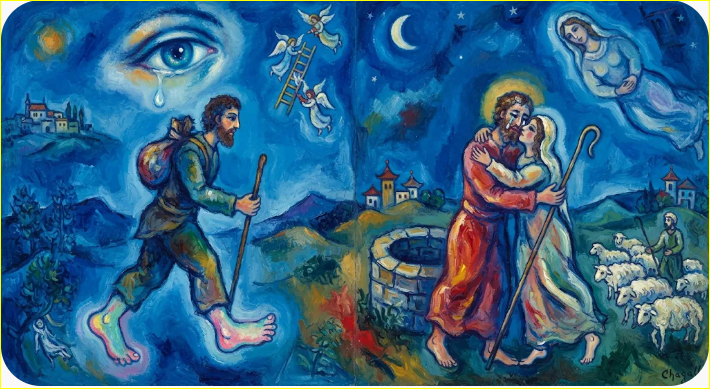
Jacob leaves Beersheva with little more than a promise and a stone for a pillow. The next morning, the Torah gives us a curious description of his departure. It is just one verse, but its grammar is doing something rather unusual. The familiar way of introducing a new scene in Genesis is through the eyes: someone lifts his eyes and sees something. Abraham lifts his eyes and sees three strangers standing before his tent (Genesis 18:2). Isaac lifts his eyes and sees camels approaching (Genesis 24:63). A few chapters later, Jacob himself will lift his eyes and see Esau coming toward him with four hundred men (Genesis 33:1). The eyes go up, and something appears. This is how Genesis usually moves its characters from one scene to another: through what they see. But here the narrator chooses a different body part:
וַיִּשָּׂ֥א יַעֲקֹ֖ב רַגְלָ֑יו וַיֵּ֖לֶךְ אַ֥רְצָה בְנֵי־קֶֽדֶם׃
“Jacob lifted his feet and went toward the land of the Easterners” (Genesis 29:1).
The standard English translation loses something when it writes “Jacob resumed his journey.” Why tell us that Jacob lifted his feet? No doubt, his feet knew what they were supposed to do! The classical commentator, Rashi, drawing on Genesis Rabbah 70:8, offers a lovely explanation:
מִשֶּׁנִּתְבַּשֵּׂר בְּשׂוֹרָה טוֹבָה שֶׁהֻבְטַח בִּשְׁמִירָה נָשָׂא לִבּוֹ אֶת רַגְלָיו וְנַעֲשָׂה קַל לָלֶכֶת
“Once he received the good news that he had been promised divine protection, his heart lifted his feet, and he became light-footed” (Rashi on Genesis 29:1, quoting Genesis Rabbah 70:8).
According to this, it is Jacob’s heart that lifts his feet. The promise he received in the dream the previous night has changed something inside him. He is no longer simply trudging along, fleeing from his brother. He can walk lightly. Midrash Aggadah on Genesis 29:1 makes the point explicitly: ordinarily, a person’s feet carry him; here, Jacob carries his feet. The unusual wording tells us that something has changed in his emotional state.
I prefer to understand it that Jacob’s feet are already moving toward the future, even though his eyes—and perhaps the rest of him—have not quite caught up. His body is moving before he has fully absorbed what he has left behind. After all, he is in a liminal state, between his old known home and his new unknown home.
A few verses later, Jacob arrives at a well covered by a large stone. Shepherds are waiting until all the flocks have gathered before rolling it away. Apparently, there is a local rule about when the stone can be removed. Jacob, still a stranger, is not particularly impressed by this arrangement. He suggests that the shepherds water their sheep and take them back to pasture. They patiently explain that this is not how things are done. While he is still talking to them, Rachel arrives with her father’s flock. The Torah adds, almost casually, that she is a shepherdess:
כִּי רֹעָה הִוא
“Because she was a shepherd” (Genesis 29:9).
It is a small but important detail. Rachel is not sitting at home waiting for a husband to arrive. She is out working, managing her father’s sheep, and doing a job that brings her to a well surrounded by men. But before Jacob even speaks to Rachel, the narrator insists on reminding us of a particular family relationship:
וַיְהִי כַּאֲשֶׁר רָאָה יַעֲקֹב אֶת־רָחֵל בַּת־לָבָן אֲחִי אִמּוֹ וְאֶת־צֹאן לָבָן אֲחִי אִמּוֹ … וַיַּשְׁקְ אֶת־צֹאן לָבָן אֲחִי אִמּוֹ׃
“When Jacob saw Rachel, the daughter of Laban, his mother’s brother, and the flock of Laban, his mother’s brother … he watered the flock of Laban, his mother’s brother” (Genesis 29:10).
Three times in one verse! Laban is never simply Laban. He is always achi imo—his mother’s brother. The English translation refers to him as “his uncle” each time, which is accurate, but misses the point. The narrator reminds us three times that Laban is Rebekah’s brother, which keeps his mother, Rebekah in the picture, even though she is physically absent. At the very moment Jacob first sees the woman he will love, we are repeatedly reminded of the woman he has left behind. And then something happens:
וַיִּשַּׁק יַעֲקֹב לְרָחֵל וַיִּשָּׂא אֶת־קֹלוֹ וַיֵּבְךְּ׃
“Jacob kissed Rachel, and lifted his voice and weeps” (Genesis 29:11).
Before Rachel has learned his name, before he has explained who he is, he kisses her and begins to weep. Only afterward does he tell her that he is her father’s relative, Rebekah’s son. Rachel runs to tell her father, and Laban runs to greet Jacob, embraces him, and kisses him (Genesis 29:12–13). Notice the repetition of the verb nasa, to lift. In the first verse, Jacob lifts his feet. Here, he lifts his voice and weeps. The first lifting carries him toward an unknown future; the second releases something that has been held inside him, the loss of his mother.
The three reminders of Laban’s relationship to Rebekah now make sense. Jacob is not simply meeting a new family. He is reconnecting with his mother’s family. A place that has not seen or heard from Rebekah for twenty years suddenly has her son standing at its door. Perhaps Jacob’s tears are tears of joy at finding his mother’s family. Perhaps they are also tears of grief for the mother he has left behind. The text does not tell us exactly what he is feeling, but it gives us much to think about.
In other words, Jacob’s feet in the first verse and his voice a few verses later represent a portrait of someone who is moving toward what comes next while something about what he has left remains very much alive. These are not two separate stages, first walking and then grieving. Jacob has not finished mourning as he moves forward. By the time Rachel appears, Jacob has already traveled a considerable distance. He has met strangers, asked about Laban, and learned that his uncle is well. He is moving forward, but the sight of someone connected to his mother suddenly releases his tears.
The same chapter will tell us that Jacob serves seven years for Rachel, but they seem to him like a few days because of his love for her (Genesis 29:20). He is capable of falling deeply in love, establishing a household, working, and building a future. None of this means that the past has ceased to matter.
We often like to organize our emotional lives into neat compartments: first grieve, then move on; or move on, and let the grief catch up later. Jacob’s story refuses to cooperate with this timetable. He can be excited about Rachel and still miss his mother. He can be relieved by God’s promise and still carry the pain of leaving home. The two experiences do not cancel each other out. This is perfectly ordinary human behavior. A person can be entirely engaged in a new chapter of life and still be unexpectedly undone by a familiar face, a place, or a reminder of someone who is no longer there.
To understand the significance of Jacob’s lifted feet, we need to return to the previous chapter. Jacob has fled his home because Esau wants to kill him. He is alone, vulnerable, and uncertain about his future. He sleeps outdoors, using a stone as a pillow, and dreams of a ladder reaching from earth to heaven, with angels ascending and descending.
God speaks to him and promises:
וְהִנֵּה אָנֹכִי עִמָּךְ וּשְׁמַרְתִּיךָ בְּכֹל אֲשֶׁר־תֵּלֵךְ
“Behold, I am with you, and I will protect you wherever you go” (Genesis 28:15).
When Jacob wakes, he is reassured. This is the promise that Rashi has in mind when he explains why Jacob’s heart lifted his feet. The dream has given him confidence that he will be protected on the road ahead.What exactly has the dream settled?
God has promised Jacob protection on his journey. That can help him face an uncertain future. But a promise about the future cannot necessarily resolve the pain of the past. The dream has something to say about where Jacob is going. It does not tell us what he feels about leaving his mother, or whether he will ever see her again. These are different emotional accounts, and settling one does not automatically balance the other. This may explain why the next scene is at a well, and why the narrator works so hard to remind us, three times in one verse, of Rebekah. The dream has helped Jacob move forward. But when he encounters his mother’s family, something else surfaces. His feet can carry him into the future, but they cannot do all the emotional work for him.
I think this is one of the most recognizable aspects of being human. There are moments when we are simultaneously moving forward and still carrying something unresolved from the past. It happens when we leave home, begin a new relationship, retire, change careers, move to another country, or start life after losing someone we love. We may be excited about what lies ahead, even as memories of what we have left behind continue to accompany us.
And it is not only a private experience. Families, communities, and entire peoples can find themselves in the same position: trying to build a future while still carrying an unfinished past. An old order may have ended, but its losses have not yet been fully mourned; a new beginning may offer hope, but that does not erase what came before. Neither condition cancels the other.
Jacob’s feet are lifted because he has received a promise. His heart gives him the strength to walk. But his tears at the well remind us that moving forward does not require forgetting, and that even a joyful new beginning can awaken old grief. Perhaps that is the real significance of the unusual wording in Genesis 29:1. The Torah does not say that Jacob lifted his eyes to see what awaited him. It says that he lifted his feet.
He was already on his way. His eyes and his heart would catch up in their own time. And perhaps that is enough. We do not always have to resolve the past before we take the next step. Sometimes we simply have to find the strength to lift our feet.
Shabbat shalom
Related Topics
Related Posts