Finding My Way Home: Parashat Va’etchanan Through the Eyes of the Husiatyn Rebbe
Dedicated to my father, Alexander ben Rachel, with a prayer for his complete and speedy recovery—a refuah shleimah.
Part I. The Prayer That Changed the Future
Every year, as I read Parashat Va’etchanan, I return to the same question.
Why did Hashem refuse Moshe?
Before us stands the man whom the Torah itself describes as “the humblest of all people on the face of the earth.” He never sought power, glory, or honor for himself. He led the people of Israel out of Egypt, ascended Mount Sinai, received the Torah, endured forty years of their complaints, prayed for them again and again after their gravest failures, and remained faithful to his mission until the very end.
And now, with the Land of Israel almost within reach, Moshe turns to Hashem with a deeply personal request.
Not for wealth.
Not for longevity.
Not for power.
He asks for only one thing: to be allowed to cross the Jordan and enter the land toward which he had led the Jewish people throughout his life.
But Hashem refuses.
For thousands of years, this response has inspired countless interpretations. This year, however, one of them led me to see the parashah in an entirely new way.
I encountered it in Ohalei Yaakov, a collection of teachings by Rabbi Yaakov Friedman, the Husiatyn Rebbe. The title means “The Tents of Jacob” and echoes the famous words: “How goodly are your tents, O Jacob, your dwelling places, O Israel”—Ma tovu ohalecha Yaakov, mishkenotecha Yisrael. The very title evokes the idea of a spiritual home that the Jewish people preserve and carry with them from one generation to the next.
As I read Ohalei Yaakov, I began to understand that the question of Va’etchanan is not only why Moshe was denied entry into the Land of Israel.
There is another question:
What did he leave behind?
The Husiatyn Rebbe explains that Hashem’s refusal was not merely a punishment. It contained Moshe’s final great act of service to his people. Had Moshe himself permanently established Israel in the Promised Land, the holiness of his achievement would have been so great that exile would have become impossible.
At first glance, this seems like the greatest blessing imaginable.
But the Husiatyn Rebbe asks us to look deeper.
Had exile become impossible, then after the people’s future sins, Divine judgment could not have fallen upon the Land or the Temple. It would have fallen upon the people themselves.
The possibility of exile became a tragedy, but also an expression of mercy. The people could lose the Land. The Temple could be destroyed. Yet the Jewish people themselves would continue to live—and with their survival, the possibility of return would remain.
Moshe did not enter the Land of Israel himself, but his final service secured a future for those who would come after him.
It was here that I noticed something I had not fully understood before.
Once Moshe realizes that he will not complete the journey with his people, he directs his attention toward the next generation. He repeats the Ten Commandments. He proclaims the words of Shema Yisrael. He commands: “You shall teach them diligently to your children.”
His greatest legacy is no longer the land he will not enter, but the Torah he will pass forward.
And then the central question of Va’etchanan begins to sound different.
Not only: “Why was Moshe denied entry into the Land of Israel?”
But also: “What have we received that we will succeed in passing on to the next generation?”
Part II. An Inheritance That Cannot Be Bought
Reflecting on the words of the Husiatyn Rebbe, I realized that the question posed by Va’etchanan does not concern Moshe alone.
It concerns every human being.
What will we leave behind?
A house?
Money?
Land?
Or something capable of outliving both us and the material possessions we once owned?
I then began to see the greatest gift I received from my father in a new light.
Some might assume that the principal inheritance my parents left me was our home in Brooklyn. I have always understood it differently. In Odesa, my father lived with my mother’s parents. After our family emigrated, the money from the sale of their home became the down payment for our house in America. In my heart, therefore, that house has always remained part of my mother’s legacy.
The greatest gift my father gave me cannot be measured in money.
He preserved memory.
He preserved family documents, stories, and archival traces through which our family’s past was saved from disappearing completely.
Years later, that archive opened a world to me whose existence I had barely known. Through it, I discovered that my great-grandparents belonged to the Ruzhin-Husiatyn Hasidic tradition of Podolia.
At first, I simply wanted to know who my ancestors had been.
But, as so often happens in the study of Torah, the answer to one question leads to another, deeper one.
Not only: “Who were they?”
But also: “What were they trying to pass on to their descendants?”
Soviet rule deprived many Jewish families not only of religious life, but also of the memory of the spiritual communities to which they had once belonged. Today, we are most familiar with those streams of Judaism that succeeded in rebuilding themselves and becoming visible once again. Yet before the Holocaust and Soviet persecution, Jewish life in Ukraine was far broader and more diverse.
Numerous Hasidic courts flourished there, each with its own spiritual language, customs, and understanding of service to Hashem. One of those nearly forgotten worlds was the Ruzhin-Husiatyn tradition.
Because of my father and the family archive he preserved, I received the opportunity not merely to learn the names of my ancestors, but to rediscover their spiritual roots.
In this sense, my father did what Va’etchanan asks of us.
He passed forward something that might otherwise have disappeared.
Part III. “All Jews Are Children of Kings”
To understand what my ancestors sought to transmit to their children, I first had to understand the spiritual world in which they lived.
The Ruzhin-Husiatyn tradition occupied a distinctive place even among the many Hasidic movements of Eastern Europe.
Hasidism is often associated with humility, simplicity, and the rejection of outward symbols of status. The Ruzhin school emphasized something different. It did not reject humility, but joined it with the concept of malchut—royal dignity.
The founder of the dynasty, the Holy Ruzhiner, Rabbi Yisrael Friedman, drew upon the Talmudic teaching: “All Jews are children of kings”—B’nei Melachim.
For him, this was more than a beautiful metaphor.
If we serve the King of Kings, then we should carry ourselves with the dignity of His children.
Not with arrogance.
Not with pride.
Not with a desire to place ourselves above others.
Royal dignity meant inner nobility, self-discipline, responsibility, and respect for oneself and for others. A person should not degrade himself, because he was created by Hashem and called to serve Him.
This is why the court of the Ruzhin Rebbe was surrounded by an atmosphere of royal splendor. He wore his famous golden kippah. Hasidic tradition tells of magnificent clothing, carriages, candlesticks, and even golden boots.
A superficial observer might have seen only luxury.
But the meaning went deeper.
The Ruzhin Rebbe did not glorify wealth as an end in itself. He glorified the dignity of divine service. Material poverty was not automatically regarded as a spiritual ideal, just as material prosperity was not automatically regarded as proof of righteousness.
The world created by Hashem need not be rejected. It can be elevated.
Education, honest labor, successful enterprise, beauty in the performance of mitzvot, and public responsibility do not contradict Torah when they are not turned into idols, but become instruments in the service of Hashem.
It was here that the history of my family began to make more sense to me.
My great-grandfather, Srul, was an educated and successful man. He managed the affairs of the landowner Dembitsky, became his business partner in brick manufacturing, and later owned his own factory in Kitaygorod. He also participated in public life as an elected representative. My great-grandmother came from a prosperous merchant family.
At the same time, they were religious Jews who belonged to the Ruzhin-Husiatyn tradition.
I had once regarded their education, business success, and public involvement as separate facts of family biography.
Now I saw a coherent worldview behind them.
They did not believe that faithfulness to Torah required the rejection of education, honest achievement, or participation in society. Their task was to sanctify those achievements and carry them with responsibility.
In this way, the Husiatyn Rebbe’s commentary on Va’etchanan helped me understand more than Moshe’s final act.
It helped me understand the spiritual language of my own family.
Part IV. What I Must Pass Forward
Rediscovering the Ruzhin-Husiatyn tradition helped me understand not only my ancestors, but also myself.
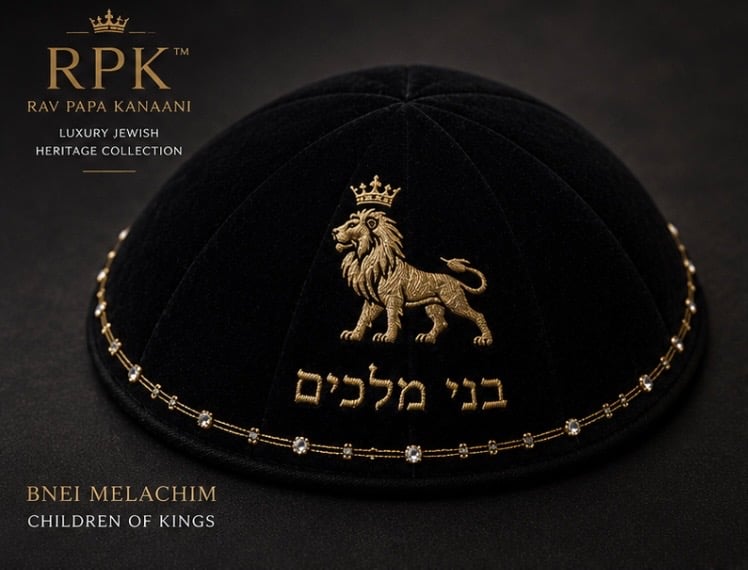
Today I am developing the Rav Papa Kanaani brand, creating items of Jewish clothing and cultural heritage. I once regarded my attraction to a dignified and ceremonial Jewish aesthetic primarily as a matter of personal taste.
Now I understand that something deeper stands behind it.
If the Talmud teaches that we are B’nei Melachim, children of kings, then these words should be reflected not only in our prayers, but also in the way we regard ourselves, prepare to fulfill the mitzvot, and express respect for the One we serve.
This is why the words B’nei Melachim have become one of the symbols of my brand.
For me, they are not a call to ostentatious luxury.
They are a reminder of dignity.
I do not know when Mashiach will come. But I know that I would like to greet him in ceremonial clothing—not out of vanity, but in the spirit of the Ruzhin tradition: with joy, inner nobility, and the awareness that we stand before the King of Kings.
Perhaps this is why the teachings of the Ruzhin-Husiatyn school have felt so deeply familiar to me. I do not see them as a historical curiosity or as a vanished world that can only be observed from the outside.
This is the tradition of my ancestors.
It is now becoming part of my own spiritual life, influencing what I create and what I hope to pass forward.
When Moshe learned that he would not enter the Land of Israel himself, he transmitted Torah, mitzvot, and memory to the next generation.
My father preserved our family archive and passed on to me knowledge of a world that the Soviet era had nearly erased from our family’s memory.
Now it is my turn to pass that inheritance forward.
Through the study of Torah.
Through my writing.
Through the effort to restore an almost forgotten voice of Ruzhin-Husiatyn Hasidism to the contemporary Jewish world.
I opened Ohalei Yaakov hoping to understand Parashat Va’etchanan more deeply. Unexpectedly, it also helped me understand the history of my own family.
Perhaps this is how Hashem sometimes leads a person home: through words of Torah carried to him from the depths of generations.