
Russian-American-Israeli Palestinian. Palestine is Israel.
Fins and Scales, Hooves and Cud
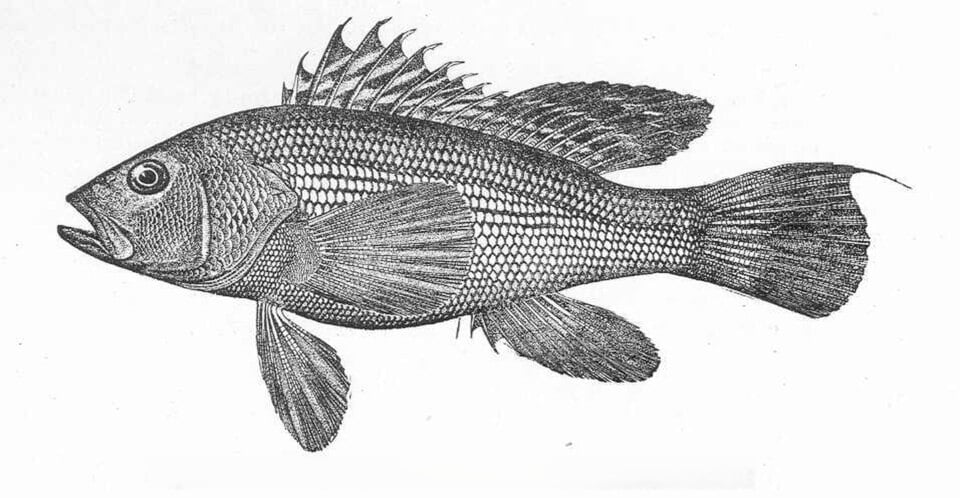
If every fish with scales also has fins, why does the Torah mention fins at all? Image: Black sea bass (Centropristis striatus). A kosher fish. Public domain. Source: Wikimedia Commons.
Kashrut Through the Lens of Information Theory: The Hidden Logic of Redundancy
The Torah is often admired for its brevity.
Yet in some places, it appears surprisingly redundant.
Consider the two most familiar signs of kashrut.
Regarding fish, the Torah states:
These you may eat of all that are in the waters: whatever has fins and scales in the seas and in the rivers, them you may eat. But whatever has not fins and scales… shall be an abomination unto you.
At first glance, this seems perfectly straightforward.
But the Mishnah records an important biological observation:
Every fish that has scales also has fins, but there are fish that have fins and do not have scales.
Maimonides codifies the same principle:
Fish have two signs: fins and scales… Every fish that has scales also has fins.
— Mishneh Torah, Forbidden Foods 1:24
In other words, the requirement for fins is logically redundant.
If every fish with scales necessarily has fins, why didn’t the Torah simply say:
All fish with scales are kosher.
The question becomes even stronger when we turn to land mammals.
The Torah states:
Whatever parts the hoof, is cloven-footed, and chews the cud—among the animals—you may eat.
It then lists four apparent exceptions:
- the camel,
- the hyrax,
- the hare,
- the pig.
Three chew their cud but lack split hooves.
One—the pig—has split hooves but does not chew the cud.
Remarkably, both the rabbinic tradition and modern observation have long regarded the pig as uniquely occupying this category among the land mammals familiar to the Torah’s original audience.
Maimonides goes even further. He states as a general principle:
Every animal that has split hooves chews the cud except the pig.
— Mishneh Torah, Forbidden Foods 1:2–3
He presents this not as a legal rule but as a fact of nature used to identify kosher animals.
Again, we may ask:
Why not simply say:
All split-hoofed mammals are kosher except the pig.
That would be both shorter and logically equivalent.
Traditional Answers
The rabbis recognized this apparent redundancy long ago.
Regarding fish, the Talmud itself raises the question: why does the Torah mention fins if every fish with scales necessarily has fins?
Over the centuries, several answers have been proposed.
One practical explanation concerns not the wording of the verse, but its application.
The Torah states the complete definition of a kosher fish, while a person inspecting a fish need only verify its scales. Since scales guarantee the presence of fins, checking one sign is sufficient in practice. This explains how the law is applied, but it does not explain why the Torah chose to formulate the rule using both signs. (Chullin 66b; Niddah 51b.)
Other commentators sought a deeper meaning.
Ramban associates the signs with the fish’s way of life and physical nature (Ramban on Leviticus 11:9).
The Hatam Sofer develops a broader spiritual interpretation in which fins and scales reflect distinct aspects of a fish’s spiritual suitability for consumption (Chatam Sofer on Torah, Shmini).
According to this approach, each sign conveys its own theological message, even if either one alone would have been sufficient for legal identification.
Although the same logical question arises for land mammals, the classical discussion centers primarily on fish. In rabbinic tradition, the pig is recognized as the unique animal with split hooves that does not chew the cud, yet the Torah still defines kosher mammals using two positive characteristics rather than one characteristic and a single exception. The reason for this literary choice is left largely unexplored.
These are profound and influential interpretations.
Yet they do not fully address the question explored in this article.
The practical explanation concerns the application of the law, while the theological explanations concern the meaning of the signs.
Here we ask a different question:
Why did the Torah choose to state the complete criterion instead of a logically equivalent but shorter one?
Suppose the Torah’s goal was not merely to define the laws of kashrut for one generation, but to preserve those laws accurately across centuries—or even millennia.
If so, the apparent semantic redundancy may serve an entirely different purpose: protecting the meaning of the text against the gradual evolution of language.
Redundancy as a Feature
Modern information theory teaches that redundancy is not necessarily waste.
It is often essential.
When Claude Shannon founded information theory, one of his central insights was that communication over noisy channels requires redundancy. A message that contains no redundancy is highly efficient—but also highly fragile. Even a small error may change its meaning beyond recovery.
Error-correcting codes deliberately transmit more information than is logically necessary. The extra information does not change the message itself. Instead, it enables the receiver to detect errors and, often, to reconstruct the original message.
For example, instead of transmitting the four-bit sequence
1011
an error-correcting code might transmit
1011110
The additional bits carry no new content. Their purpose is to make the message more resistant to corruption.
Human language works in much the same way.
English is highly redundant. Even when several letters disappear, most readers can still reconstruct the intended sentence:
Al fsh that hve scals als hve fins.
We effortlessly recognize the original:
All fish that have scales also have fins.
Human readers reconstruct missing letters because English contains redundancy. In much the same way, future generations may reconstruct the intended meaning of a word if the text provides multiple independent clues rather than a single defining characteristic.
Redundancy makes communication robust.
The same principle appears in many other disciplines. Engineers build fault-tolerant systems. Lawyers often define important concepts using multiple overlapping criteria. Database designers duplicate critical information to improve reliability. In each case, a small amount of redundancy increases resilience.
Language itself presents another source of noise.
Unlike a communication channel, language changes over time. Words gradually acquire new meanings or lose old ones.
Historical linguistics is full of examples:
- meat once meant all food.
- deer once meant any wild animal.
- girl once meant a child of either sex.
This gradual evolution—known as semantic drift—creates a different kind of transmission error. A text may survive perfectly while its vocabulary slowly changes around it.
One way to reduce this risk is to define important concepts using multiple independent characteristics rather than a single identifying term.
Missing letters are one kind of communication error. Semantic drift is another. In both cases, redundancy makes the original meaning easier to recover.
Viewed through this lens, the Torah’s apparent redundancy begins to look less like unnecessary repetition and more like a deliberate strategy for preserving meaning across generations.
Semantic Drift in Action
When we think about the Torah, we usually imagine textual transmission.
But there is another kind of noise.
Language itself changes.
Words drift.
Meanings evolve.
Cultures disappear.
Suppose the Torah had simply said:
All fish with scales are kosher.
Two thousand years later, readers might ask:
- What exactly are “scales”?
- Do tiny skin plates count?
- Cartilaginous bumps?
- Shells?
- Armor?
- Some unfamiliar anatomical feature?
The meaning of a single defining term may gradually become uncertain.
Now consider the actual verse.
A kosher fish must have both fins and scales.
The two characteristics reinforce one another.
Even if the meaning of one term becomes less certain over time, the other provides an independent clue to its intended meaning.
The redundancy acts like an error-correcting code.
Future readers who become uncertain about one term can use the other to reconstruct the intended meaning.
Rather than narrowing the class of kosher fish, the second sign makes the definition itself more robust against semantic drift.
The Mammal Case
The same principle may explain the two signs for land mammals.
Suppose the Torah had simply said:
All split-hoofed mammals are kosher except the pig.
Centuries later, imagine that the Hebrew word for pig—חזיר (chazir)—had changed meaning or fallen out of use.
Which animal did the Torah originally intend?
The exception itself would become ambiguous.
Instead, the Torah defines kosher mammals using two observable characteristics:
- split hooves,
- chewing the cud.
Unlike a species name, these characteristics are far less vulnerable to semantic drift.
Even if the name of an animal changes over time, the defining characteristics remain the same.
Once again, the apparent redundancy makes the definition itself more robust.
Redundancy Preserves Meaning
This suggests a different way to understand biblical style.
The Torah may not always be designed for minimal wording.
It may be designed for maximal preservation of meaning.
A logically minimal rule is often fragile.
A redundant rule is more resistant to misunderstanding.
Engineers recognize this principle immediately.
When reliability matters more than efficiency, redundancy is not a flaw.
It is a feature.
Perhaps the Torah employs a similar strategy—not because its original audience needed the additional information, but because future generations would.
A Broader Pattern
This possibility extends beyond the laws of kashrut.
Throughout the Torah, important concepts are frequently described using multiple parallel expressions, repeated formulations, and overlapping descriptions.
From the standpoint of modern literary taste, such passages may sometimes appear repetitive.
From the standpoint of information theory, however, they look remarkably different.
Redundancy is precisely what allows information to survive long journeys through imperfect channels.
The Torah’s communication channel is unlike any other.
Its message is expected to survive not merely across distance, but across languages, civilizations, and millennia.
If preservation across such a span was the goal, then redundancy is exactly what we should expect to find.
Perhaps what appears to be unnecessary repetition is actually one of the Torah’s most sophisticated features: a built-in defense against semantic drift, preserving meaning long after the language itself has changed.
Related Topics
Related Posts