
This Way Up: Spiritual Means to Psychological Ends
Fivefold Pathways: Jewish and Chinese Wisdom in the Palm of the Hand
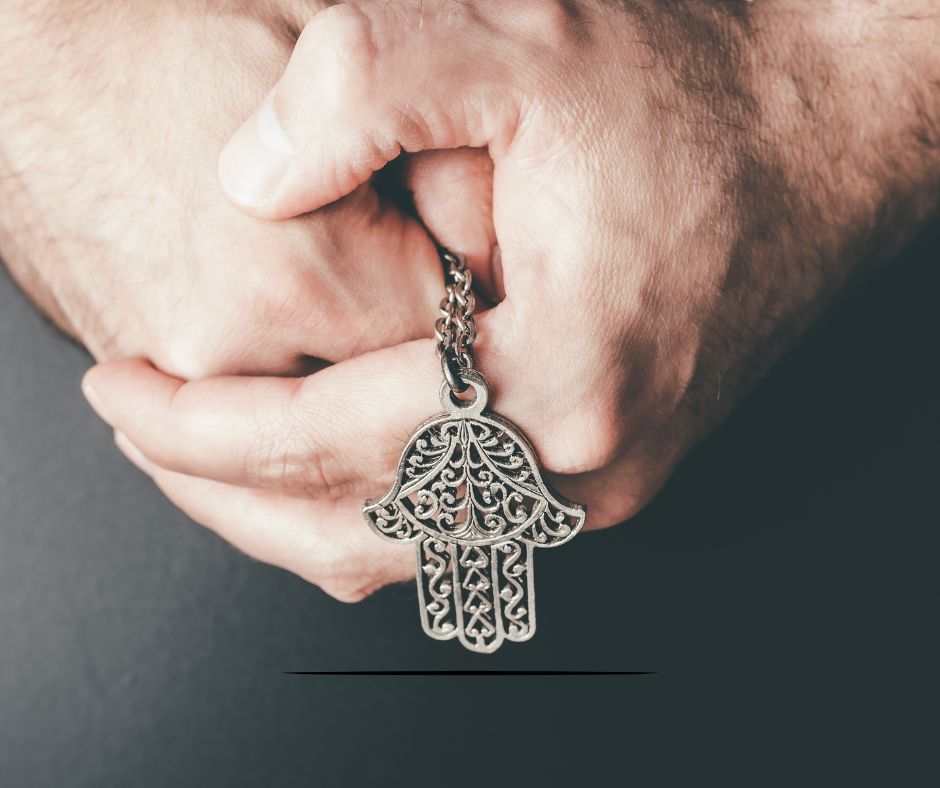
The Hamsa, a protective amulet in some Jewish communities. Image courtesy of Canva.com
Traditional Chinese Medicine (TCM) rests on a vision of the world shaped by Five Element Theory — Wood, Fire, Earth, Metal, and Water. These are not inert substances but dynamic archetypes, metaphors for life processes, personality traits, and the evolving choreography of nature and spirit. This fivefold framework organizes the cosmos in its movement and transformation.
And while Judaism does not overtly articulate a Five Element system, the premise that both traditions are working to decipher the same underlying reality invites us to seek echoes of this structure in Torah. What is explicit in Chinese thought is often implicit in Jewish sources — encoded, subtle, suggested through structure and symbolism.
The Hamsa: Five Fingers of the Sacred
The Hamsa, the ancient Middle Eastern symbol shaped as an open hand with five outstretched fingers, offers a visual and conceptual key. The Hamsa, in some Jewish communities, is a protective amulet, perhaps evoking associations to the ‘hand of G-d’ that lead the Jews out of Egypt, or reminiscent of the hand gesture used by those of priestly descent who bless the Jewish people with outstretched hands.
In a Chinese framework, the five fingers of the hand correspond to the Five Elements, each linked to an organ, emotion, and cosmic function. Similarly, the Hamsa can be read as a symbolic map of fivefold integration: five channels of Divine expression radiating from a single source. Just as the Hamsa wards off fragmentation and distortion, the Five Elements restore wholeness through balance.
The hand, then, becomes a shared emblem between East and West: a sacred glyph of strength, integration, and elemental order.
Fivefold Light: A Creation Clue
Where else might we find insinuations of the Five Elements in the Jewish tradition? Nechama Leibowitz, the renowned Torah scholar, draws attention to the repetition of the Hebrew word Ohr (light) in the creation narrative. On the first day, we read five references to light: “Let there be light,” “G-d saw the light, that it was good,” and so on. Leibowitz notes that this is not random, citing a commentator who teaches that these five mentions represent a fivefold light at the root of Creation.
In a system where light often symbolizes spirit or consciousness, could this be Torah’s subtle nod to the Five Elements — the primordial differentiation of essence? Perhaps each “light” is a facet of soul or cosmos — each finger of the Hamsa radiating one of five ‘streams’ of Divine illumination.
Waters of Eden: The River That Splits Four Ways
Shortly after the light, we are introduced to the waters of Eden. A singular river flows from the garden and splits into four tributaries — Pishon, Gihon, Hiddekel (Tigris), and Perat (Euphrates). A one-into-four model mirrors what we might call the archetypal structure — a unified source branching into differentiated forms.
In Five Element Theory, all elements emerge from a central unity and cycle through transformation. One becomes five. A central palm, five radiating fingers. The Hamsa again becomes a fitting image: a cosmogram of rooted center and radiant complexity.
The Five Blessings of Abraham
In the call to Abraham — the first spiritual awakening of humanity, the archetype of the soul’s journey — we find five blessings pronounced in quick succession (Genesis 12:2–3): “I will make you a great nation,” “I will bless you,” “I will make your name great,” “you shall be a blessing,” “I will bless those who bless you.”
Benno Jacob identifies this fivefold structure as deliberate, a poetic signature of Divine abundance. He connects these five blessings back to the fivefold light of Creation — suggesting that blessing and light are thematically and numerically aligned. The Hamsa, often associated with both light and blessing, becomes a symbolic anchor: five rays of Divine benevolence.
Torah’s Fivefold Shape
The very structure of the Torah — five books — is a bold affirmation of the number five’s symbolic power. The Chumash (from chamesh, “five”) may encode a vision of the fivefold human journey: from Genesis (origins) to Exodus (liberation), Leviticus (discipline and sanctity), Numbers (wandering and maturation), and Deuteronomy (integration and transmission).
One might map these five books to the five fingers of the Hamsa — each book a unique gesture in the unfolding of sacred history, all emanating from the same Divine ‘hand’.
The Quintessence of You
The word quintessential stems from the Latin quinta essentia, “fifth essence,” once used to describe the highest, purest element beyond the four known ones. In Torah language, this fifth essence could be the integrated soul — the self in which all five levels of soul (nefesh, ruach, neshamah, chayah, yechidah) are harmonized. Or the fully balanced being: just and merciful, masculine and feminine, fire and water.
The Hamsa points to this quintessence — a palm at rest, fingers aligned, forces balanced. Not merely a charm, it is an esoteric diagram of wholeness.
Abraham’s Transformation: Receiving the Fifth Letter
Abraham himself embodies this movement toward wholeness. Initially Avram, he becomes Avraham with the addition of the fifth Hebrew letter — Hey. This letter, breathy and open, is said to represent Divine breath, the energy of creation.
Through the Hey, Avraham becomes archetypal — the soul who integrates the fifth element and becomes a partner in creation. His transformation, we can conjecture, mirrors the hand fully extended, the final light unlocked. Maybe, then, the Hamsa represents the spiritual architecture of becoming.
A Letter Too Small
In Genesis 2:4, we read: b’hibaram — “when they were created,” a line which is meant to summarize the Creation process. But the letter Hey in this word is written unusually small in the Torah scroll. This invites interpretation. Rashi and others suggest: read it as b’Hey baram — “with the letter Hey, He created them.”
But b’hibaram also rearranges to b’Avraham — “for the sake of Abraham,” him being the one who had that Hey added to his name! Creation and quintessence are bound together. The five elements, the fifth letter, the Five books of Moses, will speak of emergence, completion, identity. The Hamsa gathers these threads into a single symbol.
Lech Lecha: The Hero’s Journey Toward Balance
G-d’s call to Abraham begins: Lech lecha — “Go . . . to yourself,” a phrase as paradoxical as it is profound. The movement outward is also a return inward. The soul’s path is not linear but cyclical — like the generative cycles of the Five Elements, or the outstretched Hamsa hand that both blesses and receives.
This is not merely a historical command but a metaphysical one. The call to balance Yin and Yang, masculine and feminine, soul and self — so that one may become aligned with the Divine pattern. The Hamsa hand, open and attuned, becomes a symbol for this inner alignment: centered, radiant, whole.
Conclusion: The Hidden Hand
We do not need a chapter in Torah labeled “The Five Elements” to recognize their presence. Torah speaks through pattern, number, and anomaly. Chinese cosmology gives us a system; Jewish tradition, a set of stories and symbols. But both encode the same message: the world is structured, dynamic, elemental — and the human being is called to harmonize with that order.
The Hamsa, with its five fingers and open palm, is more than ornament. It is a map of the journey, a mystical diagram of integration. Between the rivers of Eden and the blessings of Abraham, between elemental theory and biblical poetry, there lies a shared wisdom. The task is not to import one tradition into the other — but to awaken the resonance already present.
Two traditions. One hand. Five fingers of light.
Related Topics
Related Posts