Flubbing the Facts in My Family’s Nazi Germany Escape Story
Hardly a month goes by without news of a new project to document Holocaust history coming to my attention. Having spent much of my first decade in Germany digging into my family’s past, such projects are less likely to capture my attention these days. This changed late last year when I read about the Institute for German Jewish History’s Visualizing the Past – Creating the Future project.
The Institute was reaching out to descendants of families that fled Hamburg in the 1930s. We were invited to submit photos and documents depicting the flight from Hamburg and the arrival and beginnings in a new “home” for a digital and print publication. The project peaked my interest because my sister and I had done much to document our father’s family history in the Frankfurt area, but had done little to tell the story of our mother’s flight from Hamburg in 1938.
Our mother had passed away in 2017 and we felt the Hamburg photo project was a chance to honor her memory. I got in touch to express my interest and was pleased to receive a positive response, but things went awry from there.
Giving others a hand in documenting our personal histories has many potential pitfalls. I was aware of these pitfalls, having previously engaged with Holocaust researchers who seemed intensely eager to secure materials from my family for their projects. In one meeting with a researcher from the Moses Mendelssohn Center in Potsdam, I received little assistance for my own research but was instead asked to provide original family memorabilia for an international traveling exhibit about the Shoah. I turned down the request to send our family keepsakes around the world.
Unsure about how the Hamburg photo project would unfold, I sent in a few photos and briefly answered some initial questions about my mother and grandparents. I expected to then have an interview or some sort of in depth follow-up to share further details about my family. This never happened. The Institute requested no further information at all.
Our earlier research into my father’s family had uncovered many details about their lives in the village of Altwiedermus, near Frankfurt, where they had lived for centuries. However, my mother’s parents, Alfred and Ilse Cahn, originally from Essen and Kassel, had only moved to Hamburg after they were married. We had sparse details about their lives in Hamburg-Altona and our mother had limited memories because she was only five when they escaped. Nor did she ever dwell on traumas from the past while we were growing up.
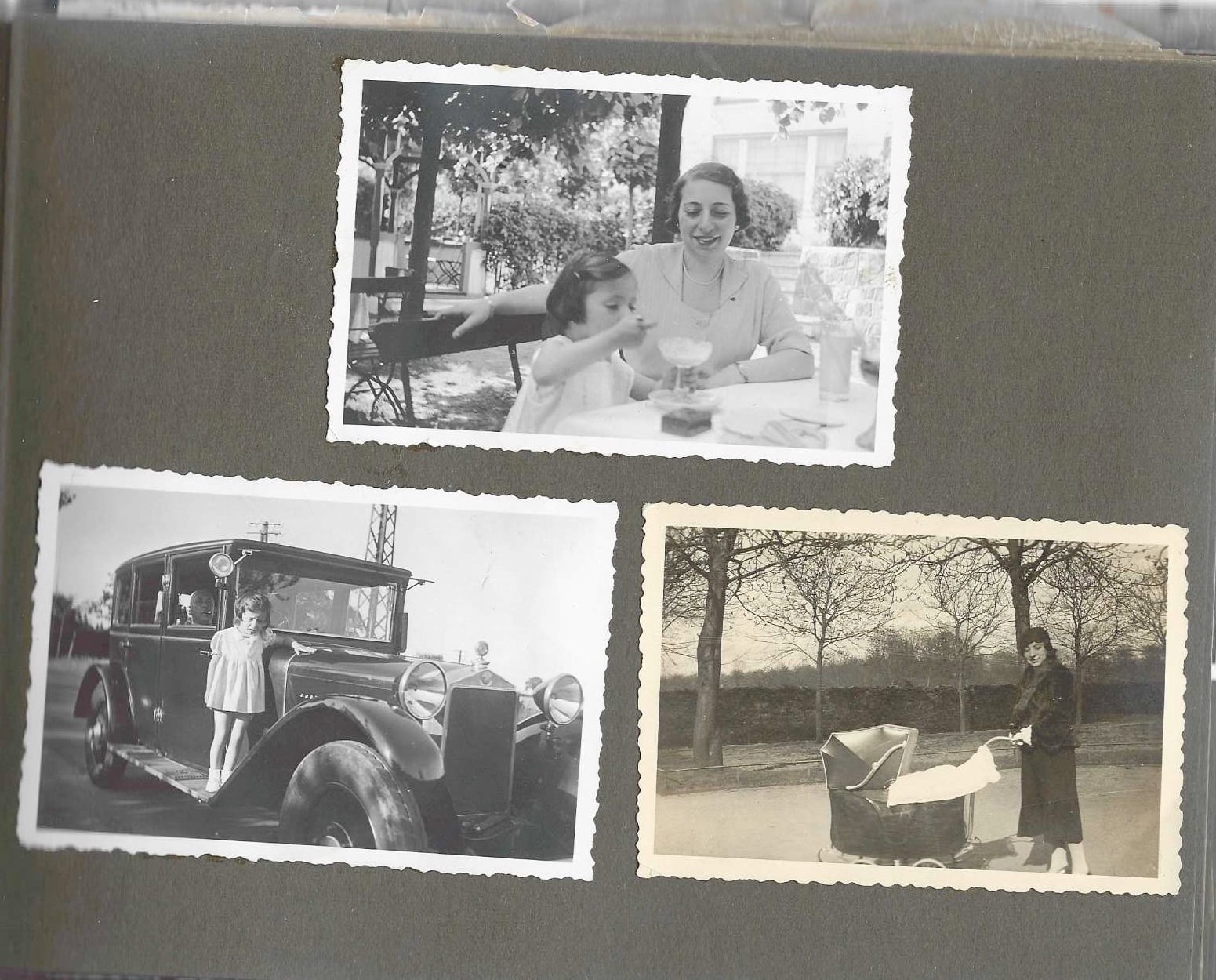
Shortly after the April 1st deadline to submit photos, my sister arrived in Berlin with three of our mother’s old photo albums. We found a few more images to reflect the family’s years in Hamburg from 1933, when our mother was born, to 1938. These photos showed a young family enjoying life in Hamburg and their new start in America. By mid-April I was able to send an additional four photos to go along with the five images I had sent before the deadline.
About a month later I received the final draft of the pages that would feature my family in the forthcoming publication. Opening the document I was stunned to discover that an entire story had been written about relatives I had never heard of and presented as my own contribution. It was a story of a prominent soccer player named Selig Cahn from a strictly Orthodox family who was one of the first Holocaust victims sent from Hamburg to Auschwitz. His children and siblings were also deported and murdered.
The story hit me like a bolt of mental whiplash. Who were these other members of the Cahn family and were they really our relations? Had the Institute staff uncovered new information about our family tree? We were not aware of any family members who had been deported from Hamburg or had an Orthodox background. After a day of frantic searching through our limited family records and German Jewish genealogy sites, my sister and I were able to establish that the people in the story had no connection to our grandfather.
The Institute staff offered profuse apologies about their mistake but without any explanation about how such an egregious error had occurred. I considered withdrawing from the photo project, but I had already provided the photos and was given the chance to write a revised text that would accompany them. No word count or other guidelines were given, leaving me uncertain about how best to represent a part of my background I knew little about.
The digital version of the final photo project publication can be found here: Fotokatalog “Visualizing the Past – Creating the Future”: Familienfotos – Familiengeschichten. The Cahn/Adler family display (pp. 70-73), with the brief text I submitted, offers the barest of outlines about the history of my maternal relatives. To my dismay, none of the additional photos I sent shortly after the deadline for submission were included (see cover image).
Germany has a plethora of professional researchers and institutes dedicated to ensuring that the world “never forgets”. Publications on the concentration camps, labor camps, Jewish ghettoes, and every other facet of Nazi persecution still appear at a steady pace more than 80 years later. Along with commemorations of lives lost, these publications are supported by a multitude of government and private sources. As in other fields, rigorous standards and adequate oversight are important to ensure that historical accounts are as accurate as possible.
When initially asked to briefly answer a few questions about my family for the Hamburg photo project, I had assumed this was the beginning rather than the end of my input. I don’t know what quality standards were used for the project, nor do I wish to accuse the Institute of wrongdoing. But significant factual errors could have been avoided if clearer protocols were in place at the outset of the project and a higher standard was set for involving the families in bringing their stories to light.
The final result of the “Visualizing the Past – Creating the Future” project is a very attractive publication that presents the heritage of seventeen German Jewish families with roots in Hamburg. A newly designed photo archive also offers digital access to the many family photos that were submitted for the project. The pages for the Cahn/Adler family are a tribute to our mother who found a safe haven in New York City, but like many German Jews of her generation, never reconciled with the country of her birth.