Flying home to vote
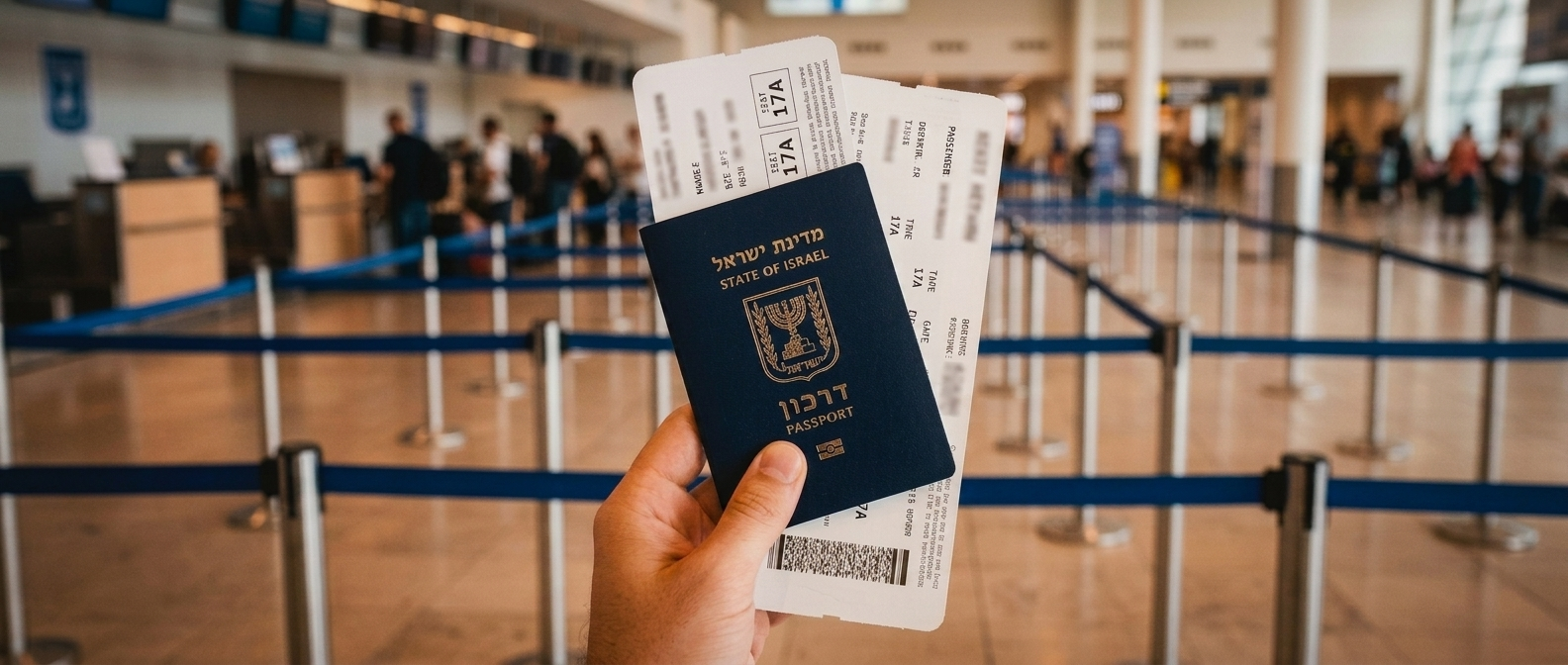
In October I will board a plane from Germany to Israel for a journey lasting barely four hours. I will be traveling for one reason only: to cast a single vote.
I will not be alone. Israel allows no absentee voting, so roughly half a million Israelis living abroad face the same choice this autumn: buy a ticket or sit the election out. Some are organizing charter flights. Others are sharing bookings online, comparing fares to Ben Gurion the way people elsewhere compare polling averages.
For a few weeks, democracy acquired an airfare.
When I left Israel, it was not because I had stopped believing in the country. It was because I had been given an opportunity to do something I thought mattered.
For years, I ran kosher restaurants in Europe. Most people would call that a career change. I never did. A kosher restaurant is more than a place to eat. It is where a community gathers after synagogue, where families celebrate birthdays and bar mitzvahs, where a traveler eating alone can sit down at a table and feel less alone. Every Friday afternoon, my kitchen raced the setting sun, trying to have every challah baked and every pot off the stove before Shabbat arrived.
My address had changed. My sense of belonging had not.
Leaving Israel did not mean leaving the Jewish people. If anything, it meant serving another part of it. The communities I cooked for in Basel were not an alternative to Israel. They were part of the same Jewish story. My move changed my address, not my allegiance.
That is why I listened carefully when, on a radio program on Israel State Radio in May, broadcaster Akiva Novick argued that Israelis who choose to live abroad should not determine the future of those who remain. The occasion was a discussion of “Fly and Vote,” an initiative founded by Israelis in the United States to help citizens overseas return for election day. Those who live in Israel, the argument runs, pay the taxes, send their children to school, sit in the traffic and – above all – bear the daily consequences of government policy. They should choose the government.
It is a serious argument. It deserves a serious answer, and I have spent the weeks since trying to give myself one.
Not on the question of whether I may vote. Israeli law settles that. Nowhere does the law say that emigrants are barred from voting. It says something narrower: every voter votes in person at the polling station where their name is registered. Israel never withdrew my vote. It simply requires me to return in order to cast it. If I board a plane and present myself at the polling station where my name appears, I vote like every other citizen.
The real question is whether I should.
For me, the answer is an unequivocal yes – not because I think my opinion matters more, or less, than that of someone who never left. Quite the opposite.
It is because I would not be able to look at myself in the mirror if I stayed away.
Voting, for me, is not about preserving the right to complain. I do not want to earn the right to criticize the next government. It is the other way round: I want there to be less for me to criticize.
My mother lives in Israel. So do my brother and my son. The government chosen in October will shape their lives long after I have flown back to Europe. The consequences of Israeli elections are not theoretical in my family. They are argued over on the telephone and lived every day.
Nor has Israel itself ever suggested that my citizenship ended when I emigrated. The law requires Israeli citizens to enter and leave the country on Israeli passports; when I land in October, I will cross the border as an Israeli because the state insists on it. Through the Law of Return, Israel offers a home to Jews who have never lived there and were not born there.
I myself was born in the United Kingdom, not Israel, and became an Israeli citizen under the Law of Return. Israel’s Nation-State Basic Law goes further still, committing the state to strengthen its ties with the Jewish people in the Diaspora. A state that is constitutionally committed to maintaining its bond with Jews beyond its borders can hardly object when one of those Jews maintains his bond with the state by voting.
Israel’s understanding of itself has never been confined by geography.
Why should mine be?
I left Israel geographically, not emotionally.
I recognize what the opposing argument gets right. Distance changes perspective. I no longer wake each morning under the Israeli government, and those who remain carry burdens I do not. But distance is not severance. If anything, living among European Jews has taught me that Israel’s decisions rarely stop at its borders. They shape how Jews are seen, how communities understand themselves, and how many of us imagine our future, including whether some of us imagine returning.
I have not closed that door. The Israel that emerges from this election may help determine whether I walk through it again.
Jewish tradition has something to say about people who stand far away and look towards the land of Israel.
The Talmud teaches that one of the non-kosher birds is called the ra’ah because it stands in Babylonia and sees carrion in the land of Israel. The problem is not that it lives in Babylonia. The problem is that all it sees is decay.
The Torah tells a similar story. Twelve spies crossed into Canaan. Ten returned convinced that nothing could be done: giants, fortified cities, inevitable defeat. Joshua and Caleb looked at exactly the same landscape and reached a different conclusion. They did not deny the dangers. They simply refused to believe the future was already written because they had not surrendered hope.
Both stories ask the same question: what does distance do to judgment?
I have no wish to become the ra’ah, perched comfortably in Europe cataloguing everything wrong with Israel, nor to join the 10 spies, convinced the country’s problems are beyond repair. Between the bird that sees only carrion and the spies who see only giants stands a third possibility: to go and look for yourself, and then to act.
Last year, I voted in Germany’s federal election because I believe democratic values matter in the country where I live. In October, I will fly to Israel because I believe they matter in the country that remains my home.
Citizenship is not measured by whether your ballot proves decisive.
It is measured by whether, when your country asks you to choose, you are willing to show up.
In October, I will.
Mine is not a flight from home.
It is a flight home.