
President of Shahvand Think Tank
Football, Politics, and the Sun and Lion
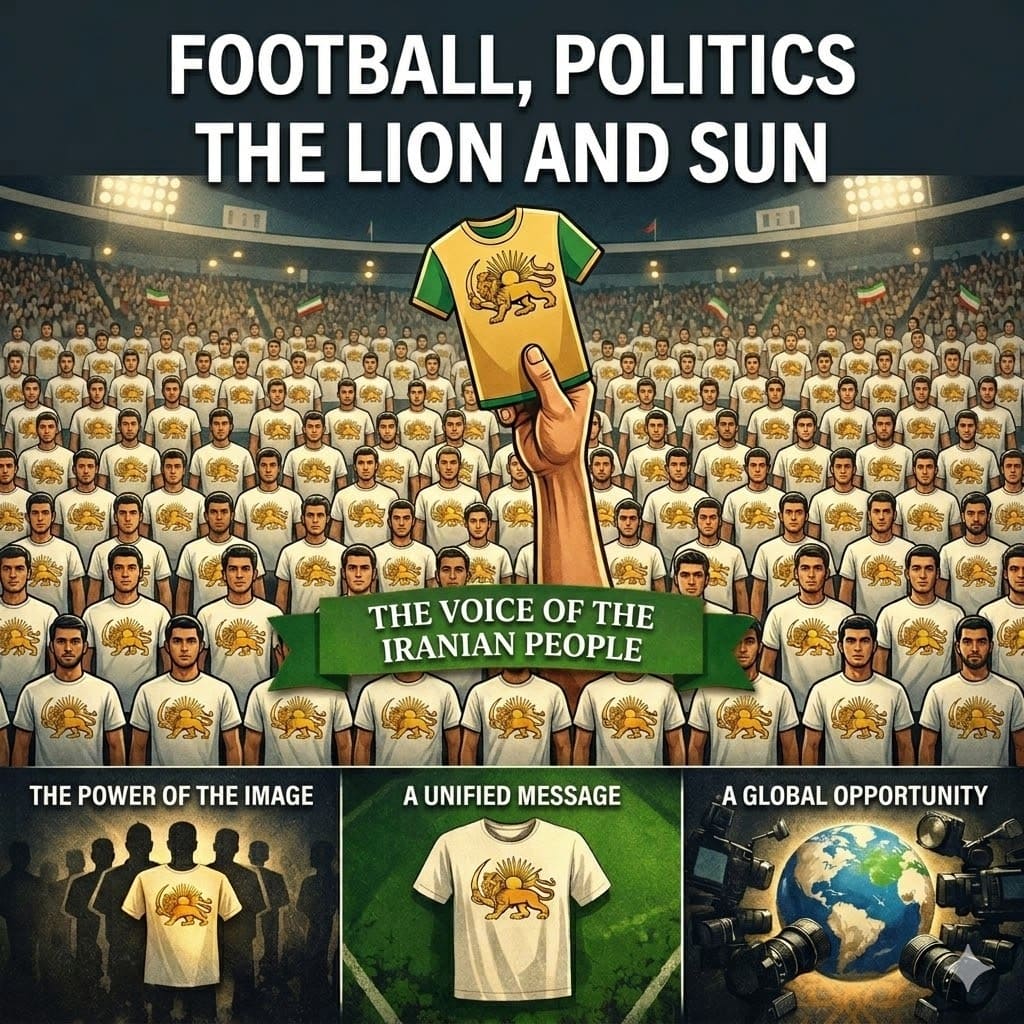
Football, Politics, and the Sun and Lion: Shaping the Narrative on the World Cup Stage.
Football, Politics, and the Sun and Lion: Shaping the Narrative on the World Cup Stage.
With the kickoff of the Football World Cup, a deeply rooted and highly charged debate has once again ignited within the Iranian diaspora and among opponents of the Islamic Republic: Does presence in the stadiums mean reinforcing the Islamic Republic’s narrative and inadvertently validating the regime’s propaganda, or does it present a rare, high-stakes opportunity to project the authentic voice of the Iranian nation to the world?
In the modern media landscape, the ultimate arena of political confrontation is no longer confined to traditional corridors of power or physical battlefields. Instead, it plays out in the meticulous management of narratives, public image-making, and the strategic capture of global attention. The World Cup, drawing an audience of hundreds of millions, stands as one of the most potent media vectors on earth. For a nation trapped in a cycle of state violence and digital blackouts, a stadium bleacher can become a vital democratic space.
Historically, activists have sought to smuggle the ancient Lion and Sun flag into matches to challenge the regime’s legitimacy. However, FIFA’s stringent regulations and aggressive stadium security protocols—which heavily censor any explicit political banners—frequently render these attempts difficult, if not entirely impossible. When standard tools of protest are blocked by administrative bureaucracy, tactical creativity must take over.
Instead of fighting losing battles over smuggled flags at security checkpoints, thousands of Iranian spectators can achieve a far greater impact by wearing simple white T-shirts adorned with the Lion and Sun emblem. While a flag is easily confiscated, individual attire occupies a legal gray zone that stadium authorities find exceptionally difficult to police.
The true potency of such a demonstration shifts from a scattered, chaotic protest to a highly disciplined, visually cohesive campaign. When thousands of individuals coordinate their presence—not randomly dispersed throughout the venue, but intentionally concentrated within specific, highly visible sections of the stadium—they effectively construct an undeniable visual wall.
In political communications, a successful symbol relies on simplicity, repetition, and immediate recognition. The global television viewer, catching glimpses of the stands between plays, reacts to visual patterns before deciphering text. A concentrated block of thousands of identical white shirts bearing a single historical emblem creates a unified image that international broadcast cameras cannot ignore and state censors cannot easily edit out.
Furthermore, this approach addresses a crucial logistical reality of civil movements: scalability and cost. Producing and distributing a standardized, cleanly designed T-shirt is immensely more practical and affordable than trying to coordinate dozens of varying banners, slogans, and political factions. Minimizing friction, lowering the barrier to participation, and focusing entirely on a single, powerful visual anchor are the foundational pillars of any effective strategic communication framework.
Within this context, the “Sun and Lion Revolution” transcends the limits of a mere flag or a historical footnote. It serves as a modern conceptual anchor capable of uniting Iranians inside the country and across the global diaspora around a shared national identity. It offers an alternative to the regime’s hijacked iconography, reclaiming a symbol that stands for freedom, deep cultural roots, and a vision for the future of Iran.
The World Cup is never just a sporting tournament; it is a global theater where states project soft power and opposition movements fight for visibility. Success on this stage is not determined by a simple choice between attendance or a boycott, but by the capacity for sophisticated organization, visual discipline, and message management. If this strategic coordination is realized, the Sun and Lion will cease to be a passive relic of the past and instead become the highly organized, universally understood language of a forward-looking movement.
Related Topics
Related Posts