
For nearly three years, we have heard the stories.
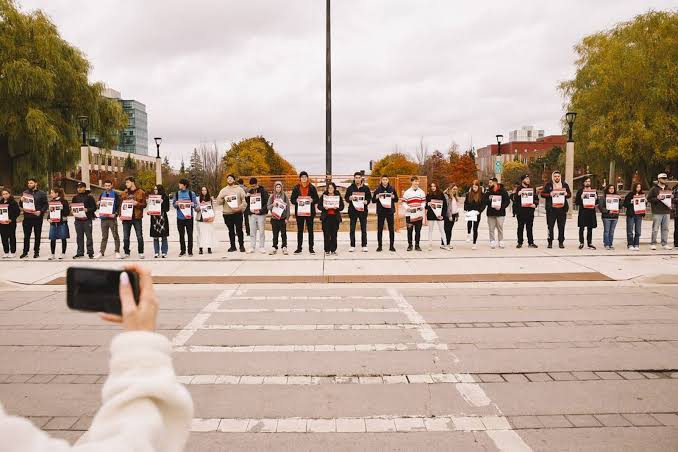
Jewish students have been harassed and intimidated. They have watched spaces they once considered welcoming become hostile to them. They have learned to think twice before wearing a Star of David, speaking openly about Israel or identifying themselves as Zionists. In classrooms, student governments and campus organizations, too many have discovered that the language of inclusion does not always extend to Jews.
For too long, these experiences have been dismissed as anecdotal, exaggerated or simply the inevitable discomfort of political disagreement.
A recent national study commissioned by Canada’s Office of the Special Envoy on Preserving Holocaust Remembrance and Combatting Antisemitism provides some of the clearest evidence yet of what Jewish students are experiencing.
The numbers are staggering.
Ninety-six per cent of Jewish students surveyed reported experiencing or witnessing at least one instance of antisemitism during the previous 12 months. Seventy-two per cent said they limit what they say in class about being Jewish. Fifty-seven per cent said they avoid wearing or displaying Jewish symbols because of concerns about their safety. And 45 per cent said they encounter Holocaust denial or distortion often or sometimes.
This is not a handful of offensive posters or ugly social-media posts. It is an environment in which young Canadians are changing their behaviour because they are Jewish. And it should force some difficult questions for university leaders.
What does academic freedom mean when a student is afraid to disclose part of their identity in a classroom? What does inclusion mean when a student hides a Jewish symbol because they fear the consequences of displaying it? And what does belonging mean when Jewish students conclude that the safest way to navigate university is to make themselves less visibly Jewish?
Then came last week’s report from Toronto Metropolitan University (TMU).
If the national data tells us how serious the problem has become, the independent review led by Justice Mary Lou Benotto offers a case study in what happens when institutions fail to confront it.
The findings are damning.
The review concluded that antisemitism at TMU has increased in recent years. It found that existing approaches had failed to achieve the desired results.
The review described a widespread belief that complaining about discriminatory conduct was effectively futile because complaints disappear into administrative processes that are slow, opaque and incapable of restoring trust.
Tellingly, the review does not describe an institution short on rules. It describes one that already has policies capable of addressing much of what was reported, and simply has not applied them.
Most significantly, the report confronts one of the most uncomfortable realities on Canadian campuses: antisemitism does not cease to be antisemitism simply because it is expressed through the vocabulary of anti-Zionism.
Benotto writes about the “redefinition of Zionism” on campus and the idea that those who refuse to embrace anti-Zionism are somehow culpable. The result, the report concludes, has helped create an environment in which antisemitism can flourish. It is why the review recommends that TMU adopt the IHRA definition of antisemitism, not as a political statement, but as what it calls the “clearest available guidance on what is, and is not, antisemitic” on campus.
For years, Jewish students have been telling university administrators that they experience demands to denounce Zionism or Israel as a condition of belonging in progressive spaces. Too often, their concerns have been met with semantic debates about where anti-Zionism ends and antisemitism begins. The review is unambiguous on this point: intent is not a required element of discrimination.
We would never tell another group that before we take their experience of discrimination seriously, we first need to debate whether the thing they experienced technically qualifies. Yet Jewish students have repeatedly been asked to prove that the hostility directed toward them is sufficiently antisemitic to merit concern.
That must end.
The report also names a dynamic many of us have watched play out for two years: a “heckler’s veto,” in which the mere threat of disruption becomes the deciding factor in whether a campus event can proceed at all. Benotto is direct about the fix, not cancellation, but mitigation: more robust security planning, clear conduct expectations, consistent enforcement. A university that lets anticipated protest decide who gets to speak has not stayed neutral. It has handed that decision to whoever shows up loudest.
None of this means criticism of Israel is antisemitic. Of course it isn’t. But there is an enormous difference between criticizing the policies of an Israeli government and treating Zionism — the belief of the overwhelming majority of Canadian Jews that the Jewish people have a right to self-determination in their ancestral homeland — as an ideology so morally contaminated that those who hold it deserve exclusion.
Universities should be capable of recognizing that distinction. And when they cannot, Jewish students pay the price.
There is another danger here, though.
If we allow antisemitism to become the defining story of Jewish campus life, we will have surrendered far too much to the people creating the problem.
Jewish students do not go to university to fight antisemitism. They go to learn. To make friends. To encounter new ideas. To fall in love. To become leaders. To figure out who they are and who they want to become.
For many, university is also one of the most consequential periods of Jewish exploration in their lives. That is why our response cannot simply be defensive.
We will continue to advocate forcefully when Jewish students are targeted and hold institutions accountable when they fail them. But as we enter our next chapter, our ambition must be bigger than protecting Jewish students from antisemitism.
We need to give more Jewish students more ways into Jewish life: more opportunities to build community, develop relationships with Israel, become leaders, celebrate Shabbat, meet lifelong friends and discover what being Jewish means to them. Because the measure of our success cannot simply be whether there are fewer antisemitic incidents.
It must also be whether more Jewish students are choosing to live richer, deeper and more joyful Jewish lives.
We are at a critical moment.
Benotto’s answer to what comes next is specific, not abstract: revise TMU’s freedom of expression policy so it expressly rules out intimidation and harassment; adopt the IHRA definition; enforce the codes the university already has; fix a complaints process that students have learned to see as a dead end.
The CASE study tells us what Jewish students across Canada are experiencing. The Benotto report shows us what can happen when institutions fail to respond effectively.
Canadians should read both.
And then they should act.
The question is no longer whether there is a problem.
It is what our leaders are prepared to do about it.