
Advocating for Jewish Well-Being in This Era of Antizionism
Forget Empathy: Here’s What Antizionist Therapists Need Instead
Maybe it started with all the Agatha Christie books I devoured as a teenager. Or perhaps it was growing up in a family with four kids. I made up stories in my head and sometimes wrote them down. I didn’t know then that I’d wind up becoming a social worker and therapist, but I’ve always been curious about people.
I ask myself, what drives someone to behave a certain way? What gets in the way of change? And what needs to shift to make room for something different?
These questions pop up when I see angry antizionist therapist posts on social media.
I am stricken when I read them. My heart rate speeds up. I’m all at once angry and sad. How can professionals trained to understand other people, to be curious about their inner worlds and to practice empathy, seemingly abandon those commitments when it comes to people they stigmatize for being Zionists?
We tend to think that empathy is always a good thing. That if you are an empathic person, you will naturally have compassion for others. But when I look at what antizionist therapists are saying, that assumption doesn’t fly.
(When I write antizionist therapists, I mean therapists who adhere to an antizionist ideology. Even though some therapists publicize themselves as “antizionist therapists” there is no such thing.)
What is Empathy anyway?
There are four qualities of empathy: perspective-taking, staying out of judgment, recognizing another person’s emotions, and communicating that understanding.
At its core, empathy is feeling with someone. It means entering another person’s experience rather than observing it from the outside. Empathy requires vulnerability because before we can connect with what someone else is feeling, we have to connect with something within ourselves that recognizes that feeling.
The comment below was posted on Instagram the other day during an online exchange with Jewish therapists. The intensity and brash certainty are a lot to take in. What would it be like to have her as your therapist?
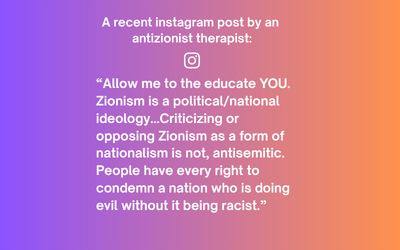
How does a therapist who presumably values empathy arrive at a place like this? One possibility is parochial empathy, also known as intergroup empathy bias. Research shows that having a strong capacity for empathy doesn’t mean it will be expressed equally. They may feel tremendous empathy for people they identify with or care about, while feeling far less for those they perceive as belonging to an outgroup.
Operationally, this is how a person can think of themselves as deeply empathic while showing remarkably little empathy toward someone they have placed outside their moral circle.
The stakes are extremely high in mental health care. My colleagues and I have witnessed therapists proudly state they won’t work with Zionist clients, and Jewish therapists describe colleagues who won’t refer to them unless they are willing to condemn Israel.
So more empathy doesn’t necessarily mean less prejudice. One review notes that simply trying to increase empathy may do little to reduce intergroup bias. The problem isn’t necessarily whether someone can empathize. It may be who they are willing to empathize with.
So what might work? Research found that empathy gaps decreased when people focused on an individual’s thoughts, feelings, and experiences rather than their group identity.
If we want to make a dent in this, wishing antizionist therapists had more empathy isn’t realistic. We have to find a way to interrupt the mechanism that allows someone to hear the word “Zionist” and believe they already know the person standing in front of them.
We need to start somewhere other than empathy. What about curiosity? In our Levari multicultural competency trainings, we try to put that into practice. We ask mental health professionals to examine what happens inside themselves when they encounter a Jewish client or colleague whose identity or beliefs evoke a strong reaction.
We might begin with a mindfulness exercise, followed by a few questions for each therapist to consider:
- Notice: What am I feeling toward this particular person?
- Compare: Would I be reacting the same way if this client belonged to a different group or held a different identity?
- Examine: What have I already assumed about this person based on their group membership?
- Get curious: What do I actually know about this person’s experiences, fears, relationships, values, history, thoughts, and feelings?
- Reorient: Am I trying to understand this person’s internal world, or am I trying to move them toward my own understanding of the world?
Part of our ethical responsibility as social workers is recognizing when our own assumptions have begun to interfere with our ability to understand the person sitting in front of us. If we can open the door to curiosity, perhaps empathy can follow.
The moment we decide a label tells us everything we need to know about another person or group, we’re lost. This doesn’t just harm Jewish clients and practitioners. It damages the ethos of the helping professions themselves. If we deem in advance who is worthy of our curiosity, understanding, and compassion, we have completely abandoned our mandate.
Related Topics
Related Posts