Carrie Bradshaw of the Middle East
Forgetting Your First Love/First Country You Flee
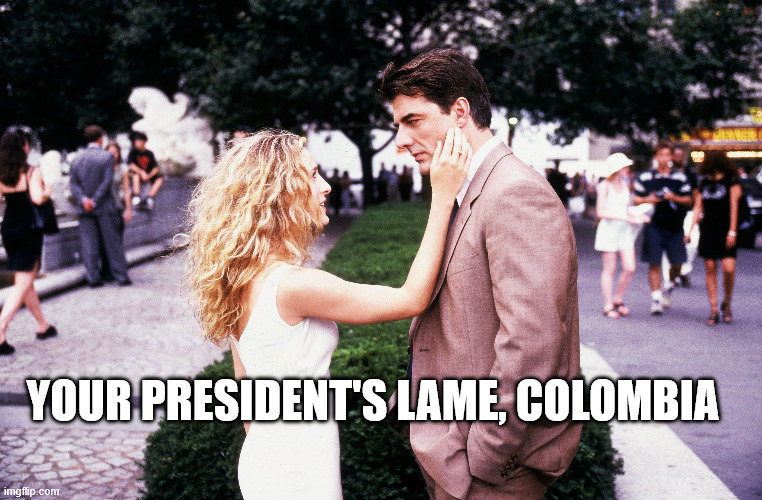
Adapted meme based on a scene from Sex and the City (HBO), included here for cultural commentary.
I didn’t know it at the time, but I met my first real love when I was fifteen. He was tall and confident, that was my first impression of him. We wouldn’t get together until four years later after he drunkenly confessed his undying love for me over BBM (Blackberry Messenger for those under thirty). I told him to drink a glass of water and go to sleep. The next morning, I woke up to a text from him saying he stood by everything he had said the night before. He flew to my city a month after that and the rest is history.
We had a two-year, long-distance relationship. I was in college in Bogotá and he was still living in Cali, our hometown. It’s hard for me to write about Colombia, my first home, the place where the sun touched my skin for the first time. Sometimes I feel I haven’t found the right voice to talk about it, but it’s a love I’ll never be able to get over.
Confident Guy introduced me to his mom as his future wife. We thought about that stuff early on, like the excited post-teenagers that we were, and saved all our pesos to see each other once a month, counting down the days for the semester to end so we’d have more time together. He had gone on a family trip to France at the very beginning of our relationship and put up a lock for us on the Seine. It was the most romantic thing anyone had ever done for me.
I had spent much of my life away from Colombia. My family moved away in the nineties when I was just a kid, during a time when anyone who could leave, did. Memories of my early years in Cali were tangled with fear and stories of cartel and political violence. I remember being in the car with my mom, my childhood friend Joel, and his mom. We took roller-skating classes together. Joel and I were playing with toy dinosaurs in the back seat when two motorcycles stopped the car and tried to snatch our moms’ jewelry. Joel and I instinctively curled up on the floor, shielding each other. We still made it to class. Another time, our Jewish day school was threatened by guerrilla groups and the military came to escort us home.
There was also my abuelita’s ranch, my horse, the neighborhood guachiman (watchman in a Colombian accent) who would smile at me and my younger brother, arepas, café de niños, and my Shakira cassette. But none of these things were safe. They were mixed in with the car bombings, kidnappings, and the occasionally detained school bus full of children.
We moved back when I was fourteen, a full year before Confident Guy came into my life. He was older and in his first semester of college for advertising. I was growing out of my emo phase and didn’t think myself as attractive as the more feminine, full Caleñas around me. By the time we got together, I had become immersed in my own culture again. I kept my hair long and learned to dance. Still, there was part of me that felt like an other with him.
Our Colombia was safer than the one our parents still talked about. All those stories we had grown up with, not being able to travel to the countryside, the danger of a narco hitting on you at a bar, someone’s uncle kidnapped for ransom (which is still illegal to give), faded into the background. An old Colombia. Sure, there was still crime. I had my wallet and phone stolen a few times and knew plenty of people who were robbed at gunpoint. You still had to be careful; it was a third-world country, por Dios. But it was nothing. It was expected. You were shamed for letting it happen to you.
Confident Guy and I squeezed the juice out of our early twenties and this post-violence Colombia. I wanted to be an actress at the time, so like two good Colombians, we daydreamed of moving to Nueva York together. I had a dream and he wanted to be with me, even if it meant translating his advertising dreams into English.
We were doomed from the start. He’d eventually feel he’d abandoned himself and his path. But that wasn’t the only issue. I never felt that his family wanted me around, that they didn’t love that he was so serious about someone so…different…so…Jewish.
I don’t know if that was ever an issue for him, but this confident and charismatic man shut down whenever he stepped into my world. We couldn’t seem to find ourselves, in his world or mine. He came to Shabbat dinners and is the only boyfriend to have met every member of my family, but he wouldn’t engage with my world the same way he engaged with everything else. My home was not his home. I told myself it didn’t matter and did everything I could to fit into his.
Confident Guy and I broke up after two years. It’s the hardest romantic break-up I ever went through. He started dating a blonde from his office less than a month after we ended things. I wrote poems and little songs about him for years, then got drunk and kissed more than a handful of strangers when they got engaged. My friends would tell me she had nothing on me, but I genuinely thought she was lovely, and more right for him than I ever was. As you can imagine, that didn’t make it easier.
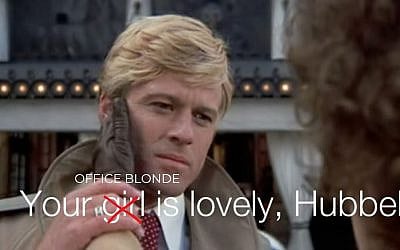
I had been traveling to see my family as often as possible before 2022, when Colombia got its own Office Blonde. Gustavo Petro, a far-left politician, promised to be the change Colombia needed—to Make Colombia Great Again, if you will, but his administration created a dangerous environment for my parents, who were forced to flee to sunny California. Though my dad’s activism was Petro’s main gripe, he didn’t hesitate to bring up his Jewishness—his otherness—as a principal offense. Of all the memorable airport moments of my life, holding my mother’s shaky hand as we crossed security at El Dorado airport to get to safety is the one that comes up the most. That break-up was much more difficult to talk about in therapy.
Whispers of the nineties have grown louder under Petro. There’s an ironic Colombian saying of disputed origins: “a people with no memory”. Memories don’t just disappear, at least that’s what I learned in therapy when I talked about my ex-boyfriend. They come back. They demand attention. In the last few years, there have been assassinations on presidential candidates, bombings, and an increase in massacres up to 120% just in the last two years. The countryside, and the city, have become unsafe again. An armed man hijacked a school bus full of terrified children and forced it off it’s route just a few weeks ago.
I took an Eat, Pray, Love trip back to Colombia last summer to see my abuelita and heal my broken relationship with my first love—my country. I changed my last name on my Uber app and called a car to take me to my cousin’s house. He and his girlfriend had taken it upon themselves to make sure I felt at home again. While I was there, there was a bombing at a military base near my abuelita’s house. We looked uneasily at each other, measuring our reactions as we decided on how big of a deal to make of this and discussed a new term we just heard, narcoterrorism. It was hard to get a car to take me back to that part of town. The driver who finally accepted the ride was older and remembered what it used to be like. He was eager to talk about the eeriness of the quiet streets. I listened. The quiet was screaming to be talked about.
It’s an election year. This week, the opposition party, Centro Democratico, got wind of an alleged assassination plot against Petro’s successor and the far-left’s main guy, Iván Cepeda. Centro Democratico is not the party I get behind, but they seem to be the most successful form of opposition to the current administration. Whether they’re efficient or not is up for debate. Their ticket includes Paloma Valencia and Juan Daniel Oviedo, two candidates who may very well be the first female president and first openly gay vice president of a country that could use shaking up, if they don’t just become mouthpieces for older leaders with firmer grips.
We Colombians seem to think the worst is always behind us. There was a period of intense political violence between liberals and conservatives in the 1940s and 50s which we call “The Violence”, as if to encapsulate all our troubles into those decades. I don’t know how to write about Colombia if it’s not through fiction. I guess that’s why I usually don’t write about it. Maybe I should ask a professional about that.
When I was back in Cali last summer, I had trouble leaving my abuelita’s house by myself. Colombia’s Office Blonde and my complex relationship with him had shattered some of my deepest friendships as well as my fragile sense of belonging. I felt silly thinking of all the times I had walked home from a party. Plus, I was desperate to get out of the house.
I finally stepped outside. The doorman, who I’ve known since before Confident Guy came into my life, smiled at me as he opened the door. “Señorita, buenos dias! Is someone picking you up?”, I shook my head and gestured to my running shoes. This man who had known me since I was roughly fifteen had never seen me go for a run.
I double tapped my earbuds to press play, pretending I didn’t feel like everyone’s eyes were on me… pretending like I didn’t think everyone knew who I was.
I got into a good pace and lost track of where I was going. I was heading north. I passed the corner store where we’d buy pirated movies on DVD. The bench where I told my best friend I had lost my virginity. There were other runners I hoped I would recognize. Stray dogs. Cracks on the uneven sidewalk, potholes in the streets, nasally voices selling avocados and chontaduros. The humidity stuck to my skin, and, for a moment, I felt I had never left.
When I left Colombia for my American dream eleven years ago, I always thought I’d go back. The stories of violence were real, but they didn’t feel mine. My Colombia was friendly and vibrant. It was two best friends I called sisters, more cousins than I could count, hot chocolate and cheese in the mountains, and heat that always carried a breeze. The threats against my father were a rude awakening to a reality that had been dormant. To think that the more right-wing parties that had dominated the political scene had fixed all of our issues was, and is, to live in pleasant denial. The plan was always for my parents to go back after Petro’s term. They could never accept being away from their first love, either.
I must have forgotten to breathe. My hands caught me as I collapsed to my knees, my feet stilled on the ground as I negotiated with my heart rate. Then I looked up. I knew this street. I had forgotten how to get to it. Memories don’t just disappear. They demand attention.
My ex’s house looked the same as it always had. I had tried to convince him to let me fill up a hole near the door (I was pretty handy), but we never got around to it. The driveway was empty. I had heard from a friend that the house had been converted into an office for his advertising agency.
I took my earbuds out and stood outside his house for no longer than two minutes, but I saw the years playing out in front of me. I could see him opening the door to me, hear my heels clicking on our way out for the night, his dogs wagging their tails at me, feel him turning my shoulder toward him after yet another fight. I let out a deep breath, hoping that would mean “goodbye”, or “thank you”, or both. Then I put one foot in front of the other and started running.
Related Topics