

Modern conflict, narratives and the battle for truth
France is burning. I’ve seen this before.
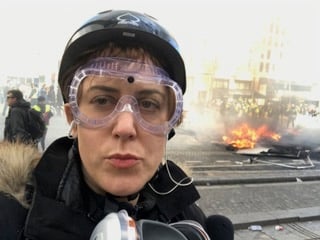
Paula Slier reporting during the Yellow Vest protests in Paris, 2018-2019, as a fire burns in the street behind her. (Photo: Personal archive)
Shop windows were smashed as people rushed inside, grabbing whatever they could carry. Clothes were pulled from racks, and looters emerged with armfuls of merchandise. I was standing in a street near the Arc de Triomphe in Paris, watching it unfold. It was frightening.
Many of the looters weren’t wearing masks. They looked like ordinary people taking advantage of the breakdown of order.
That was Paris, eight years ago. The Yellow Vest movement had erupted in protest against President Emmanuel Macron’s government, initially over rising fuel taxes before growing into a much broader revolt against the cost of living, economic inequality and a political establishment many felt had stopped listening to ordinary people.
At some of the demonstrations I covered, families lined the streets, children sitting on their parents’ shoulders and women pushing prams. But as the protests turned violent, those scenes gave way to something very different.
Fires burned in the roads. Police barricades blocked off streets and officers prevented protesters from advancing. Yet just a short distance away, shops were being looted without police intervening. I couldn’t understand why the police were so visible in one place while absent in another. Watching the latest unrest in France, I’m asking myself asking the same question again.
The protests that erupted into violence over the weekend of 17 and 18 October began with students demanding better conditions in their schools. They grew into a broader movement over the cost of living and deteriorating public services.
Hundreds of thousands demonstrated peacefully. But the weekend also brought widespread looting, fires and attacks on public buildings. By Monday, Reuters was reporting approximately 2,500 detentions, with the authorities imposing curfews in parts of several cities.
The images are familiar. So are the explanations being offered for them.
During the Yellow Vest demonstrations, there was a group we journalists watched particularly closely: the black bloc. They dressed in black, concealed their faces, often with balaclavas, and moved together. They became especially noticeable towards the end of marches. Whether they’d been there all along or arrived later, I couldn’t always tell. But when those masked groups became prominent, the risk of confrontation was all but certain.
Black bloc isn’t one organisation. It’s a tactic associated with militant protesters, including anarchist and radical anti-capitalist groups, who conceal their identities and sometimes engage in violence against police or property.
But what I remember just as clearly is that many of the people I watched looting shops were not dressed like that at all. Their faces were uncovered. They appeared to be taking advantage of the disorder rather than making any identifiable political statement. I remember wondering what stealing clothes had to do with fuel prices or Macron.
On 16 March 2019, Reuters documented extensive looting around the Champs-Élysées. Luxury shops were ransacked, a bank was set on fire and the famous Fouquet’s restaurant was badly damaged. I can’t establish whether the shops I witnessed being looted were among these. My memory places me on the smaller streets near the Arc de Triomphe, rather than necessarily on the Champs-Élysées itself.
Then, the failure to contain the violence had consequences. On 18 March 2019, Paris police chief Michel Delpuech was replaced. Prime Minister Édouard Philippe said the policing strategy had not been properly implemented. The government promised a tougher approach, including restrictions on demonstrations in areas where violent groups were expected. But that also raised a difficult question: how do police prevent organised violence without treating every demonstrator as a potential rioter?
Eight years later, France is asking some of the same questions.
In its account of the 17 October demonstrations, Le Monde described police units struggling to respond to scattered groups across Paris. Some officers were heavily outnumbered, while others were repeatedly redeployed as confrontations erupted in different locations. In the meantime, looters moved through shopping areas, attacking everything from supermarkets and pharmacies to luxury boutiques.
Interior Minister Laurent Nuñez acknowledged that the authorities had struggled to contain groups moving rapidly between locations. It reminded me of what I saw near the Arc de Triomphe. I find it extraordinary that, eight years after the Yellow Vest violence, shopkeepers are again asking why the police couldn’t protect their businesses.
There’s another development that makes the distinction between political violence and opportunistic theft especially relevant.
Reuters reported on Monday that the second-hand clothing platform Vinted was removing listings suspected of containing goods stolen during the riots. French officials had also met representatives of online marketplaces after merchandise believed to have been looted appeared for sale.
That doesn’t establish who stole the goods or whether every suspicious listing involved merchandise taken during the unrest. But it suggests that at least some of the destruction may have had a straightforward criminal purpose: stealing goods that could later be sold.
There’s a temptation to explain everything through the politics of the demonstration. The government blames radical groups. Its opponents blame government failures. Others point to immigration or wider social tensions.
Some of those arguments may be relevant. But identifying the people who confronted police isn’t necessarily the same as identifying everyone who looted a shop.
And that matters particularly when the allegations involve antisemitism.
Over the weekend, claims circulated that Jewish-owned businesses in Marseille had been deliberately targeted while Muslim-owned shops were spared. A synagogue in Paris was also vandalised. Given France’s history of antisemitic violence, those allegations deserve serious attention. But what does the evidence establish?
The Times of Israel reported that Jewish-owned shops in Marseille had been set ablaze and the Ohalei Yaakov synagogue in Paris vandalised. But the Jewish Community Protection Service said there was no evidence at that stage that Jewish businesses or institutions had been deliberately singled out.
The circumstances surrounding the synagogue were also unclear. Religious objects had been scattered, but Torah scrolls appeared unharmed, and a synagogue committee member suggested the intruders might have been looking for money. None of that excludes antisemitism. It means the motive remains unproven.
If investigators establish that Jewish businesses were selected because their owners were Jewish, that would be a serious antisemitic crime. But the conclusion cannot come before the evidence. The same principle applies when people attribute the wider violence to immigrants, students, the far left or any other group.
One of the problems with watching events unfold through social media is that the pictures often arrive with an explanation already attached. A video shows looting. Someone identifies the supposed perpetrators, attributes a motive and passes it on. Before long, the explanation is repeated as though it were something the camera actually recorded.
I think back to the people I watched stealing clothes near the Arc de Triomphe. I could see what they were doing. I could see that many weren’t masked. I could see that the families who had been demonstrating earlier had disappeared. But I couldn’t tell you who every looter was or why they were there.
France needs to establish who organised the violence, who carried out the looting and why police were unable to protect so many businesses. Allegations of antisemitic targeting deserve thorough investigation, not speculation.
Until we know, blaming an entire movement or community isn’t an explanation. It’s a shortcut.