
From 9/11 to 10/7: The Logic of Defense
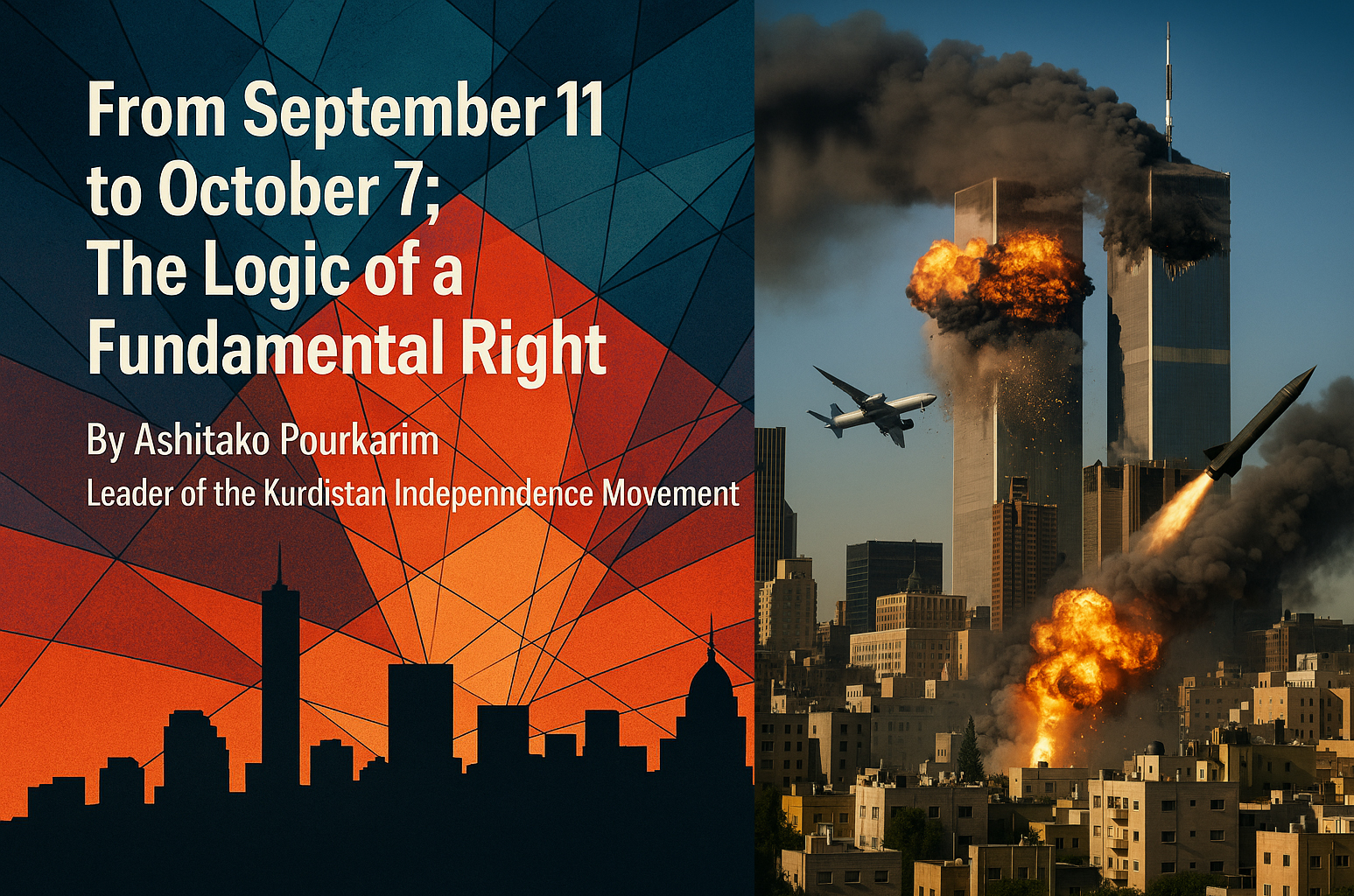
“From September 11 to October 7; The Logic of a Fundamental Right”
By: Ashtyako Poorkarim, Leader of the Kurdistan Independence Movement
Israel is in a condition where the threat to its existence is not a hypothetical danger but an evident, documented, and structural reality; the Islamic Republic of Iran from the first years after the revolution has laid out a transnational project that includes exporting terrorism, creating and arming proxy networks, and providing political-ideological direction to groups whose explicit and repeated aim is the destruction or fundamental weakening of Israel. This phenomenon is not merely a political claim; official reports and numerous studies show that Tehran has provided financial, technological, educational, and logistical support to actors ranging from Hezbollah in Lebanon to networks active in Syria, Iraq, Yemen and a number of Palestinian groups, and in some cases has facilitated the direction of military or intelligence operations.
Today Israel faces a situation in which the nature of the threat to its existence is no longer speculative or theoretical; a body of narrative, developmental and structural evidence indicates that the Islamic Republic of Iran over the past four decades has adopted the militarization of regional influence as an instrument of foreign policy and built and equipped a complex network of proxy actors. These networks (Hezbollah, armed branches in Iraq, affiliated Palestinian armed forces and other groups active in regional arenas) have benefited from the financial, training, logistical and armament support of Iranian state apparatuses; official and analytical documents and reports have documented this, and Tehran has repeatedly articulated indisputable positions against Israel in many of its official statements. This combination of “intent” and “capacity” — that is, the will to destroy or weaken a state’s existence together with the operational tools to achieve it — elevates the threat beyond rhetoric and gives it an existential and transnational character.
When a state in practice builds war-waging capacities and the ability to organize terror across a region, the security game moves beyond point-counterpoint police reactions and enters the realm of the fundamental right to defend existence. The United Nations Charter, in Article 51, recognizes the inherent right of individual or collective self-defense against an “armed attack”; recent regional examples — including October 7, 2023 — have repeatedly been clear instances of that kind of attack and by themselves provide the basis for activating the right of defense. In such circumstances, the claim of “the full legitimacy of Israel’s right of defense” from the standpoint of international law is not an emotional assertion but the logical result and interpretable application of accepted rules.
From a legal perspective, the starting point is clear: the UN Charter recognizes the inherent right of states to defend themselves in the event of an “armed attack.” Article 51 of the Charter preserves the individual or collective right of defense and, until the Security Council takes action, defensive measures are considered lawful. Ultimately, the decisive legal question is what constitutes an “armed attack” and whether proxy networks backed by state sponsorship can cross that threshold; contemporary practical and theoretical answers to this question have tended toward expanding the scope of the concept of “armed attack” (including against organized non-state actors operating with state support), especially after the major post-terrorism experiences.
The practical and historical pattern also supports this judgment: after the 9/11 attacks, the United States, by adopting the “Authorization for Use of Military Force (AUMF) 2001,” authorized itself to pursue and dismantle networks that had carried out attacks against U.S. citizens and sovereignty or had facilitated them; this approach effectively inaugurated a new practical tradition whereby states may carry out targeted, extraterritorial operations to prevent or dismantle transnational terrorist capacities. The legal comparison of Israel (after October 7) with the United States (after September 11) is, in this respect, precise and justified: both situations contain identical elements — a catastrophic attack or a series of armed incidents, evidence of transnational networking, and the presence of sponsors with the capacity to provide military and logistical support.
In the field of practice, Israel for decades has used targeted instruments to degrade threatening capacities; from prominent examples such as Operation Orchard (the 2007 strike on facilities in Syria that was described as targeting a nuclear facility) to hundreds of targeted air and intelligence operations against supply lines and logistical hubs linked to Iran in Syrian territory and elsewhere. Such actions, regardless of the substantive controversies surrounding each specific case, demonstrate the clear pattern of “cutting the enemy’s support chain” in practice. These measures have shown that when states confront a proxy network with state backing, they are compelled to strike an active balance between preserving national security and limiting political-humanitarian consequences.
At the customary-judicial dimension, the authoritative teaching of the “Caroline test” (necessity & proportionality) sets the fundamental conditions for the legitimacy of pre-emptive or extraterritorial operations: an immediate necessity and the absence of effective alternatives, and the proportionality of the response to the goal of removing the threat. This criteria-based framework does not imply an “absolute license” for any extraterritorial military act, but rather provides a conditional and controlled authorization for legitimate defensive responses; the conscience of contemporary international law similarly judges that, when faced with repeated, organized and supported attacks, targeted action to sever the enemy’s operational arteries can be legitimate and necessary.
This war — how it must be understood — is not a war for war’s sake or for bloodshed; it is a war to end terrorism. When networks supported by Tehran operate in Europe, Africa and even beyond, Israel’s fight against them is more than a purely national action: it is part of an international effort to neutralize a pervasive threat and destroy capacities that can target any society.
Opposing moral claims — such as “any extraterritorial action is condemnable” or “any civilian casualties invalidate the legitimacy of defense” — ignore objective realities: as long as terrorist networks operate with state funding, training and logistical infrastructure, the survival of a targeted state in the face of existential threat requires the employment of effective military tools to sever those chains. This defense becomes morally and legally defensible if conducted within the framework of international rules (limiting operations to military/terrorist targets, avoiding harm to civilians, reporting to international bodies and simultaneously attempting to use non-military instruments). But the emphasis must be clear: “permission to defend” does not mean “unconditional permission”; rather, it means the decisive criterion of legitimacy for a targeted defensive action.
Unconditional denial of this right or moral resistance to decisive action typically leads to a clear result: acceptance of the status quo of arming and network-building that reproduces recurring violence and exacts the cost in countless civilian lives. A policymaker tasked with protecting their citizens, when facing a structural and documented threat, cannot confine themselves to diplomatic instruments or imperfect sanctions and wait for non-military solutions to emerge; especially when there is a history of practical and programmatic threat from proxy actors and their state sponsors.
From a strategic standpoint as well, accepting Israel’s legitimate right in practice can have the desirable effect of reducing terrorist capacity and weakening supporting networks.
The conclusion is that Israel’s right of self-defense must be accepted as an axiomatic right: a right rooted in international law, supported by the tradition of international practice, and representing an ethical obligation that includes the protection of civilians and the prevention of the spread of terror beyond borders. If this war is pursued correctly and with adherence to the criteria of necessity, proportionality and accountability, it can ultimately create conditions that, instead of spreading violence, enable the restoration of security and the possibility of dialogue and sustainable peace; because only after the systematic defeat of terror can regional societies hope for political, economic and social reconstruction and build a future for their citizens less tainted by violence and disorder.
When the threat to a state is structured, sustained and transnational in nature and this structuring is reinforced by state support, that state’s right of defense — including targeted extraterritorial action to destroy the enemy’s operational capacities — is legitimate, necessary and morally justifiable. This claim is not based on sentiment but on legal evidence (Article 51), customary teachings (necessity and proportionality), contemporary practical precedent (the AUMF and other examples), and documented reports of state support to proxy groups. Within this logic, Israel’s war against terrorist networks is not a war for war’s sake and bloodletting, but a war to end terror and secure the possibility of sustainable peace and security.