Iran Analyst | Human Rights | Middle East Politics
From Revolution to Succession: New Khamenei and IR
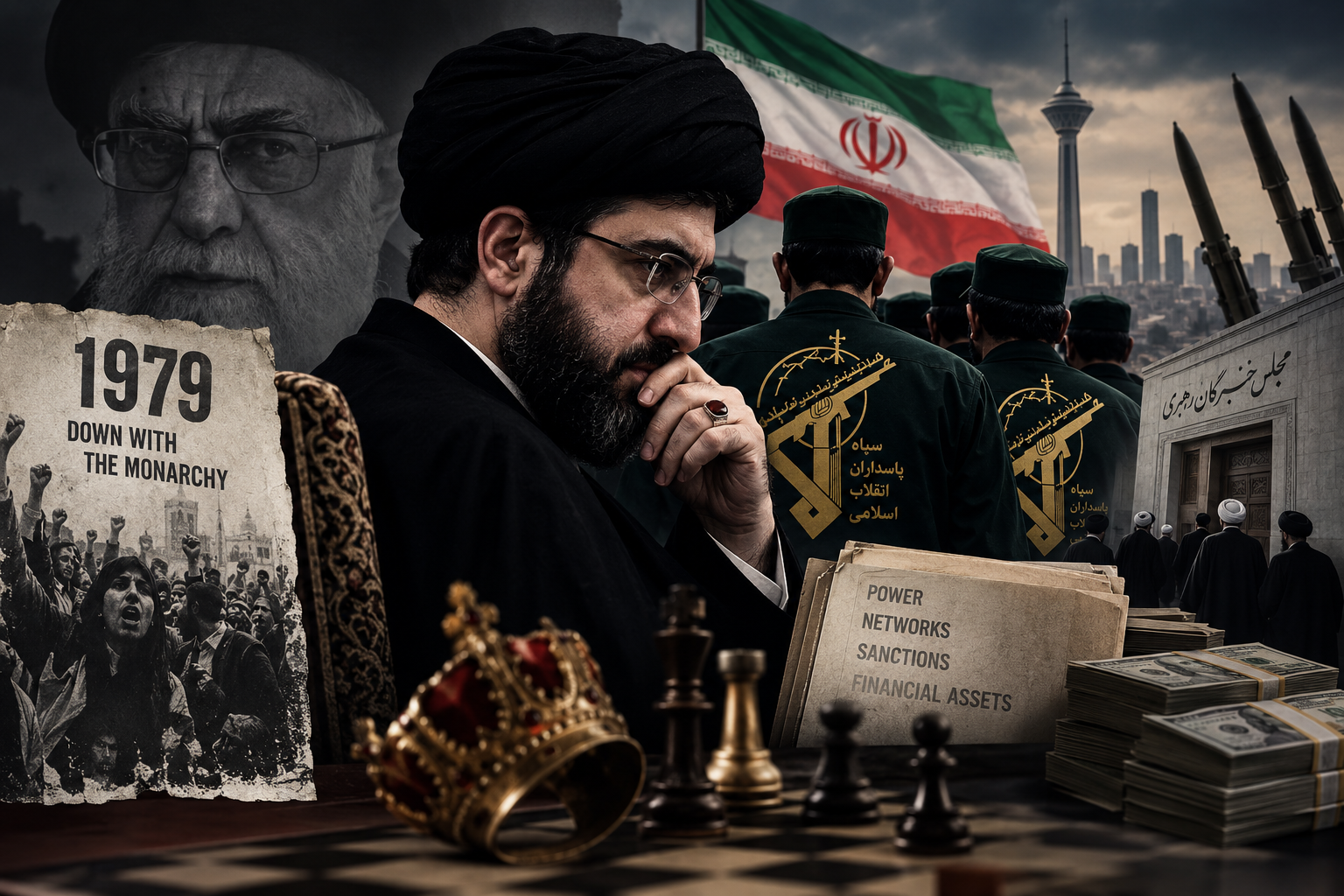
An AI-generated editorial illustration depicting Iran’s changing power structure, the succession of Mojtaba Khamenei, the role of the Islamic Revolutionary Guard Corps, and the tension between the Islamic Republic’s revolutionary origins and its evolving political order.
The rise of Mojtaba Khamenei exposes a tension at the heart of the Islamic Republic: a system that formally rejects hereditary rule has placed the son of its longtime supreme leader at the top, amid reporting of an increasingly powerful Revolutionary Guard.
For nearly half a century, the Islamic Republic of Iran has presented itself as a revolutionary alternative to the hereditary monarchy it overthrew in 1979. The choice of Mojtaba Khamenei as supreme leader has put that self-image under an unusual strain.
In March 2026, after the death of his father, Ayatollah Ali Khamenei, Iran’s Assembly of Experts selected Mojtaba Khamenei as the country’s new supreme leader. The formal procedure matters: under Article 107 of Iran’s Constitution, the Assembly of Experts is responsible for choosing the leader from among qualified religious jurists. But the identity of the successor matters too. Mojtaba did not simply follow another senior cleric into the office; he followed his father.
That fact does not, by itself, establish that Iran has become a hereditary monarchy. The constitutional mechanism was still invoked, and the Assembly of Experts announced the decision. But it creates a striking political image: an institution born from a revolution against dynastic rule has placed a founder of the existing power structure’s son at its apex.
The power behind the office
Mojtaba Khamenei was not a conventional public official before becoming supreme leader. The US Treasury Department said in 2019 that he had never been elected or appointed to a government position, apart from working in his father’s office. Treasury also stated that Ali Khamenei had delegated part of his leadership responsibilities to his son and that Mojtaba worked closely with the commander of the Islamic Revolutionary Guard Corps-Quds Force and the Basij. Those are U.S. government assertions, not independent judicial findings, but they document how Washington viewed his position and network years before his succession.
Reuters, in reporting on the March 2026 succession, described Mojtaba as a longtime behind-the-scenes operator who had built close relationships with the Revolutionary Guards. That history is important because the office of Supreme Leader is not merely ceremonial. Article 110 of the Constitution assigns the leader supreme command of the armed forces and gives the office authority to appoint the commander of the Revolutionary Guard, among other powers.
How much did the Guards shape the succession?
The most consequential question surrounding Mojtaba’s elevation is not whether the Assembly of Experts voted. It did. The question is how the decision was reached.
A March 10 Reuters report, based on five Iranian sources, said the Revolutionary Guards pushed through Mojtaba’s selection, overcame reservations among some senior clerics and political figures, and used the argument that wartime conditions demanded a rapid choice. Reuters also reported that some members of the Assembly could not attend the vote after the body’s meeting location in Qom was bombed, while an Assembly member said the constitutional quorum was reached.
Those claims should be treated as reported accounts rather than as independently established facts. The same Reuters report noted that the constitutional authority to choose the leader belongs to the Assembly of Experts. What the reporting does establish is that senior Iranian sources themselves described the Guards as a decisive power broker in the succession.
That distinction is crucial. Saying that the Guards formally appointed Mojtaba would go beyond the evidence. Saying that credible reporting has identified the Guards as a major force behind his elevation is supported by the available record.
From religious authority to security-centered power
The succession also raises a broader institutional issue. The Islamic Republic was designed to place a senior Islamic jurist at the top of the state. Article 109 lists religious scholarship, justice and piety, political and social insight, prudence, courage, administrative ability and leadership capacity among the essential qualifications. The Supreme Leader then exercises extensive constitutional powers over the armed forces and several key institutions.
Yet Reuters’ reporting after the succession described a system in which the Revolutionary Guards had acquired greater influence during the war and had become central to strategic decision-making alongside the Supreme National Security Council. One senior Iranian source told Reuters that the Guards were effectively running Iran; another source warned that the new balance could give them the final say on major decisions. Those are the sources’ assessments, not a constitutional transfer of authority.
The distinction between legal authority and practical power is therefore becoming central to understanding Iran. A leader can possess the formal powers written into the Constitution while relying on, negotiating with, or being constrained by institutions that command coercive and organizational resources of their own.
A leader who remains out of sight
The other unusual feature of Mojtaba Khamenei’s rule is his absence from public view. Reuters reported on August 28 that six months after his appointment, no photograph, video or audio message featuring him in his capacity as leader had been released. Officials and senior insiders told Reuters that he remained in control, held meetings and made major decisions while staying hidden for security reasons. President Masoud Pezeshkian said publicly on August 10 that he had held a seven-hour meeting with Khamenei.
By mid-September, reporting from EFE and the Financial Times likewise said Mojtaba had still made no public appearance. The Iranian authorities’ explanation has centered on security concerns. Other observers have questioned what prolonged invisibility means for the functioning and legitimacy of the office. These competing accounts can coexist without resolving the underlying question: how does a system built around the visible authority of a Supreme Leader operate when the holder of that office communicates almost entirely through written statements and intermediaries?
There is a temptation to turn that absence into speculation about his health or whereabouts. A stronger journalistic approach is more limited: document the absence, record the official explanation, and examine its institutional consequences. The question is not what cannot be verified, but what can be observed about the distribution of authority while the leader remains unseen.
The financial network around the leader’s office
The political story also has a financial dimension. In July 2026, the US Treasury sanctioned Iranian financier Ali Ansari and said he oversaw a global network of assets benefiting Mojtaba Khamenei and other regime elites. Treasury alleged that Ansari used overseas property and commercial holdings, as well as shell companies and bank accounts in multiple jurisdictions, to move and hold wealth. It also linked him to the Islamic Revolutionary Guard Corps. These are Treasury’s allegations and sanctions designations, not findings from an independent court.
The importance of this record is broader than any single allegation. It shows that US authorities are treating the Supreme Leader’s office, the IRGC and cross-border financial networks as interconnected targets. It also provides additional evidence that the struggle over political authority in Iran cannot be separated neatly from the institutions and economic networks surrounding the center of power.
The contradiction at the heart of the transition
Mojtaba Khamenei’s ascent does not erase the formal architecture of the Islamic Republic. The Assembly of Experts made the selection, and the Constitution still defines the powers and qualifications of the office. But formal rules are only part of the story of power.
Three facts now stand together. First, the son of the previous supreme leader occupies the same office. Second, multiple Reuters sources have described the Revolutionary Guards as a decisive force in making that succession possible and as an increasingly influential actor around the top of the state. Third, the new leader has remained publicly invisible for months while Iranian officials insist that he continues to exercise final authority behind the scenes.
Taken together, these facts suggest a transition that is about more than the replacement of one individual. It raises questions about how religious legitimacy, inherited political networks, military power and financial influence are being combined inside the Islamic Republic.
For a political system created in opposition to monarchy, the visual symbolism of father-to-son succession is difficult to ignore. But the deeper issue is not whether Iran has formally abandoned its republican institutions. It is whether those institutions are increasingly operating within a power structure in which the boundaries between the Supreme Leader’s office, the security establishment and the networks surrounding them are becoming harder to distinguish.
That is the real significance of Mojtaba Khamenei’s rise. The question is not simply who succeeded Ali Khamenei. It is what the succession reveals about where power resides in Iran now.
Related Topics
Related Posts