
From apartheid to genocide: B’Tselem’s new gambit
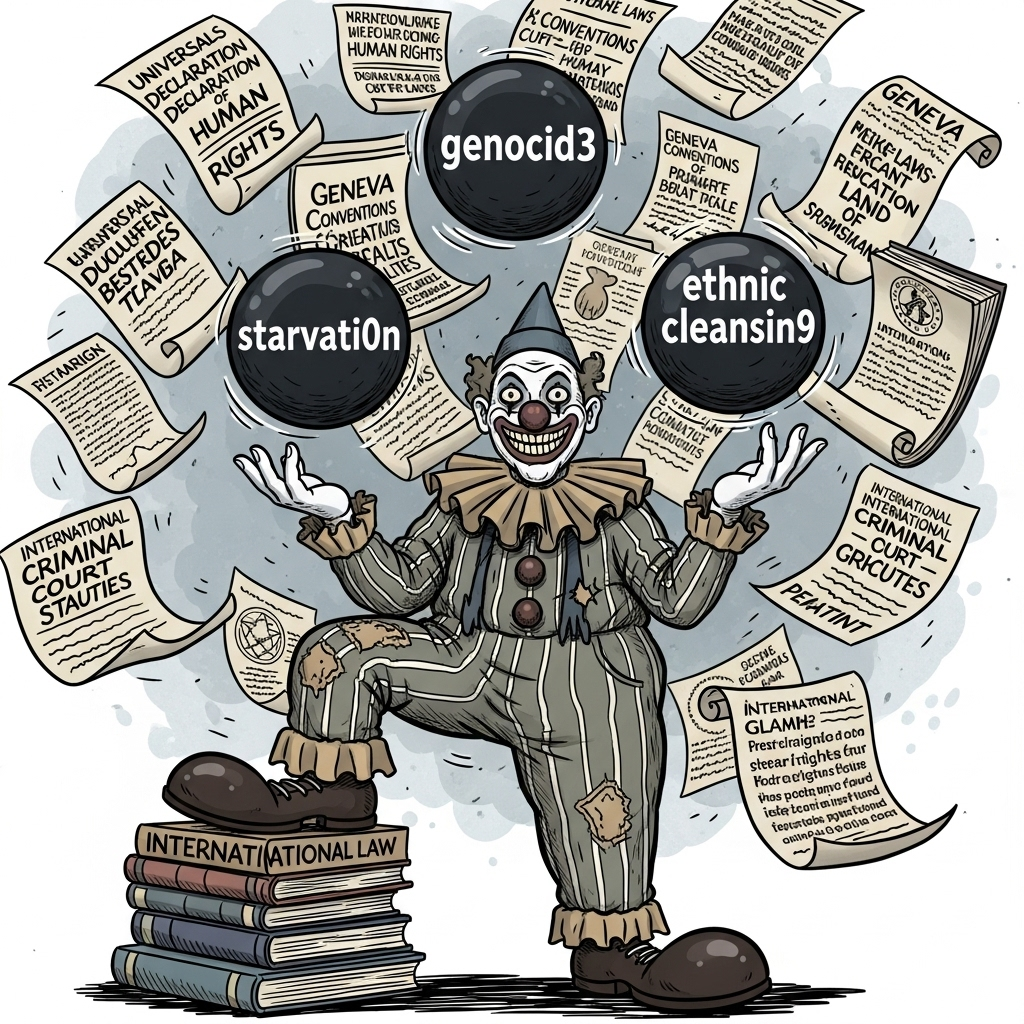
Earlier this week, the Israeli NGO B’Tselem released a report titled “Our Genocide,” accusing Israel of committing genocide against the Palestinian population of Gaza since October 2023. Spanning more than 80 pages and dense with legal citations, the report wraps itself in the language of international law and humanitarian concern. But its conclusions are not simply flawed, they are ideologically driven, legally unsound, and designed not to prevent human suffering but to permanently undermine Israel’s legitimacy as a sovereign state.
The report begins with the claim that Israel, in the aftermath of the October 7 Hamas massacre, launched a premeditated campaign of annihilation in Gaza. Rather than address the war in its actual context, as a defensive response to a terrorist onslaught that slaughtered over 1,200 people, raped and burned civilians alive, and abducted 250 hostages, B’Tselem proposes that Israel’s military campaign was genocidal from its very first day. It treats the mere act of self-defense as a crime of extermination.
To sustain this charge, B’Tselem abandons legal rigor. Under the UN Genocide Convention, genocide is the gravest crime in international law, and requires proof of specific intent to destroy a group “in whole or in part”, based on nationality, ethnicity, race, or religion. B’Tselem dilutes this definition beyond recognition and explicitly adopts a broader framework drawn from sociological literature, to include infrastructural collapse, psychological trauma, displacement, and cultural loss, elements that fall outside the scope of the Genocide Convention’s legal definition, and which risk conflating sociopolitical harm with criminal intent. By this logic, any war that causes civilian suffering, no matter its cause or the enemy’s tactics, can be labeled genocidal.
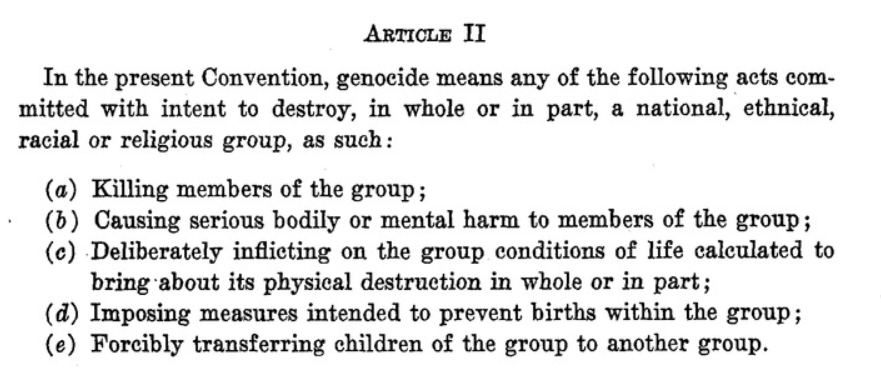 Article II of the Convention on the Prevention and Punishment of the Crime of Genocide, as approved by UN General Assembly resolution 260 A (III) on 9 December 1948 and entered into force on 12 January 1951.
This conceptual inflation is not merely academic. It enables B’Tselem to portray virtually every aspect of Israel’s military effort, from airstrikes on Hamas command nodes to the destruction of tunnel networks deliberately built under schools and hospitals, as proof of an extermination campaign. The report almost entirely omits the reality that Gaza is controlled by Hamas, a terrorist organization whose charter calls for Israel’s destruction and which embeds its forces in civilian infrastructure. It ignores Hamas’s systematic use of hospitals, mosques, and UN facilities as shields and weapons depots. It all but ignores the fact that Israel is fighting an enemy that operates from within heavily dense civilian areas, a challenge rarely seen in modern warfare and without clear precedent on this scale.
Nor does the report meaningfully engage with October 7 itself. While it briefly notes that over 1,200 Israelis were murdered, many through sexual violence and immolation, and that babies, women, and Holocaust survivors were taken hostage, this atrocity is treated as little more than a narrative prelude, a “trigger” for Israel’s alleged descent into genocide. There is no sustained examination of Hamas’s war crimes. The report concedes these crimes, then promptly pivots to assert that the attack merely catalyzed a preexisting genocidal agenda.
Even more alarming is how the report constructs its case for genocidal intent. It concedes it offers no documentary evidence of a state policy to destroy the Palestinian people, because no such policy exists. Instead, it infers intent from battlefield destruction, the scale of civilian harm, and incendiary remarks by individual politicians. The report declares that intent can be established if genocide is the “only reasonable inference” from Israel’s conduct, a formulation that severs legal analysis from evidentiary standards. If war itself becomes evidence of genocide, then no democracy can ever defend itself against terror.
Meanwhile, the report ignores or downplays Israel’s adherence to the laws of armed conflict. The IDF has issued repeated evacuation warnings, established humanitarian corridors, designated safe zones, and facilitated the entry of aid and medicine – even as Hamas has looted that aid to fuel its war machine, sell on the black market, and tighten its grip on the civilian population.
None of this is reflected in B’Tselem’s narrative. Instead, it portrays these efforts as deceptive, citing the bombing of corridors and “safe zones” such as al-Mawasi. But such criticism overlooks the operational reality in which Hamas embeds itself within civilian areas, shows blatant disregard for civilian safety, and seeks to exploit these protected zones for military advantage. Rockets have even been launched from within these areas, necessitating IDF responses and further complicating the distinction between civilian and combatant zones.
The legal distortions are matched by moral ones. B’Tselem collapses the distinction between combatants and civilians, between tragic collateral damage and deliberate extermination, between the unintended consequences of warfare and the systematic destruction of a people. It simply states that the bombing of civilian infrastructure, economic collapse, and even the psychological toll of war on children are all indicators of genocide. According to the report, life expectancy drops and amputation statistics, no matter their combat context, are evidence of a genocidal policy.
The effect is to recast the war not as a response to terrorism but as the unmasking of Israel’s “true” identity, a state whose essence, B’Tselem suggests, is genocidal. This is not human rights advocacy. It is an indictment of Jewish sovereignty itself.
Why B’Tselem does this
B’Tselem is not simply an NGO documenting abuses. It is a political actor pursuing a declared objective: the end of Israel. Its website states this explicitly. This is not neutral language. “Ending the regime” means dismantling the Jewish state as it exists today. The 2025 genocide report must be read in this light. It is not a good-faith effort to enforce international law. It is part of a sustained campaign, launched in 2021 with their declaration that Israel is an apartheid regime “from the river to the sea,” to redefine Zionism itself as a crime.
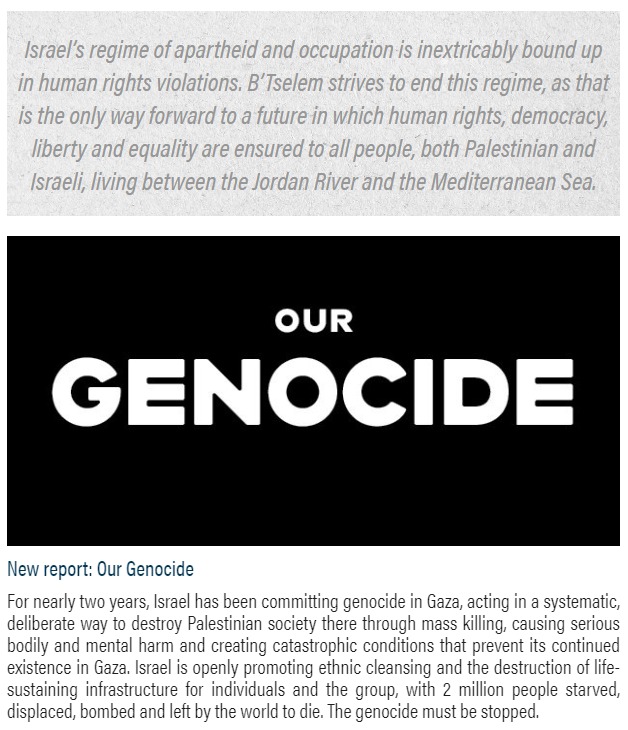 A screenshot from B’Tselem’s website showing a statement outlining the NGO’s position on the State of Israel, placed above a link to their recent report (accessed 1 August 2025).
Their rhetoric confirms this trajectory. In an interview with Christiane Amanpour on CNN, B’Tselem Director General Yuli Novak stated: “No genocide in history happened without the support, either by taking part or supporting it from afar or just turning a blind eye, of the people, of the group of the perpetrators. And […] this is exactly what takes place now in Israel.” She further emphasized that this serves as “a really good example for how disconnected people that conduct [genocide] can be from what they actually do”. Such language implies that the Israeli public at large is complicit in genocide, an extraordinary and sweeping moral indictment of an entire nation and contribute to a narrative that extends beyond criticism of specific policies, instead framing an entire population as morally responsible for the gravest of crimes.
A pattern of delegitimization, not advocacy
The genocide report is not a bug, but a feature. It follows a long trajectory: accusing Israel of apartheid in 2021, lobbying for international sanctions, supporting ICC investigations against Israeli officials, and consistently erasing the context of Palestinian terror. These positions go beyond the defense of rights. They target the very legitimacy of Jewish national self-determination.
The cost of this framing is immense. It erodes moral clarity. It trivializes actual genocides, in Rwanda, Bosnia, Cambodia, and yes, the Holocaust, by collapsing the term into a propaganda tool. It arms those who deny Israel’s right to exist. And it empowers terror movements by signaling that democratic states defending their citizens will be branded as criminals, no matter the enemy they face or the precautions they take.
Final thoughts
“Our Genocide” is not a legal analysis. It is a dangerous attack disguised as scholarship. It offers no solutions, no engagement with complexity, no vision for peace, only a relentless narrative that equates Israel’s very existence with atrocity. By conflating defense with destruction and sovereignty with supremacy, B’Tselem does not seek to resolve conflict but to undermine Israel’s legitimacy, putting Israelis and Jews at increased risk.
The war in Gaza is tragic. It demands scrutiny. But scrutiny requires intellectual honesty and legal precision. This report offers neither. It offers a verdict in search of a trial, and a narrative dressed as law.