An Aging Jewish Feminist
From Blessing to Battle: Parshat Be’Haalotcha
FROM BLESSING TO BATTLE: HOLDING THE TENSION BETWEEN PEACE AND POWER
In Sefer Bamidbar (Numbers), the Torah presents contradictory portrayals of God’s role in our lives. Last week’s parsha Naso includes the Priestly Blessing (Numbers 6:23–27), a prayer of divine care: “May the Lord bless you and protect you… bestow favor upon you and grant you peace.” This blessing— recited by parents on Friday nights and by kohanim in the synagogue—embodies grace, love, and above all, peace. In our synagogue last Shabbat, we reflected on how often this blessing shapes our spiritual language. During the discussion, I was thinking about the verses my granddaughter was preparing for her bat mitzvah this week, which is parshat Be’Haalotcha—verses that strike a very different tone:
As the Ark begins its journey through the wilderness, Moses declares, “Advance, O God! May Your enemies be scattered, and may Your foes flee before You!” (Numbers 10:35). This militaristic cry, recited every time the Torah is taken from the ark, casts God not as a source of peace, but as a warrior leading Israel into battle.
The contrast is jarring. How do we reconcile the God of peace with the God of war? In light of current events, especially the war in Gaza, the urgency of this question deepens. The yearning for peace is profound, yet the rhetoric of military might dominates headlines: Our Finance and National Security Ministers have been sanctioned because they incited extreme violence and serious violations of the human rights. It is as if our ministers have taken to heart the latter passage literally. Can these dual visions coexist, or are we forced to choose?
THE PRIESTLY BLESSING: A VISION OF PEACE
The Priestly Blessing consists of three elements:
The Lord shall bless you and protect you – asking for God’s guarding presence; The Lord shall deal kindly and graciously with you – seeking divine favor; The Lord shall bestow [divine] favor upon you and grant you peace – culminating in the ultimate hope: peace.
Together, these lines form a complete vision of wellbeing—physical safety, emotional kindness, and spiritual wholeness. The final verse, “So shall they put My name on the children of Israel, and I will bless them,” signals an intimate relationship between God and Israel, centered on protection and peace. Jewish tradition elevates peace above all other values. Rabbinic sources state, “There is no vessel that holds a blessing except peace” (Midrash Tanchuma, Tzav 7:1), and “Great is peace, for the whole Torah was given to promote peace in the world” (Talmud, Gittin 59b). Peace is not merely the absence of war; it is the foundation that gives meaning to all other blessings.
THE ARK AND THE CRY FOR POWER
Yet in this week’s parsha, the Torah gives voice to a radically different image. When the Ark sets out, we hear a militant plea:
Advance, O God! May Your enemies be scattered! When it rests: “Return, O Lord, to the myriads of thousands of Israel (Numbers 10:35-36).
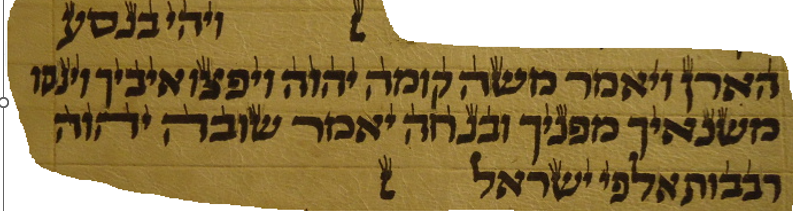
These verses depict a God who fights for Israel. Their inclusion in synagogue liturgy—before removing the Torah from the ark—reminds us of divine protection, especially in vulnerable moments. The presence of inverted Hebrew letter נ nuns נ around these verses in the scroll (see above) suggests they may have been later additions, perhaps liturgical in origin. Regardless, they reflect a historical memory of God as a warrior, as in Exodus 15:3: “The Lord is a warrior; the Lord is His name.” This God does not only bless us with peace—He battles. And this duality forms a tension at the heart of our tradition.
RECONCILING THE CONTRADICTION: PEACE AND POWER
Our tradition is not monolithic. It allows for many points of view. It recognizes that peace is often preceded by danger, and that justice sometimes requires struggle. Does the cry to “scatter enemies” contradict the Priestly Blessing for peace? Or is it a necessary companion? Our tradition acknowledges complexity. It does not offer a sanitized spirituality. Instead, it allows that peace may require struggle and even violence.
The Midrash teaches that “Great is peace, for even in times of war, peace must be sought” (Midrash Tanchuma, Shoftim 18:1). Rabbi Joshua ben Korcha’s statement that “whenever there is absolute justice, peace cannot prevail, and where there is peace, there cannot be absolute justice” (Midrash Tanchuma, Mishpatim 7:1) reminds us that life often demands tradeoffs, and peace is not always won by passivity.
In some moments, the call to “scatter enemies” is not a contradiction of peace, but a step toward it. The Torah does not promise that peace will come easily; it acknowledges the obstacles—internal and external—that must be overcome.
GAZA AND THE MODERN DILEMMA
These ancient verses feel painfully relevant today. What happens when we can no longer argue on the grounds of self-defense; when we seem to have become the aggressors—certainly in the perception of the world? The war in Gaza, with its devastating toll, brings the battle cry to life. Leaders in Israel invoke security, but their actions—sanctioned internationally for promoting violence—have led many to question whether defense has turned into aggression.
Where does the Priestly Blessing fit in this reality? Can we claim to be seeking peace while enacting policies that result in widespread destruction? The answer lies in moral courage and spiritual honesty. If we truly believe in peace as the ultimate good, we must ask hard questions about our actions. We must examine whether we are living up to the values of the Torah or merely using its language to justify power. Peace cannot be a slogan—it must be a discipline. And that discipline includes restraint, empathy, and a willingness to pursue resolution even when vengeance seems easier.
MIRIAM: A MODEL OF COMPASSIONATE RESPONSE
At the end of the parsha, we encounter a different kind of conflict—one rooted not in external enemies, but internal discord. In chapter 12, Miriam and Aaron speak critically of Moses. God punishes Miriam with a skin affliction, and Aaron pleads for her healing. Moses immediately pleads, “El na, refa na la” – “Please God, heal her now.” God makes her wait for seven days, but she is healed and the nation moves on.
This short, heartfelt prayer reveals another face of divine response—not judgment, but compassion. God’s power is not expressed in retribution, but in healing. Miriam’s story adds a third layer to our understanding. It reminds us that conflict within a community—especially among those closest to us—requires not conquest but care. Healing does not happen instantly, but through time, humility, and prayer. In today’s fractured climate, we need more Miriam moments—spaces where we pause, reflect, and reach for healing instead of doubling down on our own righteousness.
ZECHARIAH’S VISION: SPIRIT OVER SWORD
This week’s Haftarah, from the prophet Zechariah, offers a final perspective: “Not by might, nor by power, but by My spirit, says the Lord of Hosts” (Zechariah 4:6). This vision challenges the assumption that strength alone can secure peace. True power, the prophet insists, lies in spirit—in values, in justice, in holiness. The Torah’s complexity does not suggest indecision, but wisdom. We are meant to hold both the battle cry and the blessing, not as contradictions, but as expressions of a deeper truth: that peace is sacred, but not simple.
LIVING WITH DUALITY
Our tradition does not demand that we choose between peace and power. Instead, it asks us to hold the tension between them. To acknowledge that the world is broken, but that we must still seek repair. To carry the Torah both into battle and into blessing. We do not omit the uncomfortable verses. We read them all. We sit with the contradiction. And we resist the urge to label those who wrestle with complexity as traitors to a cause. This is the Torah’s gift: a spirituality that is honest, layered, and profoundly human. A Torah that blesses and battles. A Torah that cries out and also comforts. A Torah that does not hand us answers, but insists that we keep asking the right questions.
BLESSING IN THE MIDST OF STRUGGLE
As we lift the Torah, whether in celebration or mourning, we do so with the hope that its teachings will guide us—not only in times of peace, but especially in times of war. That we will remember that even when enemies must be scattered, peace remains our goal. May we live not by might or power alone, but by God’s spirit. May we uphold the dignity of all human life, even in times of conflict. And may we merit a time when the Ark need not go forth in battle, but only in blessing. When the final words of the Priestly Blessing—“and grant you peace”—become not just a prayer, but our enduring reality.
Related Topics
Related Posts