Thinking about 'Resilient Zionism'
From Community to Capital: Building Resilient Zionism Over Time
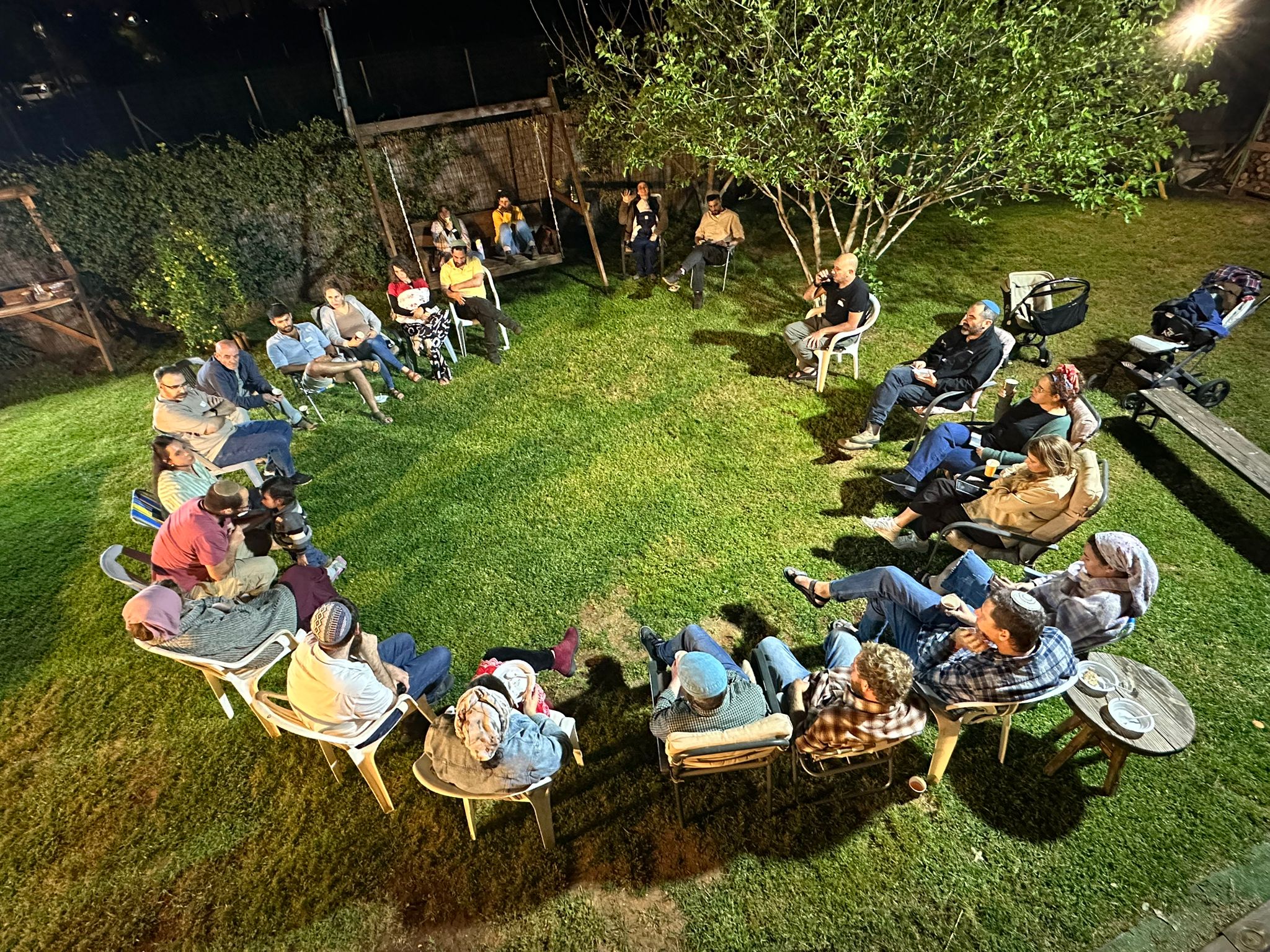
Recent working meeting of the founding members (Garin) of Yachad
In my previous reflections, I began to describe something I didn’t set out to define—a way of thinking about what I was seeing in and around the Yachad community. Yachad is an initiative focused on establishing a diverse, values-driven community in the Negev, bringing together a diversified group of Israelis as part of a broader effort to strengthen Israel’s social and geographic resilience. I called what I was observing, somewhat tentatively, Resilient Zionism. Not as a slogan or an ideology, but as a way of making sense of something that felt both familiar and new.
What I want to do here is continue that thread, but from a slightly different angle. If communities like Yachad are indeed building something real—something that has the potential to last—then the question that naturally follows is how that kind of building is actually sustained over time. And inevitably, that leads to the role of capital.
Through spending time in Yachad as we prepare to establish our community, what becomes clear quite quickly is that things don’t unfold in neat stages. There is no clean starting line where a plan becomes a project and then an investment case. Instead, what emerges is something closer to a lived theory of change, though no one would call it that in conversation. It begins, as most meaningful things do, with people. A relatively small group of committed families chooses to anchor themselves in a place like the Negev. From there, something starts to take shape. Not all at once, and not always smoothly, but with enough consistency and drive to begin forming a kind of gravitational pull.
Around that initial commitment, other layers begin to gather. Social organizations and thought leaders step in and help shape the educational and communal fabric. Agricultural initiatives bring not only economic activity, but a tangible connection to land that feels deeply rooted in the Zionist story. Technology partners introduce tools, networks, and possibilities that stretch beyond geography. None of these elements, on their own, define a community. But together, over time, they begin to reinforce one another in subtle but meaningful ways.
It’s only after watching this unfold that I began to recognize a pattern that felt familiar from my professional life. In another context, I might have described this as system formation. Here, it simply felt like something taking root.
And that is where the question of capital becomes more nuanced.
From a distance, it’s easy to assume that if something has value, it should be investable in the conventional sense. But early-stage community building resists that kind of framing. The timelines are longer, the signals are quieter and the risks don’t present themselves in ways that can easily be modeled. What might look, from the outside, like inefficiency is often just the natural pace of formation.
Over time, though, a different picture begins to emerge—one that looks less like a gap and more like a layering. Different forms of capital begin to find their place, almost organically. In the earliest moments, when very little is proven and much depends on belief, philanthropic capital carries a kind of quiet weight. It enables the first steps, absorbs uncertainty, and supports the social and human dimensions that have no immediate return but are foundational to everything that follows.
As the community begins to stabilize, something else starts to appear—a more structured but still patient form of capital, often described as catalytic. This is the kind of capital that helps bridge the space between vision and viability. It supports early infrastructure, backs initial economic activity, and allows partnerships to move from intention to operation. It doesn’t demand immediate returns, but it does begin to shape the conditions under which a community can function more independently.
I am assuming that only later once initial economic milestones are hit with some consistency, does more traditional investment begin to make sense. By that point, something important will have happened. The community will no longer be an idea. It will be a place where people live, work, and make decisions about staying. Economic activity takes shape. Relationships, both internal and external, deepen. It is in this context that professional capital can enter with a different kind of confidence.
Seen this way, what is often described as blended finance doesn’t feel like a constructed financial model. It feels like a reflection of reality. Different types of capital, each with their own expectations and time horizons, aligning around something that none of them could fully support on their own.
Alongside this, the question of impact also evolves. In the early stages, it’s difficult to point to metrics in any formal sense. Instead, you notice patterns. People choosing to stay. Relationships forming across differences that might otherwise divide. Local economic initiatives beginning to sustain themselves. A sense, however subtle, that something is holding together.
Only later do these observations begin to translate into indicators that can be measured and tracked such as retention, employment, economic diversification, institutional development. But what becomes clear is that the measurement follows reality and not the other way around.
There is also a layer here that is harder to articulate, but perhaps more important than any framework. Communities like Yachad are shaped not only by economics or geography, but by values. A commitment to place, even when it is not the easiest option. A willingness to live alongside difference without needing to resolve it entirely. A sense of responsibility that extends beyond the individual. These are not variables that fit easily into financial models, and yet they influence outcomes in ways that are hard to ignore. They shape whether a community can absorb stress without fracturing. In this sense, Zionist values are not external to the system being built, they are part of its internal logic.
What gives me some confidence that this way of thinking is not entirely abstract is that there are already efforts underway to create the foundations for it here in Israel. Organizations like the Israel Forum for Impact Investment have been working to develop the language and ecosystem needed to support impact-oriented investment in Israel. At the same time, institutions such as the Milken Innovation Center have contributed to the development of frameworks around blended finance and the role of capital in addressing complex societal challenges.
What feels different now is not the existence of these frameworks, but their relevance. In the current Israeli context, particularly in places like the Negev, where questions of security, demographics, and economic development intersect, the need to connect these ideas to lived reality feels more immediate.
All of this is still early. Yachad itself is still in formation. The partnerships are evolving, and the investment logic is being shaped more through experience than design.
But perhaps that is precisely the point.
As our community continues preparing to establish its physical presence in the Negev, it is becoming increasingly clear that how we build matters as much as what we build. The act of building—when done with intention, patience, and a long-term view—has the potential to create a different kind of alignment between people, place, values, and capital.
Resilient Zionism, at least as I’m beginning to understand it, isn’t something that can be declared in advance. It takes shape over time—built mindfully, imperfectly, and together.
Related Posts