
From Defensive Army to Offensive Defense
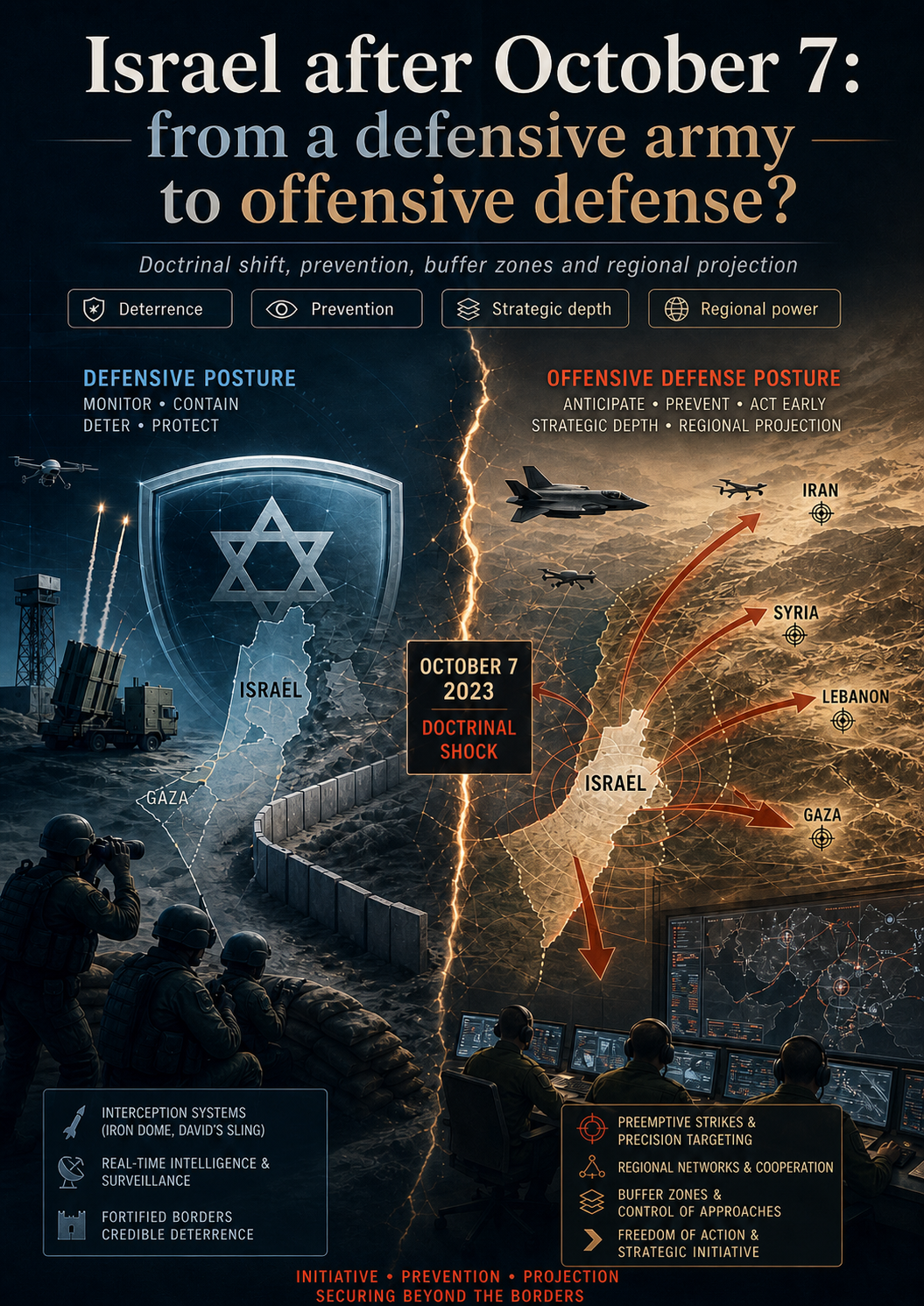
Since October 7, 2023, the IDF has not become an “offensive” army in the sense of a classic army of conquest. It has become an army that seeks to defend Israel through the offensive initiative, prevention, depth and disorganization of the enemy before he can reconstitute a threat.
1. The real break: the end of the “risk management” doctrine
Before October 7, Israel lived partly on a logic of containment: monitor Gaza, contain Hamas, strike punctually, restore deterrence, and then return to a form of precarious calm. The shock of October 7 destroyed this belief. An overly optimized posture for surveillance, control, and defensive reinsurance, but not enough for operational initiative.
Israel no longer just wants to intercept the threat; it now wants to prevent its reenactment. It is no longer just “to protect the border”; it is to create a depth, strike enemy infrastructure, and prevent Hamas, Hezbollah or other actors from rebuilding offensive capabilities near the borders.
2. Israel is not abandoning defense: it is radicalizing the offensive as a method of defense.
Historically, Israel has never been a purely defensive army in its methods. Its classical doctrine was already based on an apparent contradiction: a defensive purpose—ensuring the survival of the state—carried out by an offensive military doctrine. The INSS recalls that the Israeli doctrine combines a defensive security orientation with an offensive military doctrine because Israel lacks territorial depth and cannot absorb war for long on its soil.
The novelty after October 7 is therefore not that “Israel discovers the offensive”. The novelty is Israel no longer believes that passive deterrence and surveillance technology is enough. All this has shown its limits in the face of an enemy who observes, learns, waits and strikes at the moment of vulnerability.
3. The new doctrine: prevention, buffer zones, deep strikes
Three pillars are emerging.
First, defense by a preventive offensive.
Then, the logic of buffer zones. Gaza, southern Lebanon, and Israel seek to stop allowing hostile forces to settle directly in contact with its localities. This logic transforms the border into an active security space, no longer just a defensive line.
Finally, the regional projection includes a doctrine that seeks not only to restore deterrence but also to prevent the reconstruction of threats.
4. Israel changes its regional profile
Israel appears more as an established regional power, not just as a besieged state reacting to its neighbors. The difference is significant.
Before, Israel wanted, above all, to be recognized as a technologically superior defensive power. After October 7, it seeks to be perceived as a power capable of saying that no hostile actor will be able to quietly build an existential threat near our borders.
This move changes its status. It seeks to shape its immediate strategic environment. This is the behavior of a regional power.
5. Regional power or strategic overextension?
A more offensive army does not automatically mean a more stable power. Israel can win militarily and lose politically some of its room for maneuver.
Risk of international legitimacy. The further away Israel acts from its borders, the more it must justify each operation. A pre-emptive offensive can be militarily rational but diplomatically costly.
October 7 accelerated the mutation of the IDF from an army of territorial defense and deterrence to an army of initiative, prevention and regional projection.
Israel does not become an “offensive army” against its nature. It comes down to an old Israeli strategic truth, but in a much broader context: to defend a territory without depth, Israel now chooses to create its own depth in the adversary.
That is the major change. Not the end of the defense army, but the birth of a much more offensive, more regional, more preventive defense—and therefore also more politically risky.
The key question then becomes: can Israel transform this military superiority into a sustainable strategic order? Only a strategy can prevent another threat from reappearing in its place.