
From Deterrence to Prevention
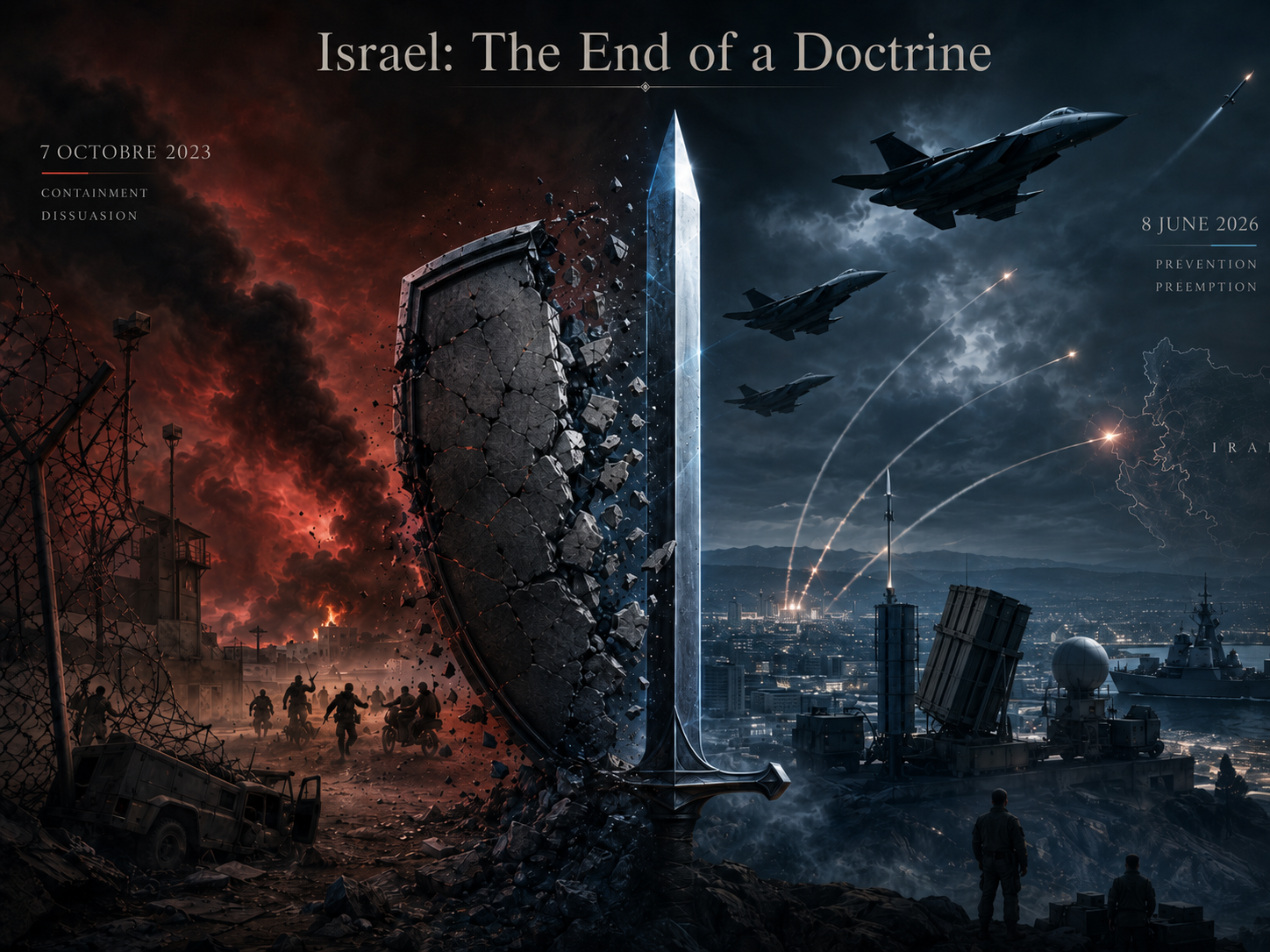
Since October 7, 2023, Israel has not only been waging a war. It has changed its strategic framework. Many observers have not yet fully understood the implications. People often continue to analyse Israel with the old vocabulary: deterrence, proportional response, American pressure, diplomatic restraint, and return to calm. These words partly belong to the pre-October 7 era.
Before October 7, Israel’s doctrine was simple: enemies could be contained. Hamas could be deterred. Hezbollah kept in a balance of fear. Iran slowed through strikes, covert actions, sanctions, or negotiations. Israel operated on a risk-management model: strike, respond, restore deterrence, and return to a fragile calm.
October 7 destroyed this belief.
On that day, Israel discovered deterrence could be an illusion. Barriers could fall. Intelligence could miss the essentials. The enemy could prepare for years for an attack considered impossible, irrational, or too costly.
This realization marks the start of a new doctrinal phase.
Since that date, Israel’s objective is no longer just to punish the enemy after an attack. It is to prevent the enemy from attacking again. The difference is immense. To punish is to respond. To prevent is to transform the strategic reality. This means destroying capabilities, dismantling infrastructures, striking command structures, and preventing reconstruction. It means refusing a return to the status quo. In other words, Israel no longer wants to simply restore deterrence. Israel wants to shift the balance of power.
This is visible in Gaza. The objective was not presented as a simple punitive operation against Hamas. It was to destroy the group’s military and governmental capabilities. It is visible in Lebanon, where Israel no longer seems willing to accept Hezbollah at its borders with the same capabilities as before. It is visible in Syria, in the strikes against Iranian networks. Now it is visible in Iran.
The events of June 7 and 8, 2026, illustrate this new approach.
When Iran launches missiles against Israel in a context where Washington seeks to preserve negotiations, Israel no longer acts as before. In the past, the question was: how to respond without embarrassing the American ally? How to preserve diplomacy? How to avoid escalation? These questions still exist. But they are no longer the only ones. The central question is now: if Israel does not respond, what will Iran, Hezbollah, the Houthis, and all the actors of the Iranian axis understand?
In the new Israeli doctrine, the absence of a response can cost more than the response itself. Not retaliating is not just about avoiding war. It can be read as weakness, dependence, or even as an invitation to repeat the attack. This is the fundamental shift. Israel no longer wants its enemies to think they can calibrate violence, strike, then hide behind international or American pressure to prevent an Israeli response.
That is why the disagreement with Donald Trump is so important. It does not necessarily mean a break between Washington and Jerusalem. The United States remains Israel’s indispensable ally militarily, diplomatically, and strategically. But the episode shows one thing: since October 7, Israel no longer wants to delegate its existential security, not even to its best ally.
This change can be summed up as follows: consultation with Washington continues, but automatic subordination does not.
In this episode, Netanyahu is not just defying Trump. He is sending a message to Tehran. He says, ‘Even if Washington wants to buy time, even if negotiations are underway, even if America seeks a diplomatic solution, Israel will keep its right to respond.’ For Israel, Iran is not just an American diplomatic issue. It is a direct, regional, military, ideological, and existential threat.
It is also a matter of timing. Trump thinks like a negotiator: agreement, political timetable, American opinion, promise of peace, and the need to manage escalation. Israel thinks like a strategic survivor. If a threat is not stopped today, it may become unbearable tomorrow. The United States can test negotiations. Israel believes it can no longer afford to make mistakes.
Thus, the events of October 7 continue to reverberate in Israel’s strategic thinking.
Since that day, Israel’s tolerance threshold has dropped. What was once considered a manageable threat now seems to be a threat in the making. A stockpile of missiles is no longer just a stockpile. Perhaps it is the next October 7. A militia at the border is not just a tool of pressure. It could be the next invasion. A limited attack is not just a signal. It may be a test.
The new Israeli doctrine is therefore based on an implicit phrase: never again should the enemy be able to quietly build the next surprise.
This doctrine has its logic. It also has risks. The more Israel strikes, and the harder it strikes, the greater the danger of diplomatic isolation, American fatigue, European criticism, economic wear, and domestic exhaustion. A doctrine of permanent prevention offers protection but can trap one in a long war. The real question is how to prevent threats without constant mobilisation.
This issue shapes the core of Israel’s post-October 7 dilemma.
Israel can no longer return to the old doctrine because it failed. But Israel cannot settle for a purely military doctrine either. No army can provide absolute security on its own. A comprehensive doctrine is now needed: military, diplomatic, regional, economic, and domestic. Strike threats, yes. But also rebuild alliances, restore trust with citizens, keep the American link, and turn tactical successes into strategic gains.
June 8, 2026, may remain a revealing moment. Not because Israel has broken with the United States. That would be an exaggeration. But because Israel has shown that, it no longer sees restraint as an automatic virtue. Restraint remains possible, but now it must serve Israeli security. It cannot be imposed from outside if it gives the enemy the impression that attacking is bearable.
Before October 7, Israel mainly sought to restore calm.
After October 7, Israel aims to preempt the resurgence of threats altogether.
This is not just a military adjustment; it represents a comprehensive shift in doctrine.
Related Topics
Related Posts