
From Fringe to Mainstream: How the Unacceptable Becomes Ordinary
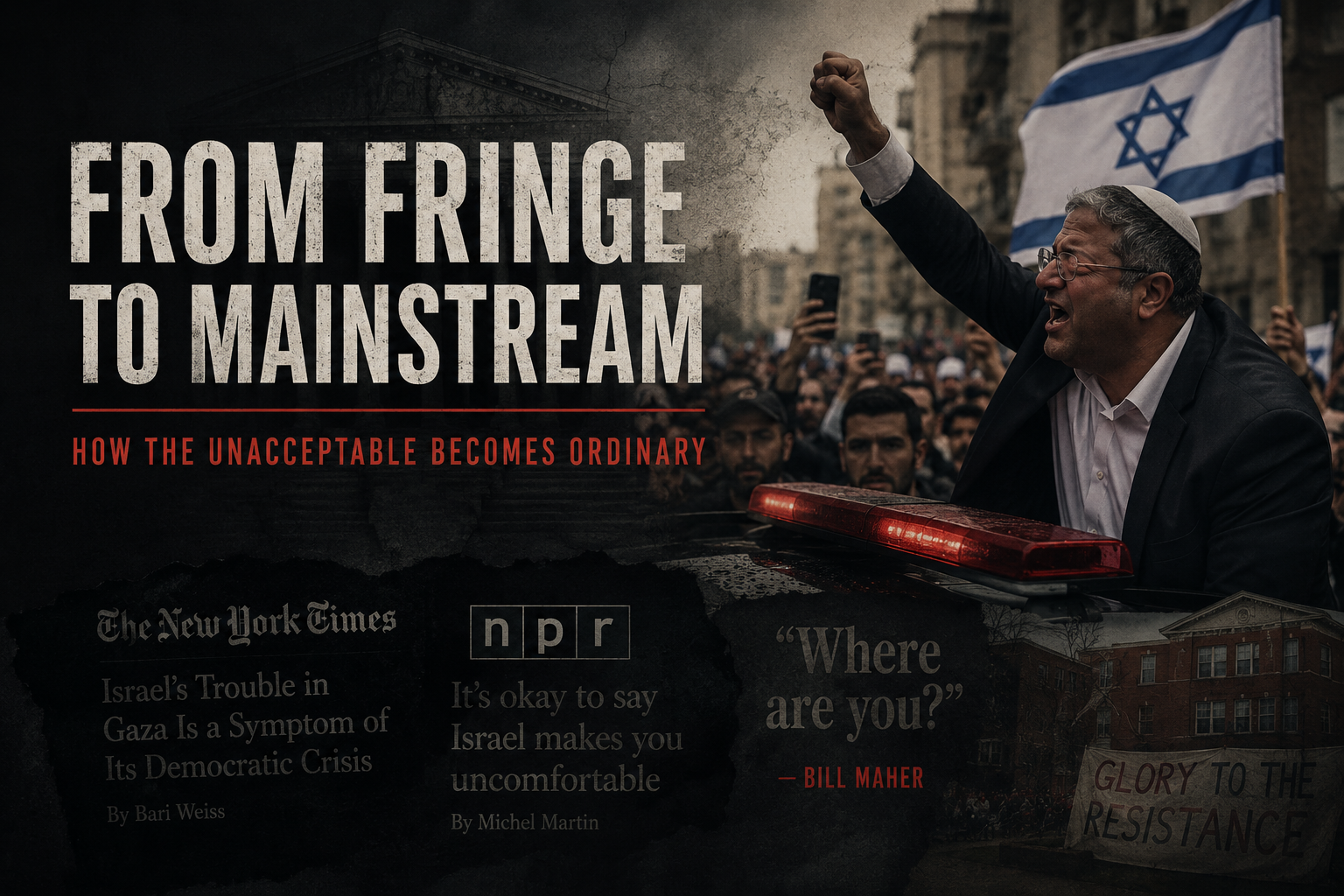
This week, Israeli National Security Minister Itamar Ben-Gvir posted a grotesque video mocking detained aid flotilla activists in a performance seemingly designed less for governance than for social media applause from his political base.
Quite apart from one’s views of the flotilla itself, the spectacle was juvenile, humiliating, and strategically disastrous. It handed Israel’s critics exactly the imagery they wanted while further normalizing a style of politics built on provocation, humiliation, and performative cruelty.
What disturbed me most was not the video itself. It was how unsurprising it felt. The rise of Ben-Gvir reflects a broader pathology that increasingly transcends ideology, geography, and tribe.
There is nothing respectable about Ben-Gvir’s style of politics. The disturbing part is not that such extremism exists. Every society has extremists. The disturbing part is that it was gradually mainstreamed. Institutionalized. Absorbed into governing power.
Prime Minister Benjamin Netanyahu’s Faustian bargain to preserve his coalition and political survival helped move figures once considered far outside respectable Israeli political life into the center of state power.
That is how normalization works. Not by transforming extremists into moderates. But by slowly transforming institutions into places willing to accommodate them.
To be fair, many Israelis — including figures on the political right — condemned the video quickly and forcefully. And that matters. Healthy societies are supposed to produce moral antibodies against this kind of behavior.
But the fact that such conduct now emerges from within the governing structure itself would have been politically unimaginable in Israel not very long ago. And once institutions begin accommodating extremism, the process rarely stays confined to one ideology or one country.
The disturbing truth is that modern extremism rarely enters respectable society wearing a swastika or waving a black flag. It arrives dressed in the language of justice. Human rights. Liberation. Resistance. Security. Anti-colonialism. National survival.
And depending on the ideological preferences of the audience, institutions begin selectively lowering their moral defenses. That is how normalization begins. Not all at once. Not with giant speeches or marching bands. But gradually. Respectably. Institutionally.
Increasingly, however, the path from fringe to mainstream no longer runs primarily through political parties or religious institutions. It runs through influencers, activist networks, algorithms, universities, media organizations, and social media ecosystems that selectively sanitize ideas depending on who delivers them.
Ideas rarely move directly from the fringe into government policy or prestige media. The process, by now, is plainly visible. They travel through a cultural pipeline as follows:
First, activists normalize them. Then influencers popularize them. Academia intellectualizes them. Media institutions sanitize them. And eventually political and cultural elites absorb them into respectable discourse.
In the United States, we watched versions of this process unfold in real time after October 7.
Slogans and rhetoric that once would have been viewed as openly extremist or eliminationist suddenly appeared on elite campuses, in faculty statements, activist circles, social media feeds, and even portions of mainstream political discourse — often defended not as hatred, but as the language of “resistance,” “decolonization,” or “social justice.”
“Globalize the Intifada” comes immediately to mind — a morally repugnant slogan that should be abhorrent to anyone with even a passing understanding of Israeli and Jewish history.
Yet even the mayor of the city with the largest Jewish population outside Israel hesitated to clearly condemn it.
That hesitation mattered. Because normalization rarely begins with endorsement. It begins with euphemism, contextualization, and the gradual loss of moral clarity.
Historically, dangerous ideas rarely became powerful because fringe voices shouted them from the margins. They became powerful when institutions such as universities, media organizations, political parties, intellectuals, and cultural elites began laundering them into legitimacy.
That is one of the defining paradoxes of the modern progressive era. Institutions built to resist bigotry increasingly struggle to recognize it when it arrives wrapped in the language of social justice, anti-colonialism, or resistance politics.
The result is not always open support. More often it is hesitation. Silence. Selective outrage. The instinctive urge to explain away rhetoric that would be condemned instantly in almost any other context.
That shift did not happen overnight. At The New York Times, many observers saw the removal of opinion editor James Bennet after internal backlash to a controversial op-ed as a symbolic turning point. The issue was not whether one agreed with the op-ed itself. The deeper signal was that editorial judgment was increasingly being shaped by ideological pressure and moral conformity rather than pluralism and debate.
Around the same period, journalist Bari Weiss published a resignation letter that quickly became a kind of cultural Rorschach test. Supporters saw it as a warning about groupthink, internal intimidation, and the shrinking boundaries of acceptable opinion inside elite media institutions. Critics dismissed it as self-dramatization. But regardless of where one landed politically, the letter captured a growing sense that many journalistic institutions were becoming less comfortable with genuine disagreement and more vulnerable to activist pressure, social-media dynamics, and ideological sorting.
As a liberal Jew who has spent decades subscribing to The New York Times and listening daily to NPR, I do not say any of this with pleasure. These were institutions I once viewed as imperfect but fundamentally committed to pluralism, skepticism, and liberal democratic values.
Today, I still read the Times, though increasingly with concern and hesitation (except for the puzzles of course). NPR, however, largely lost me years ago. Not because it became “too liberal,” but because too often it no longer sounded curious. It sounded more certain of communicating news that fit a progressive narrative.
A similar critique has emerged around NPR itself, where even longtime insiders and liberal critics such as Josh Levs have warned about narrowing viewpoint diversity, activist framing, and the subtle transformation of journalism from skepticism into moral performance.
That may help explain why Bill Maher’s recent monologue resonated so strongly with many Jews, including many liberal Jews like myself.
Bill is not everyone’s cup of tea, but on his most recent episode of Real Time, Maher delivered one of the bluntest monologues about modern antisemitism heard on mainstream American television in years.
“There is a frothing anxiousness for the literal extermination of this one group [Jews],” he said, before asking Democrats a simple question:
“Where are you?”
Not because Jews expect ideological uniformity. But because many increasingly sense a moral hesitation inside institutions that once prided themselves on recognizing bigotry early rather than explaining it away after the fact.
Again, this is not fundamentally a left-versus-right story. It is an institutional story. Institutions do not radicalize all at once. They drift.
Through staffing changes. Through social incentives. Through fear of internal backlash. Through the gradual narrowing of acceptable opinion. Through euphemism. Through selective moral blindness. And eventually through public desensitization.
Which brings me back to that Ben-Gvir video.
The truly disturbing part was not the thuggery itself. Every society has thugs. The disturbing part was how normal it suddenly felt for a senior government minister to behave that way publicly and how many people instinctively rushed not to condemn it, but to rationalize it.
That is how normalization works. Not when extremists scream from the fringe.
But when institutions, coalitions, media ecosystems, and ordinary people gradually stop reacting to extremism as though it were extreme at all.
Maybe that is why Bill Maher’s question to the Democrats resonated so strongly.
“Where are you?”