The views expressed herein are solely mine.
From Gaza to Jakarta: Bibi’s Abraham Accords Bet
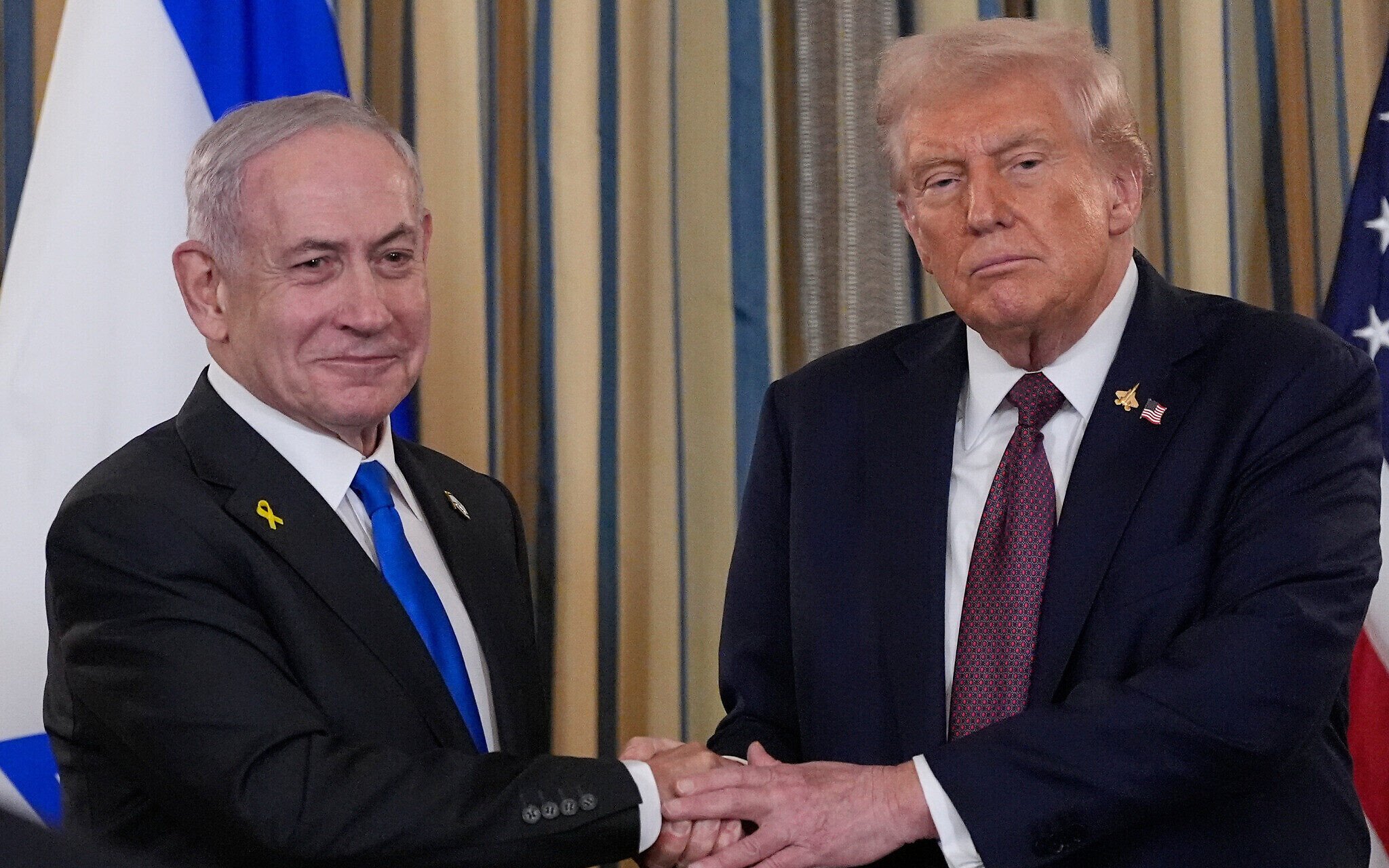
Prime Minister Benjamin Netanyahu (L) shakes hands with US President Donald Trump after a news conference in the State Dining Room of the White House, Washington, DC, September 29, 2025. (AP Photo/ Alex Brandon)
The ground just shifted under the Middle East, and few noticed why. At the White House today, Israel and the United States unveiled a sweeping deal to end the Gaza war: hostages freed within 48–72 hours, Hamas exiled, the IDF pulling back in three phases, and a so-called “Board of Peace” installed to administer Gaza until a new order takes root. But the heart of the deal goes far beyond Gaza: U.S. security guarantees for Israel against Iran and the promise of expanding the Abraham Accords. For Prime Minister Benjamin Netanyahu, this was not only about hostages — it was about history, and about opening the door to potential Arab and Muslim partners (with Indonesia as the most obvious new addition to Israel’s circle of peace).
Let us cut through the smoke. What Israel agreed to today is no small gesture. Hamas operatives will be exiled from Gaza. The IDF, after nearly two years of brutal fighting and more than 1,000 soldiers dead, will progressively withdraw — first from northern Gaza, then central sectors, and finally from the entire Strip — while still maintaining a buffer zone to prevent Hamas and others’ infiltration.
In their place, an international “Board of Peace,” handpicked and chaired under American oversight, will manage reconstruction and governance. Israel, under this plan, halts its push for voluntary Palestinian migration and suspends any annexation steps. In short: the war ends not with Hamas annihilated, but with Israel stepping back under a new Washington-driven framework.
This is why critics — from Israeli nationalists to American hawks — are sounding alarms. They see Netanyahu parking annexation not as a strategy but as a surrender. They warn that Hamas, though bloodied, will survive in exile, its ideology intact, waiting for its return. They argue that a phased IDF exit, even with a buffer zone, hands terrorists breathing space, and that talk of a “Board of Peace” is code for the return of the corrupt Palestinian Authority and the slow creep toward a Palestinian state carved out of Israeli sacrifice. To them, this is Oslo 2.0 — with all the risks and none of the lessons learned.
So why did Netanyahu sign on? The answer may lie not in Gaza’s rubble but in Jakarta’s speech at the UN. When the president of Indonesia — the world’s most populous Muslim nation — stood at the General Assembly and defended Israel’s right to security, jaws dropped from Ramallah to Tehran. For decades, Indonesia parroted the anti-Zionist script. Yet here was the leader of 270 million Muslims defying the mob, affirming Israel’s right to exist and resist — even during the Gaza war, when propaganda outlets from Doha to Paris screamed “genocide.”
That speech was no slip of the tongue. It reflected a generational and strategic shift: Indonesians tired of Arab obsessions, leaders desperate for high-tech partnerships, and an economy hungry for innovation. Israel’s cyber know-how, agritech, and water technology are not just desirable; they are survival tools for a sprawling archipelago battling jihadists and climate crises. If Jakarta normalizes relations with Israel through the Abraham Accords, the symbolism would be seismic. The Palestinian veto collapses. Arab holdouts lose their excuses. And the largest Muslim-majority nation on earth would show that backing Israel is not betrayal — it is common sense.
For Netanyahu, this is the calculation: park annexation for now, trade Gaza certainty for Abraham Accords expansion, and aim for the unthinkable — Indonesia and potentially other key Arab and Muslim elements in Israel’s camp.
For example, in the case of Indonesia, the payoff would be monumental: trade routes to Southeast Asia, counter-terror cooperation against Islamist networks from Jakarta to Bali, and a political earthquake that forces the Palestinians to face reality. Critics can scream “retreat,” but Bibi may be gambling on a bigger prize.
The Gaza plan unveiled today is no love letter to Hamas. It is an American-brokered truce that buys Israel breathing room and tests whether the Islamic world is ready to normalize with the Jewish state. And if the Arab and Muslim world breaks ranks, the game does not just shift. It shatters.
Yet, I remain skeptical: with Islamic Jihad already warning this deal will “ignite” Gaza, Hamas has every incentive to stall, cheat, and plot its survival — and Bibi, boxed in with no other options, may have signed onto a deal so hard to implement that even if Hamas accepts, it will spend every waking moment scheming to cling to power militarily and politically inside Gaza.
Fingers crossed.
Related Topics
- Abraham Accords
- Anti-Zionism
- Benjamin Netanyahu
- Cyber-security
- Donald Trump
- Gaza
- Gaza Border
- Gaza Disengagement
- Gaza Rocket Attacks
- Gaza Strip
- Hamas
- Hostages in Gaza
- Indonesia
- Iran
- Islam
- Israel At War
- Israel-Iran Conflict
- Israel-Saudi Normalization
- Israel-US Relations
- Israeli Foreign Policy
- Jewish-Arab violence
- Jewish-Muslim Relations
- Middle East
- Muslim-Jewish Dialogue
- October 7 anniversary
- Palestinian Authority
- Palestinian Statehood
- Palestinians
- Peace Builders
- Peace Process
- Peace to Prosperity
- Saudi Arabia
- Terrorism
- The Arab World
- Trump Peace Plan
- UAE-Israel Peace
- United Nations
- Zionism