Somaliland Historian, Biographer and Political Commentator
From Grievance to Geopolitics: What Somaliland’s CFR Appearance Reveals About a Changed Diplomatic Strategy
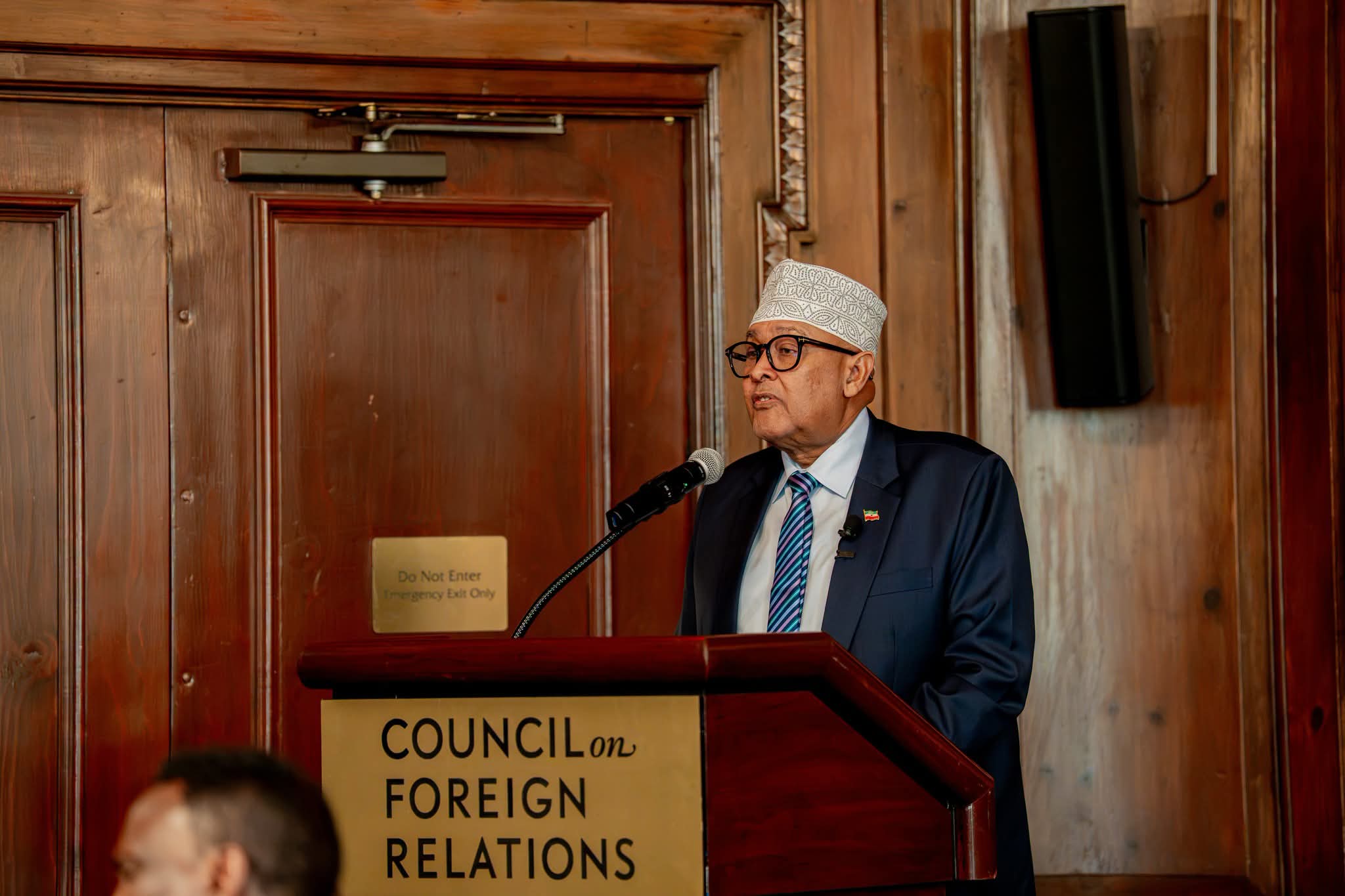
President Abdirahman Mohamed Abdullahi (Cirro) addresses the Council on Foreign Relations, New York, September 24, 2026. (Photo: Office of the President, Republic of Somaliland)
At the Council on Foreign Relations, President Abdirahman Mohamed Abdullahi framed recognition as a strategic bargain, not a historical debt — but the gap between his reception in Washington and actual U.S. policy tells its own story.
For thirty-five years, Somaliland’s case for statehood has rested on a moral argument: a peaceful, self-governing democracy of some six million people, born of a 1991 secession that undid a failed 1960 union, deserves the recognition that history and international law arguably already owe it. On September 24, in a wood-paneled room at the Council on Foreign Relations in New York, President Abdirahman Mohamed Abdullahi — known to Somalilanders as Cirro — largely set that argument aside. What he offered American foreign-policy elites instead was a transaction: Somaliland’s ports, its 850 kilometers of Gulf of Aden coastline, its willingness to patrol alongside the U.S. Navy, and its record as one of the only functioning democracies in the Horn of Africa, in exchange for a status the United States has so far declined to grant.
That a head of a self-declared republic recognized by only one UN member state — Israel — could command a CFR platform at all says something about how far Somaliland’s diplomacy has traveled since Cirro took office in December 2024 after winning roughly 64 percent of the vote. It also explains why his remarks are worth reading closely by an Israeli audience: Israel is not a bystander in this story. It is the reason Somaliland’s argument has evidence behind it.
From grievance to geopolitics
In his prepared remarks, Cirro made the legal case for Somaliland’s statehood briskly — the Montevideo Convention criteria, the precedent of Senegal and Gambia’s dissolved federation, the memory of watching the Soviet Union split into fifteen states while he served as a young diplomat in Moscow. But he spent noticeably more time on a different register: Somaliland as an “indispensable partner” for Western maritime security, a potential supplier of critical minerals, a market ready for American investment once the country’s own government finance ministry’s projection of $10 billion GDP by 2035 becomes deployable capital rather than aspiration.
This is a calculated shift. A grievance-based appeal invites sympathy, which is cheap for great powers to withhold. A strategic-interest appeal invites cost-benefit analysis, which is harder to ignore — particularly for a Trump administration that has shown a preference for framing foreign policy in transactional terms. Cirro’s own language mirrored that framing throughout the discussion: recognition, in his telling, is less a favor to Somaliland than an instrument the United States could use to advance its own interests in a contested waterway.
Whether this recalibration reflects genuine strategic logic or simply better public-relations instincts is a fair question, and probably both are true. Somaliland’s location is real: it sits opposite one of the world’s most consequential chokepoints, and Houthi attacks on shipping in the Red Sea corridor have made Bab el-Mandeb a live security concern rather than an abstraction. But strategic value alone does not typically confer statehood — plenty of geographically significant, unrecognized, or contested territories exist without becoming independent states. The argument Cirro is making to Washington is really a bet: that in a moment when both parties in Congress are wary of ceding regional influence to China, Turkey, or Iran-aligned actors, strategic usefulness can do the political work that historical justice alone has not.
Israel as precedent, not endpoint
Cirro’s moderator did not let him avoid the subject: Israel’s decision, announced on December 26, 2025, to become the first UN member state to formally recognize Somaliland. The declaration was signed jointly by Prime Minister Benjamin Netanyahu and Cirro, with Israel signaling it would expand cooperation in agriculture, health, technology and economic development, and Somaliland separately pledging to join the framework of the Abraham Accords. The reaction was immediate: the UN Security Council convened an emergency session at the request of Algeria, Sierra Leone, Somalia and Guyana, and Kuwait, speaking for the Arab Group, called the recognition an illegal, null and void unilateral action that violated Somalia’s sovereignty and the UN Charter.
Cirro’s own account of the fallout at CFR was more candid than triumphant. Asked directly why African and Arab governments had denounced the move so uniformly, he did not claim broad Muslim-world enthusiasm; he argued instead that only about half of Africa’s states and roughly half of Arab and Islamic-majority countries had formally condemned it as individual governments — and he read that partial silence as latent acceptance rather than rejection. That is an optimistic reading of silence, and he did not offer independent verification for it. It also does not erase the reality that Somalia, Egypt, Turkey and Djibouti issued a joint statement of condemnation, or that the African Union’s leadership has continued to treat the recognition as a dangerous precedent for the continent’s colonial-era borders.
What Cirro’s answer did reveal, intentionally or not, is that Israel’s recognition functions for Somaliland less as an end in itself than as a demonstration effect — proof that a Western democracy can recognize Somaliland and absorb the diplomatic cost without catastrophic consequence. That is precisely the case Somaliland’s delegation has been making in Washington: the fallout was loud but manageable, as Israeli analysts framed it at the time. Whether Washington agrees is the more important question, and here the picture Cirro presented was considerably rosier than the public record supports.
Washington’s mixed signals
Cirro told his CFR audience that his nearly two-week stay in Washington had produced “very useful” engagement with the administration, meetings with roughly a dozen members of Congress, and what he described as being “eye to eye” with the State Department’s Africa bureau on security, trade, counterterrorism and investment. All of that may be true, and warm private meetings are not nothing. But it sits awkwardly alongside the documented state of U.S. policy: in a report to Congress this past June, the State Department explicitly reaffirmed Somalia’s sovereignty and territorial integrity over Somaliland — a formal “One Somalia” position — even as it continued narrower tactical security cooperation with Hargeisa. One regional analyst close to the file noted that while former Trump officials had encouraged Somalilanders’ hopes for U.S. recognition, there was never a genuine sign the president would follow through.
There is also legislative interest that has not translated into legislative action. A bill introduced in the House in June 2025, the Republic of Somaliland Independence Act, would declare Somalia’s territorial claims over Somaliland invalid and authorize the president to extend recognition — but it has sat in committee for over a year with no floor movement. Cirro is not wrong that “many in the US government” understand Somaliland’s strategic argument, as he put it in his opening remarks. He is on shakier ground suggesting that understanding has moved the needle on formal policy. The honest reading of his Washington trip is that it advanced relationships and possibly incremental security cooperation, not recognition — and Cirro, to his credit, did not claim otherwise when pressed directly; he spoke of “fruitful discussions,” a phrase notably short of “commitments.”
Geography as argument
If there was one note Cirro returned to more than any other, it was geography. Somaliland’s 850 kilometers of coastline opposite the Gulf of Aden, its proximity to Bab el-Mandeb and, by extension, to the Strait of Hormuz problem further east, gave him his most concrete offer: intelligence sharing, maritime patrols, participation in a sustained international presence against Houthi-linked disruption of shipping. One questioner, the Atlantic Council’s Ariel Cohen, pushed him to characterize the “correlation of forces” around the Horn in language that echoed Cold War geopolitics; Cirro’s answer was essentially a sales pitch — Somaliland has kept its waters safe “for free for the whole world” for 35 years and is now ready to formalize that role as a paid partnership.
This is where Somaliland’s case is strongest and most verifiable. The Houthi campaign against Red Sea shipping since late 2023 has already reshaped global shipping routes and insurance costs; a stable, cooperative partner on the southern shore of that corridor has obvious value regardless of one’s view on recognition. It is also, notably, the argument least entangled with the emotionally charged questions of Somali unity, colonial borders or Israel — which may be exactly why Cirro leaned on it so heavily with an American audience he wanted to persuade on interest rather than sentiment.
The Taiwan parallel — and its risks
Cirro’s answer on Taiwan was shorter than his answer on almost any other topic, but it may be the most geopolitically loaded. Somaliland and Taiwan established a reciprocal diplomatic-style relationship in 2020, exchanging representative offices; Cirro told the CFR audience his interior minister was in Taipei that same week meeting Taiwan’s president, and that cooperation spans health, education, training and technology. He acknowledged, without elaboration, that “China is not happy” — an understatement. Days before the CFR event, China’s embassy in Somalia condemned Cirro’s pro-Taiwan remarks in Washington as a violation of the one-China principle and Chinese sovereignty.
There is a strategic logic behind Somaliland’s Taiwan relationship that goes beyond sentiment: Cirro has explicitly said he would welcome a Taiwan-like status for Somaliland from the United States — something short of full recognition but substantive enough to matter — describing it as a middle path between Somaliland’s current limbo and full statehood. That is a more modest ask than outright recognition, and possibly a more achievable one in the near term. But it also means Somaliland is positioning itself, deliberately or not, inside the broader U.S.-China rivalry — a strategy that has worked reasonably well for actual Taiwan, backed by decades of embedded economic and security relationships, but is a considerably higher-risk bet for a state with far less leverage and far more fragile international standing. If Somaliland becomes primarily useful to Washington as an irritant to Beijing rather than as a partner valued on its own terms, that is a precarious foundation for a recognition campaign.
Africa’s unresolved contradiction
Cirro’s answer on the African Union deserves particular attention because it points to a genuine institutional inconsistency that predates his presidency. A 2005 African Union fact-finding mission to Somaliland concluded that its case was “unique and self-justified in African political history” and explicitly stated the situation should not be treated as opening a “Pandora’s box” for other separatist claims on the continent. The mission further found that the 1960 union between Somaliland and Somalia had never been properly ratified and had malfunctioned, bringing what it called enormous injustice and suffering to the region — and recommended the AU find a special mechanism for handling Somaliland’s case.
That report has never been formally adopted or acted upon by the AU, and the organization’s current leadership has continued to treat Somaliland’s recognition as a threat to continental stability. Cirro’s request — simply that the AU revisit its own commissioned findings — is modest and, on its face, reasonable. It is also unlikely to be granted soon: as Cirro himself acknowledged, Turkey and Egypt have actively lobbied African governments against recognizing Somaliland, and the AU’s institutional inertia, twenty years on, shows no sign of yielding to its own 2005 conclusions.
The economic case, and its limits
Somaliland’s economic pitch — a free market open to American investment in minerals, energy, tourism and trade corridors into Ethiopia — was long on ambition and comparatively short on specifics. Asked directly about critical-minerals cooperation, Cirro’s answer amounted to: some companies are interested, discussions are ongoing, no major breakthrough yet. That candor is worth noting, since it undercuts any temptation to read the CFR appearance as evidence of imminent deals. The more substantive economic argument Cirro made was structural: Somaliland’s exclusion from international banking and development finance — no ability to open letters of credit, no direct access to institutions like the IMF or World Bank — is, in his telling, the single largest barrier to converting the country’s natural wealth (livestock exports, mineral potential, the Berbera port) into actual growth. That claim is plausible and consistent with what independent observers of unrecognized states generally report, though it remains, like much else in Cirro’s presentation, not independently verifiable in dollar terms from the transcript alone.
What could go wrong
Cirro’s strategy carries risks he did not dwell on. Aligning Somaliland’s international profile so closely with Israel, at a moment of intense controversy over the war in Gaza and plummeting Israeli favorability across much of the Muslim-majority world, is a gamble Hargeisa’s own officials have acknowledged privately as having “no alternatives” — recognition, in their calculation, outweighs the reputational cost. Leaning into a Taiwan-style relationship invites Chinese hostility that a small, resource-constrained state is poorly positioned to absorb. And courting one administration’s warm words while the underlying State Department policy remains unchanged risks a familiar trap for small states in great-power politics: mistaking access for alignment.
A recognition campaign that has changed its own terms
What Cirro’s CFR appearance ultimately reveals is not that Somaliland is on the verge of American recognition — the documentary record argues against that — but that Hargeisa has concluded moral suasion alone will never get it there, and has recalibrated accordingly. The new pitch treats recognition as a strategic transaction rather than a historical correction: Israel supplies the proof that the diplomatic sky does not fall; Taiwan supplies a fallback model if full recognition remains elusive; geography supplies the leverage. It is a more sophisticated argument than Somaliland has made in the past, and a more honest one in some respects, since it does not pretend Somalia’s grievances or the AU’s objections will simply disappear.
Whether it succeeds will depend less on the persuasiveness of any single CFR appearance than on factors largely outside Cirro’s control — whether Washington’s institutional caution gives way to the kind of political calculation Israel already made, whether the Gulf of Aden security picture continues to deteriorate in ways that reward partners rather than punish them, and whether Somaliland’s own leverage as a “Taiwan of the Horn of Africa” proves durable or merely convenient rhetoric for the moment. For Israel, which took the first and still lonely step, the question that follows is whether it will continue investing in that relationship as a strategic bet on the Horn of Africa’s future, or whether December’s recognition remains, for now, a singular and unrepeated act.
Related Topics
Related Posts