From Hargeisa to Washington: Somaliland Makes Its Strategic Case to America
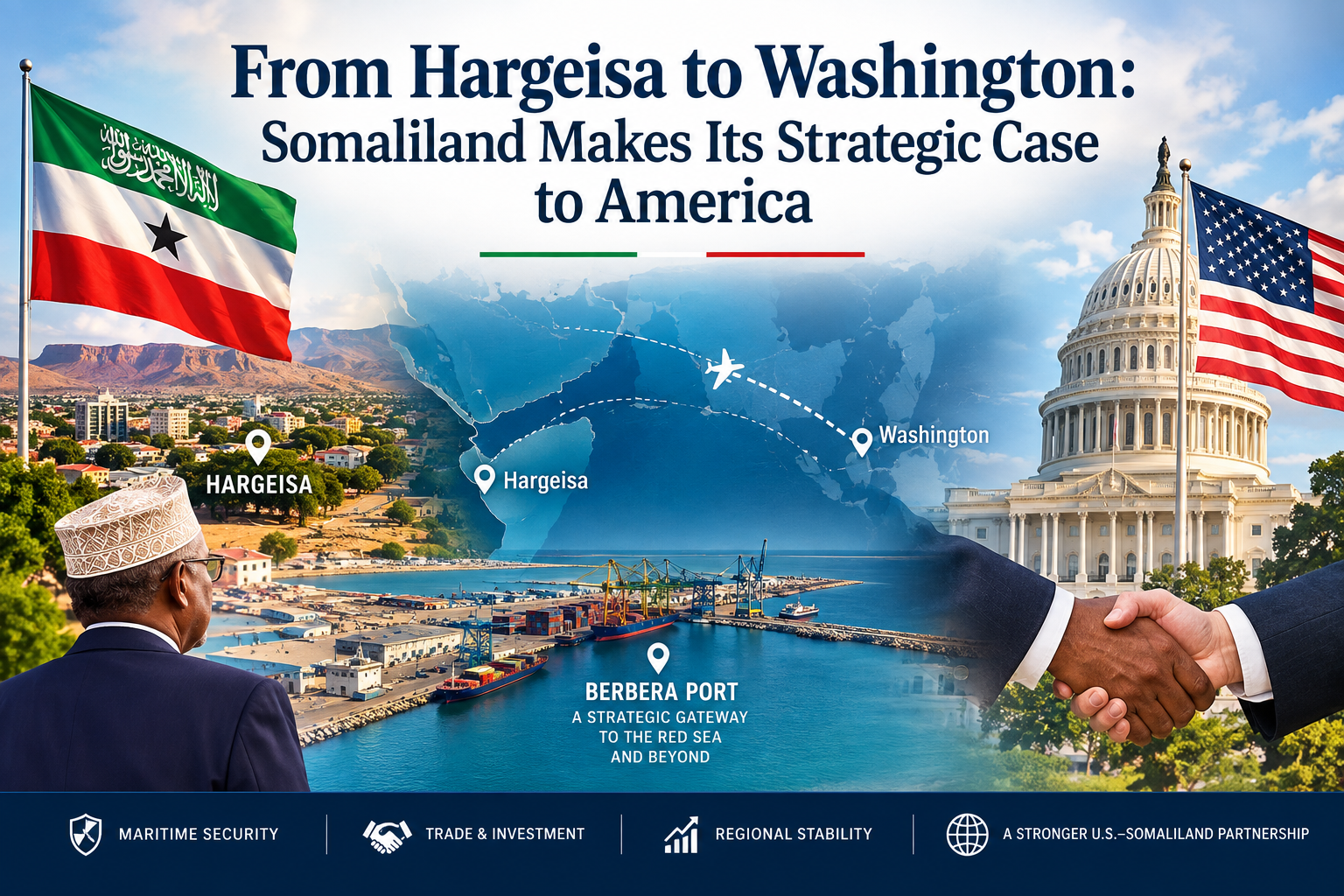
When President Abdirahman Mohamed Abdullahi “Irro” travelled from Hargeisa to Washington this September, Somaliland was carrying more than a diplomatic message. It was presenting a strategic proposition: that a stable, democratic and geographically important partner on the southern shores of the Gulf of Aden deserves to be viewed by Washington not simply through the traditional framework of Somalia policy, but on the basis of Somaliland’s own institutions, interests and strategic potential.
The President’s visit comes at a moment when the security environment surrounding the Red Sea and Gulf of Aden has become increasingly important to the United States and its allies. The disruption of maritime trade, the continuing instability around the Bab el-Mandeb, and competition among regional and global powers have made geography matter again in international strategy.
For Somaliland, this creates an opportunity but also a responsibility.
The message to Washington should be clear: Somaliland does not seek a relationship based on symbolism alone. It seeks a partnership grounded in mutual interests.
A strategic geography Washington cannot ignore
Somaliland occupies a remarkable position on the Gulf of Aden, facing one of the world’s most important maritime corridors. The Port of Berbera is located relatively close to the Bab el-Mandeb, the gateway connecting the Red Sea with the Gulf of Aden and the Indian Ocean.
That geography does not automatically translate into diplomatic recognition. But it does create a strategic reality that policymakers in Washington cannot easily dismiss.
The United States has a direct interest in the security of international shipping, freedom of navigation and stability across the Red Sea and Horn of Africa. Somaliland’s leadership is therefore making a straightforward argument: a territory located at such a strategically significant point, with functioning institutions and a record of relative internal stability, should be considered on its own strategic merits.
During his Washington meetings, President Irro emphasized exactly these themes, including maritime security, international trade, the Gulf of Aden, the Red Sea and opportunities for stronger US–Somaliland cooperation.
This is not simply a Somaliland argument. It is an argument about American interests.
Somaliland’s case is bigger than geography
Yet geography alone cannot sustain a long-term partnership.
Somaliland’s strongest argument is the combination of geography, governance and stability.
For more than 35years, Somaliland has developed its own political and constitutional institutions, conducted competitive elections and experienced peaceful transfers of political power. President Irro highlighted these features during his Washington engagements, presenting Somaliland’s democratic experience as part of its contribution to regional stability.
That record matters because American foreign policy is rarely based exclusively on geography. Washington also considers the reliability of institutions, political stability, security cooperation and the capacity of local partners to deliver on commitments.
Somaliland therefore has an opportunity to present itself not merely as a territory seeking recognition, but as a potential strategic partner with demonstrated institutional capacity.
Recognition and partnership should reinforce one another
For years, Somaliland’s international diplomacy has understandably focused on recognition.
Recognition remains central to Somaliland’s foreign-policy objectives. But the argument presented to Washington can be broader: recognition and strategic partnership do not have to be separate conversations.
The question for American policymakers is not simply whether Somaliland deserves recognition in historical or legal terms. It is also whether a stronger relationship with Somaliland could advance American interests in the Horn of Africa and the Red Sea.
That is why President Irro’s meetings in Washington are significant. His delegation has engaged not only with political figures but also with American policy institutions and strategic thinkers. The President met members of Congress, including Representatives John Rose and John Moolenaar, and later held discussions with the Atlantic Council and the Foundation for Defense of Democracies. The discussions covered security, trade, investment and regional stability.
This represents a broader diplomatic approach: make the Somaliland case relevant to the interests of the United States while continuing to explain Somaliland’s own aspirations.
Berbera: from port to strategic asset
Berbera is central to this conversation.
The development of Berbera’s port and surrounding infrastructure has already increased the territory’s economic and strategic importance. Its position on the Gulf of Aden gives it potential relevance to international trade, logistics and maritime security.
For Washington, the question should not be whether Berbera replaces existing American facilities elsewhere. It does not.
The more useful question is whether Berbera can become part of a wider network of commercial and security partnerships that strengthens maritime resilience in the Red Sea and Gulf of Aden.
President Irro has publicly emphasized Somaliland’s willingness to explore cooperation around its facilities, trade and natural resources while stressing that such cooperation should be based on mutual interests. Recent reporting has described this as a central part of the President’s Washington strategy.
That approach deserves serious examination because strategic partnerships are rarely built on one issue alone. They emerge from overlapping interests.
A partner in an increasingly contested region
The Horn of Africa is no longer a peripheral arena in global geopolitics.
The Red Sea connects Europe, the Middle East, Africa and Asia. Events in Yemen can affect international shipping. Competition among regional powers reaches deep into the Horn of Africa. China, Gulf states, Turkey, Europe and the United States all have significant interests in the region.
In such an environment, Washington needs reliable local relationships.
Somaliland is arguing that it can offer precisely that: a stable political environment, access to a strategically located coastline, functioning institutions and a population with a strong interest in maintaining security and economic development.
This does not mean that every American policy objective automatically aligns with Somaliland’s interests. Nor should Somaliland expect recognition simply because it occupies an important geographic location.
Rather, the strategic relationship should be built through concrete areas of cooperation: maritime security, counterterrorism, trade, investment, aviation, education, technology and institutional development.
Somaliland must also make a credible economic case
Security is only one part of the argument.
American policymakers and businesses will want to know what Somaliland can offer economically.
Berbera can potentially serve as a gateway connecting the Horn of Africa with international markets. Infrastructure development, logistics, fisheries, agriculture, telecommunications, renewable energy and other sectors could create opportunities for American companies and investors.
The objective should therefore be to move the conversation from:
“Why should America recognize Somaliland?”
to:
“What can Somaliland and America build together?”
The first question is political.
The second is strategic.
The second question can create practical relationships that strengthen the first.
Somaliland should speak the language of American interests
The Washington visit also illustrates an important lesson for Somaliland’s diplomacy.
Foreign policy is not simply about explaining what Somaliland wants. It is about explaining why Somaliland matters to the interests of the country whose partnership it seeks.
Washington policymakers are naturally concerned with American security, trade, maritime freedom, terrorism, geopolitical competition and the protection of international commerce.
Somaliland’s diplomatic task is therefore to demonstrate where Somaliland’s interests intersect with those priorities.
The message should be neither confrontation nor dependency.
It should be mutual interest.
Somaliland should tell Washington:
We have strategic geography.
We have functioning institutions.
We have a stake in regional stability.
We are prepared to cooperate.
And we want that cooperation to produce tangible benefits for both sides.
A new diplomatic chapter
The significance of President Irro’s Washington visit should therefore not be measured only by whether it produces an immediate announcement on recognition.
Diplomacy rarely works that way.
The more important question is whether Somaliland can establish itself as a serious subject of American strategic policy.
The President’s meetings on Capitol Hill and with American policy institutions demonstrate an effort to move Somaliland’s case into precisely that conversation.
For Somaliland, this requires patience, professionalism and consistency.
For Washington, it requires looking at the Horn of Africa not only through inherited diplomatic frameworks, but also through realities on the ground.
For more than 35 years, Somaliland has built institutions, maintained relative stability and pursued international recognition. Whether Washington ultimately changes its policy is a decision for the United States. But the strategic question is increasingly difficult to avoid:
Can America afford to overlook a stable partner located at one of the world’s most strategically important maritime crossroads?
Somaliland has now brought its answer directly to Washington.
The next stage is not simply to ask America to recognize Somaliland.
It is to show America why a stronger Somaliland–US partnership can serve the interests of both countries and contribute to a safer, more stable Red Sea and Horn of Africa.
That is the strategic case from Hargeisa to Washington.