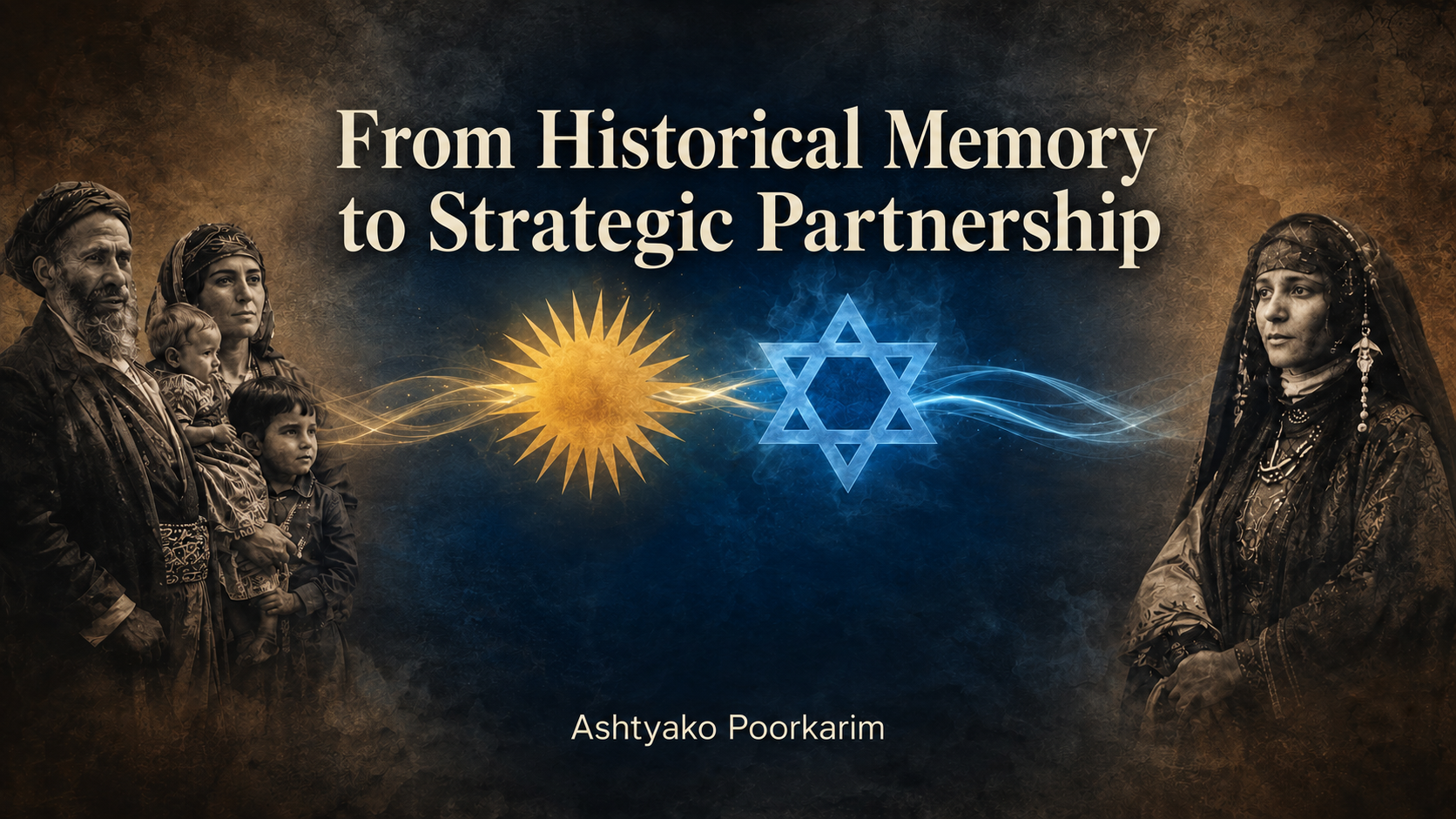
From Historical Memory to Strategic Partnership
Abstract
Kurdish-Jewish relations are often framed through historical coexistence, the Jewish presence in Kurdistan, collective memory, and experiences of persecution and dispersion. These elements matter, but they are insufficient to sustain a political relationship. This article argues that Kurdish-Jewish relations should be examined through sovereignty, self-determination, collective security, memory diplomacy, state-building, diaspora power, and the changing regional order. It uses “occupied nation” rather than “stateless nation” to describe Kurdistan, because Kurdish statelessness is understood here as the result of partition and dispossession of sovereignty, not an inherent incapacity for statehood. Without equating the Holocaust and Anfal, the article identifies comparable mechanisms of enemy-making and organized state violence, and argues for converting memory into prevention. It concludes that a durable Kurdish-Jewish partnership should rest on political independence, complementary interests, institution-building, and “ethical realism”: the union of power, rights, and responsibility.
Introduction: From Memory to Politics
The international conference “Jewish-Kurdish Relations in a Changing Middle East,” to be held in London on 6–7 September 2026, brings together the history of the Jews of Kurdistan, national movements and survival, genocide and collective memory, regional transformation, Western policy, women and youth, diaspora, and the possibility of sustained Kurdish-Jewish cooperation.
The importance of this agenda is that it can move the relationship beyond historical sympathy. Memory can create trust, but durable political relations require defined interests, institutions, rights, and responsibilities. My approach therefore considers power and survival, law and institutions, and the political force of identity, memory, and narrative together.
From “Stateless Nation” to “Occupied Nation”
Kurds are commonly described as a “stateless nation.” The phrase describes the present condition but obscures the history that produced it. It may suggest that the Kurd nation naturally lacked a tradition or capacity for sovereignty. I reject that implication. The problem of Kurdistan is not a natural absence of statehood, but territorial partition, dispossession of sovereignty, and the imposition of centralized states over Kurdistan.
For that reason, I consider “occupied nation” a more accurate concept. Kurdistan is not merely a set of peripheral regions inhabited by a “Kurdish minority.” It is the historic land of a nation divided among Iran, Turkey, Iraq, and Syria through war, foreign intervention, post-imperial settlements, and the consolidation of centralized states. Their policies have differed, but the underlying fact remains: the Kurd nation has not been allowed freely to determine the final political status of its own land.
Kurdish political history also contradicts claims of incapacity. From Simko’s political authority and the Republic of Kurdistan in Mahabad to contemporary Kurdish institutions, Kurds have repeatedly demonstrated political organization and governance despite military pressure and the absence of international guarantees.
This is why minority rights and self-determination must be distinguished. Minority rights protect language, culture, religion, equality, and participation within an existing state. Self-determination asks a prior question: who has authority to determine the political status of a nation and its land? The UN Charter recognizes self-determination, and common Article 1 of the two 1966 human-rights covenants affirms that all peoples may freely determine their political status.
International law does not automatically turn every national claim into an immediate right of secession. Yet if a people is told it may determine its future while independence is excluded in advance under every circumstance, the result has already been decided.
From the standpoint of the Kurdistan Independence Party, the right to determine Kurdistan’s future belongs to the Kurd nation itself. In my view, independence is not a concession to be granted by the states occupying Kurdistan, nor a temporary tactical preference. It is the fullest expression of Kurdish self-determination and the historical answer to partition, occupation, assimilation, repression, and genocide.
The Jewish Experience: Sovereignty and Political Agency
Comparing Kurds and Jews does not mean declaring their histories identical. Their geographies, social histories, persecutions, migrations, and international positions differ fundamentally. The Holocaust was a specific historical catastrophe and should not be dissolved into loose analogy. What makes comparison useful is a shared political question: what becomes of a nation whose ultimate security and political future remain in the hands of others?
European antisemitism moved from religious prejudice and social exclusion into racial and political ideology, culminating in a state project of annihilation. The Holocaust showed how enemy-making can proceed through deprivation of rights, normalization of hatred, removal of citizenship, dehumanization, and organized state violence.
In this reading, the establishment of Israel in 1948 transformed the position of the Jewish people within the structure of international power. A people whose security had long depended on other states and majorities became a sovereign political actor with institutions, diplomacy, and the capacity for self-defence.
The lesson for Kurds is not imitation. Kurdistan must emerge from its own society, history, and interests. The relevant lesson is the transition from being an object of other peoples’ politics to becoming a political subject in one’s own right. A Kurdish-Jewish partnership should therefore reject dependency and recognize the independent will of both sides.
Enemy-Making, Antisemitism, and Structural Kurdophobia
Authoritarian systems frequently stabilize themselves by producing a “threatening Other.” A manufactured enemy generates fear, legitimizes repression, and redirects attention from political failure. Jews in Europe were at different times portrayed as both capitalists and communists, enemies of tradition and agents of corrupt modernity. Such contradictions reveal that the purpose was not description but political enemy-making.
Kurds have encountered different versions of the same mechanism in Iran, Turkey, Iraq, and Syria. Demands for national rights have been labelled “separatism”; political resistance has been securitized as “terrorism” or a threat to national unity; and Kurdish identity itself has repeatedly been treated as a security problem.
In Eastern Kurdistan, the Pahlavi state and the Islamic Republic, despite ideological differences, shared a refusal to recognize the Kurd nation’s right freely to determine its political future. The Islamic Republic combined centralism with religious fundamentalism and, after 1979, answered the Kurdish question through a jihad decree, military campaigns, executions, and repression. In Turkey, centralized nation-building denied or securitized Kurdish identity. In Ba’athist Iraq, Arabization, village destruction, forced displacement, Anfal, and the chemical attack on Halabja represented an extreme manifestation of this logic. In Syria, deprivation of citizenship, the Arab Belt, and restrictions on Kurdish language and culture served demographic and identity engineering.
Kurdophobia is therefore more than private prejudice; it has functioned as an instrument of centralized state-building. Islamic fundamentalism and extreme nationalism may start from different premises, yet both can treat pluralism as a threat. The Islamic Republic illustrates their convergence: religious fundamentalism, Iranian nationalism, and state centralism meet in its treatment of Eastern Kurdistan, while antisemitism and ideological hostility toward Israel form part of the regime’s identity and regional policy.
A serious Kurdish-Jewish dialogue must reject both antisemitism and Kurdophobia. Selective opposition to one while tolerating the other would undermine the relationship at its foundation.
Holocaust, Anfal, and a Diplomacy of Prevention
The Holocaust and Anfal are not equivalent events. Their contexts, scale, ideologies, and methods differ. Yet responsible comparison can identify mechanisms that enable collective destruction: enemy-making, deprivation of rights, normalization of hate, official discrimination, dehumanization, and organized violence.
For Kurds, Anfal and Halabja are not only memories. They demonstrate a structural vulnerability: when a nation lacks sovereignty, its security can remain in the hands of the same state that threatens it. Human Rights Watch documented Anfal as an organized Iraqi state assault involving killing, disappearance, village destruction, and forced displacement.
Memory should therefore not remain confined to commemoration. I argue for a “diplomacy of memory”: moving memory from mourning into education, law, policy, and prevention. “Never again” must acquire institutional form before catastrophe occurs through documentation of incitement and demographic engineering, education about early signs of organized violence, legal networks, permanent engagement with parliaments and international institutions, and early-warning mechanisms.
This requires a broader definition of security. A region may have stable interstate borders while millions within those borders remain politically, culturally, or physically insecure. Security cannot mean only the security of states; it must include the security of nations. A Kurdish-Jewish partnership could give this principle practical form through a permanent body for research, education, early warning, and legal advocacy on genocide prevention.
Strategic Partnership: Complementary Interests, Not Dependency
Relations between Kurdistan and Israel should be approached with realism, not romanticism. Israel acts according to its national interests, as every state does. Kurdish political movements have the same responsibility toward Kurdistan. A durable partnership cannot be based on subordination.
Shared threats are real but insufficient. Governments, enemies, and balances of power change. An alliance defined only by opposition to a third party is fragile. A more durable foundation lies in complementary interests and a positive agenda.
Israel possesses significant capacities in technology, water management, agriculture, security, research, diplomacy, and state-building. Kurdistan possesses strategic geography, natural resources, human capital, and a position linking Iran, Turkey, Iraq, Syria, the Caucasus, and major regional routes. Cooperation in water, agriculture, energy, technology, cybersecurity, higher education, health, culture, diplomacy, and heritage preservation could serve both sides.
The Jews of Kurdistan are especially important as a living bridge between the two peoples. Oral histories, archives, research, and a permanent centre for Kurdish-Jewish studies could preserve this heritage while creating institutional links among universities and younger generations.
The principle must remain clear: Kurdistan must not become an instrument of Israeli policy—or of any other power—and Israel should not be treated merely as an instrument for Kurdish goals. Partnership requires reciprocity and political independence.
Kurdistan and the Geopolitics of a New Regional Order
The Middle East is increasingly shaped by energy and trade corridors, transit routes, water, data, technology, and security networks. Kurdistan lies at the centre of much of this geography. Yet without Kurdish sovereignty, this position has often served the power of others: resources are extracted, borders militarized, and strategic decisions made elsewhere.
The difference between geography and geopolitics is the authority to decide. A territory whose routes, resources, and security are controlled by others remains the geography of someone else’s power. The same territory, when it possesses sovereignty and the capacity to enter agreements in its own name, becomes a geopolitical actor.
An independent Kurdistan could transform energy and trade routes from instruments of coercion into lawful sources of revenue and cooperation. But independence is not merely a declaration. It requires state-building: domestic legitimacy, the rule of law, public administration, security, a sustainable economy, trained human capital, diplomacy, and the ability to overcome Kurdish political fragmentation.
Cooperation with Israel can assist in knowledge transfer, education, technology, agriculture, water management, cybersecurity, and institutional development, but it cannot substitute for Kurdish agency. In my view, an independent Kurdistan—if built on democracy, responsible government, economic sustainability, and balanced regional relations—could become a stabilizing actor rather than a source of instability.
Eastern Kurdistan and Iran after the Islamic Republic
The future of Iran cannot be reduced to regime change. The Islamic Republic is an especially violent expression of centralized power, but homogenization of identity and securitization of non-Persian nations predate it. If the regime falls while the same concentration of authority in Tehran, the same single-nation definition of the state, and the same denial of self-determination survive, the government will have changed but the underlying relation of power will not.
The geography now called Iran contains distinct nations, languages, and historical identities, including Kurds, Baluch, Arabs, Azerbaijani Turks, Turkmen, and others. Denying this plurality has turned national questions into permanent security crises.
Three broad scenarios are possible after the Islamic Republic: renewed centralism under different leadership; uncontrolled collapse; or fundamental reordering based on recognition of national plurality, redistribution of power, and acceptance of self-determination. Fear of collapse must not lead Western governments automatically to support renewed centralism. Repressive centralism is not stability; it is postponed conflict.
In Eastern Kurdistan, the fall of the Islamic Republic alone cannot solve the Kurdish question. The issue is not merely who governs in Tehran, but by whose consent Tehran would determine Kurdistan’s future. Different constitutional arrangements may be debated during transition, but independence must not be excluded in advance from the Kurd nation’s freedom of choice.
Diaspora, Britain, Women, and the Next Generation
A nation without a recognized state is not necessarily a nation without diplomacy. Diasporas, universities, media, parliaments, think tanks, legal organizations, and civil networks can form part of national diplomatic capacity. The Jewish experience demonstrates how dispersion, when joined to organization and knowledge, can become soft power.
The Kurdish diaspora in Europe and North America has substantial academic, professional, media, and political capacity. But presence alone is not power. Diaspora becomes influential when it produces knowledge, builds durable institutions, and engages decision-makers continuously rather than only in moments of crisis.
Britain is particularly important because of its Parliament, universities, media, think tanks, civil society, and historical role in shaping the modern Middle East. Kurdish diplomacy there should move from reaction to policy: publishing research, building parliamentary relationships, developing scenarios, and presenting Kurdistan as an issue of regional security, energy, migration, extremism, international law, and political order.
The same principle applies internally. National freedom cannot reproduce domination inside Kurdish society. Women must have substantive roles in leadership, diplomacy, the economy, universities, public administration, and the future state. The younger generation must inherit not only the memory of Anfal, Halabja, prison, and exile, but also the knowledge required for state-building: law, diplomacy, economics, technology, administration, research, and journalism.
From Dialogue to Institution-Building
The value of a conference lies in what remains after the speeches end. Kurdish-Jewish relations will become durable only when personal ties are converted into institutions with programmes, resources, and accountability.
Possible steps include a permanent Kurdish-Jewish strategic dialogue or cooperation council; a joint research centre; an oral-history project on the Jews of Kurdistan; programmes for women and youth; a genocide-prevention network; and policy platforms in major centres of decision-making. Practical working groups could focus on water, agriculture, technology, energy, health, cybersecurity, and education.
Institution-building matters because individuals and governments change. A durable institution can preserve memory, knowledge, and relationships across political and generational change.
Ethical Realism: Conclusion
I describe the framework for such a partnership as “ethical realism.” Politics cannot be understood without power. A nation may possess moral legitimacy and still remain unable to protect itself if it lacks organization, deterrence, and diplomatic influence. Yet power detached from law and responsibility can itself become domination. Ethics without power may end in mourning; power without ethics becomes tyranny. Responsible politics must join the two.
A Kurdish-Jewish partnership must therefore be realistic because it concerns security, interests, state-building, and geopolitics; and ethical because its legitimacy should rest on self-determination, opposition to genocide, rejection of antisemitism and Kurdophobia, democracy, individual liberty, and responsibility toward other nations and civilians.
The Jewish experience shows that memory, organization, diaspora, knowledge, diplomacy, and sovereignty can transform a nation’s place in the international system. Kurdish history shows that a nation can survive partition, assimilation, forced displacement, repression, and genocide without surrendering its identity or political will. But survival is not the final objective. For the Kurd nation, the task is to turn survival into sovereignty.
In my view, the independence of Kurdistan is not a privilege that the occupying states may grant or withhold. It is the fulfilment of the Kurd nation’s right freely to determine its future and the historical answer to partition, occupation, denial, and Anfal. This does not equate Kurdish and Jewish histories. It states a political principle: the lasting security of a nation cannot forever depend upon those who rule over it.
For a century, the Middle East has pursued “stability” through concentrated power, assimilation, fixed borders, and the securitization of national demands, producing recurring war, displacement, repression, and crises of legitimacy. A genuinely new order requires nations to be recognized as political actors and bearers of rights.
The London conference can contribute to such a shift if it moves from memory to politics, from empathy to partnership, from personal ties to institutions, and from mourning after catastrophe to an architecture of prevention. The aim should be larger than improving Kurdish-Jewish relations. It should demonstrate how two nations with different histories can transform memory into knowledge, knowledge into institutions, institutions into responsible power, and power into freedom and security. That is what I mean by ethical realism: the union of right with power, memory with the future, and independence with responsibility.
Selected References
Bauer, Y. (2001). Rethinking the Holocaust. Yale University Press.
Gunter, M. M. (2016). The Kurds: A Modern History. Markus Wiener Publishers.
Hilberg, R. (1985). The Destruction of the European Jews. Holmes & Meier.
Human Rights Watch. (1993). Genocide in Iraq: The Anfal Campaign Against the Kurds. Human Rights Watch.
McDowall, D. (2004). A Modern History of the Kurds. I.B. Tauris.
Natali, D. (2005). The Kurds and the State: Evolving National Identity in Iraq, Turkey, and Iran. Syracuse University Press.
Poorkarim, A. (2026a). Kurd and Israel: Politics, Identity, Security; The New Middle East. Kurdnation Media Center.
Poorkarim, A. (2026b). Kurdistan and Israel in the New Middle East. Kurdnation.
United Nations. (1945). Charter of the United Nations.
United Nations General Assembly. (1966). International Covenant on Civil and Political Rights; International Covenant on Economic, Social and Cultural Rights.