
CEO of Time to Stand Up for Israel
From Indoctrination To Peace
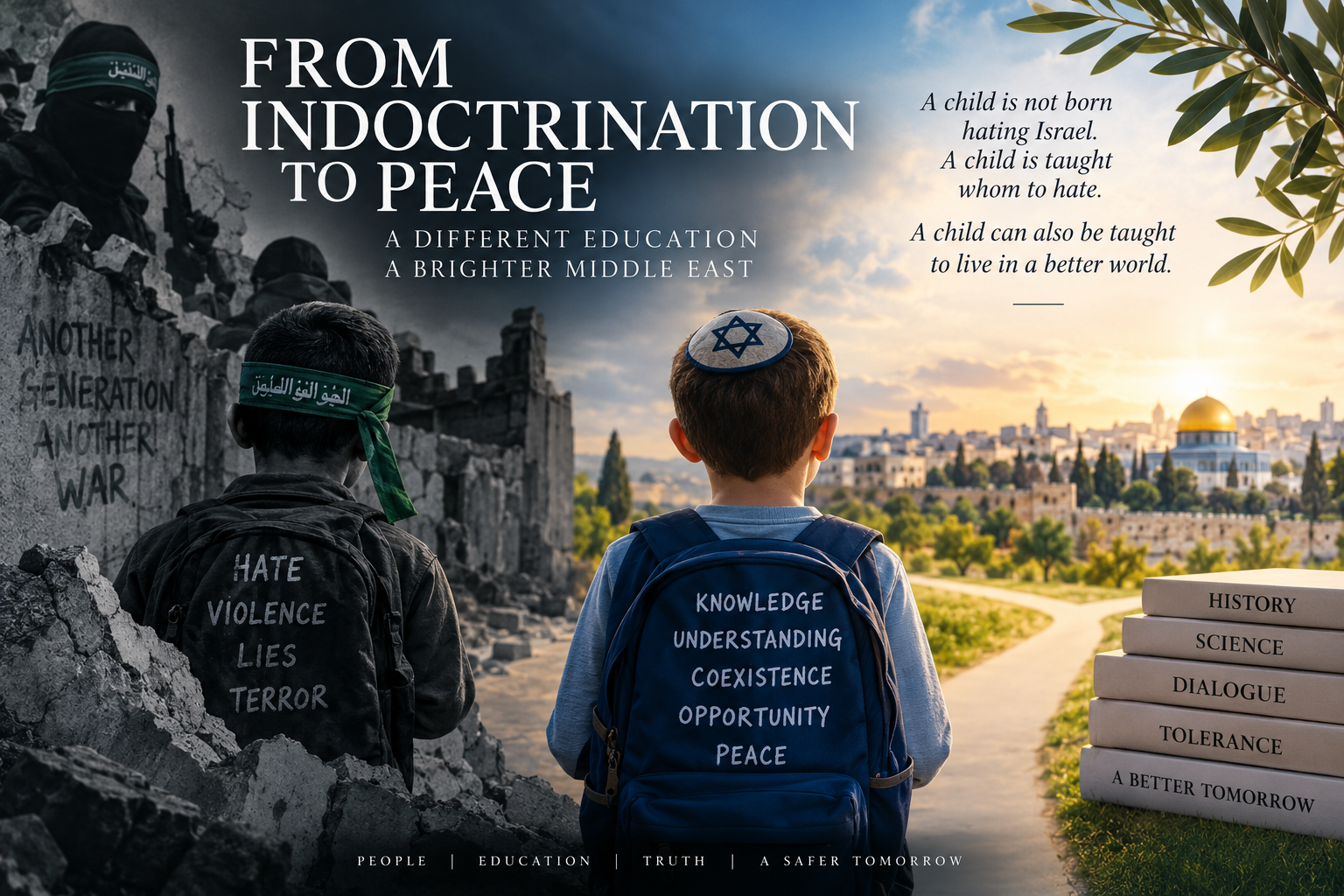
Photo Credits: Sabine Sterk (AI)
At this moment, it appears that the wars with Hamas in Gaza and Hezbollah in Lebanon have entered a quieter phase. For how long, nobody knows. In the Middle East, silence does not necessarily mean peace, and a ceasefire does not necessarily mean that the ideology which created the war has disappeared.
Iran is a different story altogether.
When it comes to the Islamic Republic, I no longer believe the question is whether another confrontation will come. The question is when.
For decades, the Iranian regime has built its power around an ideology in which hostility toward Israel is not a side issue but an essential part of its revolutionary identity. It has financed, armed, trained, and encouraged forces throughout the region that have threatened Israel and destabilized neighboring countries. Hamas, Hezbollah, Palestinian Islamic Jihad, the Houthis, and other Iranian aligned groups did not emerge in a vacuum. Tehran understood something the democratic world has been painfully slow to understand: you do not need to fight every war yourself when you can export ideology, weapons, money, and terror.
Removing such an extremist system is extraordinarily difficult. Governments can be defeated militarily, nuclear facilities can be destroyed, commanders can be eliminated, weapons can be intercepted, and terrorist organizations can be weakened. But an ideology cannot simply be bombed out of existence.
That is precisely why the struggle against radicalism is ultimately much bigger than Iran.
It is a struggle over what children are taught to believe.
For decades, the dream of peace in the Middle East has been poisoned by hatred, historical distortion, religious extremism, and political indoctrination. We repeatedly ask how Hamas can be dismantled, how terrorism can be defeated, and how the cycle of violence can finally be broken.
Part of the answer begins in a place far less dramatic than a battlefield.
It begins in a classroom.
I learned this personally as a teenager living in Damascus, Syria. A friend returned from a school trip to Quneitra, the devastated Syrian city near the Israeli border. When I asked why her school had taken children there, she explained that it was effectively a history lesson. They were shown the ruins as evidence of Israeli and Jewish brutality.
There was another detail I have never forgotten. In her environment, Israel was not even spoken about normally. It was referred to as “the other side.”
Think about what that does to the mind of a child.
She was not encouraged to study competing historical accounts, understand the wars between Israel and Syria, investigate how Quneitra became a battlefield, or distinguish between Jews, Israelis, governments, soldiers, and political decisions. She was given a villain.
That is not education. That is conditioning.
And generations later, we continue to see the consequences of education that portrays Israelis not as human beings with families, fears, dreams, and rights, but as an enemy whose very existence is illegitimate.
This problem has been documented repeatedly in Palestinian educational material, including criticism of textbooks for glorifying martyrdom, presenting violence approvingly, erasing Israel from maps, or promoting antisemitic themes. Children have also appeared in militant camps where weapons, military exercises, and the language of martyrdom become part of their formative environment.
Then the world acts surprised when hatred survives from one generation to another.
October 7, 2023 should have destroyed the illusion that indoctrination is merely offensive rhetoric. Israelis witnessed what happens when the dehumanization of Jews and Israelis is combined with weapons, organization, and opportunity. Civilians were murdered, kidnapped, tortured, and terrorized. Families were destroyed.
Yet somehow, within an astonishingly short period of time, Israel found itself transformed from the victim of a massacre into the defendant before world opinion.
Schools, hospitals, mosques, and residential buildings became central to that information war. International humanitarian law protects civilian objects, but those protections are not a magical shield for military activity. When an armed group uses civilian infrastructure for military purposes, the legal and moral picture becomes more complicated. Hamas has every incentive to operate among civilians because civilian casualties create international pressure on Israel.
This is one of the most cynical strategies of modern warfare.
Israel is expected to fight an enemy that embeds itself within the population while being judged as though that enemy were standing in an empty desert wearing uniforms.
But there is an even deeper problem.
The ideological battlefield is no longer confined to Gaza, Lebanon, Syria, or Iran. It has reached Europe and North America. On Western university campuses, slogans are repeated by people who often possess astonishingly little knowledge of Jewish history, Zionism, the wars of the Middle East, Palestinian politics, or the history of Israel. Complex history is reduced to fashionable words such as colonialism, genocide, and apartheid.
Once again, education matters.
You cannot build lasting peace while teaching children that compromise is betrayal. You cannot build peace while glorifying death. You cannot build peace when Jewish history is erased and Israel’s existence is presented as a temporary mistake that eventually must be corrected.
And Israel cannot solve that problem alone.
The international community has spent billions trying to manage the consequences of this conflict while paying far too little attention to the ideas perpetuating it.
Perhaps that is the greatest failure of all.
We speak endlessly about rebuilding Gaza. Fine. Rebuild it.
But what will be taught inside the rebuilt schools?
We speak about a future Palestinian generation. Fine. But what will that generation learn about Jews?
Will a Palestinian child learn that Jews are indigenous to the history of this land and that Jewish civilization existed there thousands of years before the modern State of Israel?
Will that child learn about the Holocaust without conspiracy theories?
Will an Iranian child be allowed to learn that Israelis are not monsters?
Will children learn that disagreement does not justify murder?
Will they learn that becoming a doctor, scientist, engineer, teacher, artist, or parent is infinitely more honorable than becoming a martyr?
Those questions may determine the future of the Middle East more profoundly than another diplomatic conference.
Iran’s extremist regime may eventually fall. Hamas can be dismantled as a military organization. Hezbollah can lose weapons, commanders, territory, and influence. But if the ideology survives intact and is transferred to another generation, another organization will eventually take their place.
That is why victory must mean more than winning wars.
Peace requires an educational revolution.
Replace martyrdom with ambition. Replace antisemitism with knowledge. Replace conspiracy theories with history. Replace the glorification of death with respect for human life. Give children something more valuable to dream about than destroying their neighbor.
Perhaps genuine peace will not come in our generation. I desperately wish I could believe otherwise.
But we can decide what the next generation inherits.
A child is not born hating Israel. A child is not born hating Jews. A child is taught whom to hate, just as a child can be taught how to live beside someone different.
The future of the Middle East will therefore not be decided only in Tehran, Jerusalem, Gaza, or Beirut.
It will also be decided in classrooms.
Destroying weapons may end a battle.
Changing education may finally end the war.
Related Topics
Related Posts